
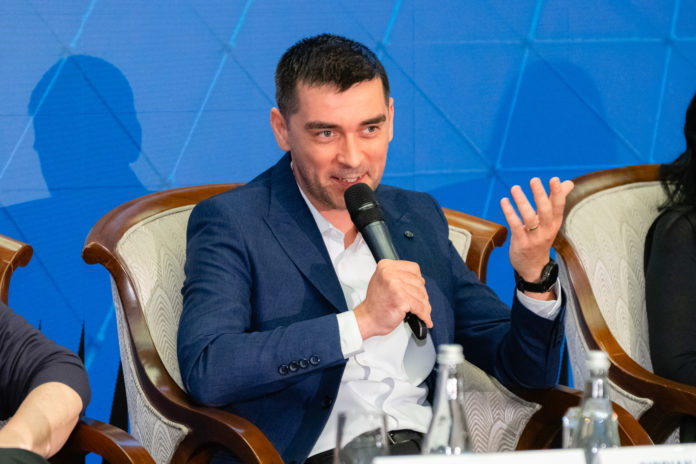
Effective leadership requires strategic thinking, authenticity and the ability to build trust within teams, particularly in an industry characterised by rapid change and increasing customer expectations, according to Ciprian Broasca, Commercial Director at TP Romania, who spoke at the People Empowering Business Forum, organised by The Diplomat-Bucharest.
A good leader must be able to look beyond immediate business priorities and anticipate developments over the coming years, while maintaining authentic relationships with both employees and business partners, Broasca argued.
“I believe a leader is, first and foremost, someone with strategic thinking – someone who sees beyond tomorrow and can look several years ahead. Secondly, leadership is about authenticity, both towards the teams you coordinate and the partners you choose to work with, as well as the trust you place in the people you lead. A leader cannot exist without a team,” he said.
The pace of change in the business services industry is another major challenge for leaders, particularly as customers increasingly expect faster delivery, higher volumes and lower costs.
“Everything happens very quickly in our industry, and I believe our partners also set this pace. Everyone wants things fast, everyone wants more and everyone wants it cheaper. As a leader, you have to adjust your strategy accordingly and understand what your partners expect from you in order to deliver excellence. That is what we do – we deliver excellence. Otherwise, our partners would not want to continue working with us,” Broasca explained.
Reflecting on his own professional journey, the TP Romania executive highlighted the importance of being open to learning opportunities, accepting new responsibilities and having the confidence to make decisions, even in challenging situations.
He said he started his career at the company in a junior role, with the opportunities to learn and take on additional responsibilities playing a key role in his professional development.
“I started at the company in a role that was not particularly significant. What brought me to where I am today was being given the opportunity to learn a great deal, combined with my own openness and willingness to do so. I was never afraid to make decisions or to step into situations that required a firefighting approach,” he said.
Broasca also emphasised the importance of trusting managers and accepting additional responsibilities as opportunities for growth rather than as obstacles.
“I always trusted the managers and leaders I worked with because I understood that being given additional responsibilities did not necessarily mean something was wrong. It meant something positive: I had something new to learn, an opportunity to develop, and eventually the chance to apply what I had learned and deliver excellence,” he added.
Another defining characteristic of effective leadership, according to Broasca, is the ability to ask the right questions rather than having all the answers.
“A leader is not necessarily someone who always has the answers. A very good leader is also someone who knows how to ask the right questions, both of business partners and, especially, of the teams they coordinate. A leader learns alongside their team,” he concluded.