
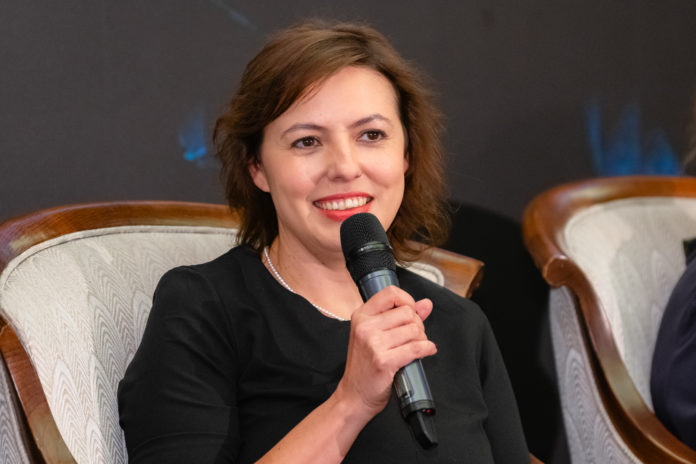
The rapid evolution of the skills required in the workplace, the growing importance of AI literacy and the need for continuous learning are transforming how organisations approach talent development and leadership, according to Ina Custura, Regional Talent Development Lead at Concentrix, who spoke at the People Empowering Business Forum, organised by The Diplomat-Bucharest.
Citing the latest World Economic Forum report, Custura highlighted that nearly 40% of current skills are expected to be reshaped by 2030, making continuous learning an increasingly important part of professional life.
“There is this concept of continuous learning that has started to enter people’s collective mindset, which was not necessarily the case before,” she said.
Alongside AI and big data, which are among the most in-demand skills, analytical thinking, critical thinking, resilience, flexibility and adaptability are also becoming increasingly important in the workplace.
Custura pointed to the changing expectations regarding digital competencies, noting that skills that once differentiated candidates are now becoming basic requirements.
“Twenty years ago, having Excel and Word on your CV was essential, and you were considered highly proficient if you knew the entire Office package. Today, tomorrow and in the years ahead, AI literacy will probably become an important filter and part of the basic skills expected from any entry-level candidate,” she explained.
Rather than simply trying to catch up with technological developments, organisations should learn to integrate AI into their daily activities and working practices, she added.
“We are not necessarily running to catch up. We are already there, and we are embracing AI as much as we can. However, we are still in a bubble of organisations that have adopted AI, are making efforts and are succeeding in this area,” Custura said.
She illustrated the gap between corporate adoption and the broader business landscape with Concentrix’s own experience. The company has achieved 100% completion of its AI Academy among the targeted employee population. However, Custura noted that only 5% of companies in Romania use AI frequently, pointing to significant room for improvement across the business environment.
Beyond technological capabilities, structured learning remains essential, particularly when it comes to leadership development. At Concentrix, leadership onboarding includes mandatory modules focused on organisational culture, ensuring that new leaders understand the company’s values and ways of working.
The company also uses AI-powered learning platforms to recommend personalised curricula based on employees’ skill levels.
“We can have people practising the same activity, but their skill levels in that particular area may be very different. This is where personalised learning recommendations make a difference,” she explained.
Another area gaining importance is working across cultures, a capability that Concentrix has also piloted this year.
“In a global world where we rely on shared resources, it is extremely important to take cultural differences into account – how we relate to one another and how certain practices may be understood or interpreted by colleagues from different cultures,” Custura said.
She concluded by emphasising that organisational culture does not develop by chance, but requires deliberate and sustained investment through dedicated programmes and initiatives.
“Organisational culture is built intentionally through the programmes we implement within the organisation,” she said.