
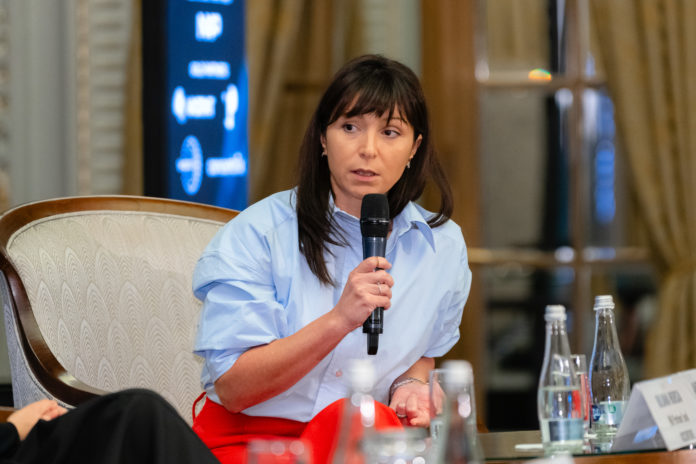
As artificial intelligence reshapes businesses and economies, companies operating critical infrastructure must approach its adoption with a strong focus on governance, accountability and risk management, according to Angelica Raducanu, Chief Administration Officer at Distributie Oltenia, who spoke at the People Empowering Business Forum, organised by The Diplomat-Bucharest.
AI is affecting multiple population groups and audiences, while transforming economic ecosystems at every level, Raducanu noted, highlighting the particular responsibilities of electricity distribution companies.
Distributie Oltenia serves approximately 1.5 million consumers, works within an ecosystem of more than 60,000 prosumers and employs around 2,000 people. Its operations are essential to the functioning of local communities and multiple sectors of the economy.
“My colleagues are not only part of the community, but they also have the responsibility of keeping the lights on for a number of subsectors across the entire local economy,” she said.
Against this background, business continuity and resilience have become essential priorities, extending beyond organisational preparedness to the resilience of the wider economic and social environment.
One of the company’s HR objectives is to embed business continuity awareness and behaviours throughout the organisation, ensuring that every employee understands their individual role in maintaining operational resilience.
“One of our objectives is to develop these business continuity reflexes at the level of every individual in the organisation, because each person has a very specific role to play in this respect,” Raducanu explained.
She also stressed that artificial intelligence adoption requires a structured and responsible approach, particularly in an industry where operational risks can have far-reaching consequences.
“For us, the one word that must accompany us throughout the entire process of AI strategy, implementation and democratisation within the organisation is responsibility,” she said.
Distributie Oltenia’s approach to AI adoption is based on three main stages. The first involves establishing a robust governance framework, supported by clear policies and well-defined responsibilities. The second focuses on gradually educating employees across the organisation, with learning programmes tailored to their specific roles. The third involves assessing the solutions already implemented, who uses them and how, while continuously identifying their risks, limitations and benefits.
“The nature of our business requires a high degree of responsibility. That is why our approach is methodical, with governance always at its core,” Raducanu emphasised.
In this context, she believes HR has an increasingly strategic role to play, extending beyond traditional people management to include organisational risk governance.
“The strategic role of HR is more important than ever. Ultimately, HR is involved in governing risk through people,” she said, adding that employees are simultaneously the subjects, objects and enablers of the transformations driven by technology and broader societal changes.