
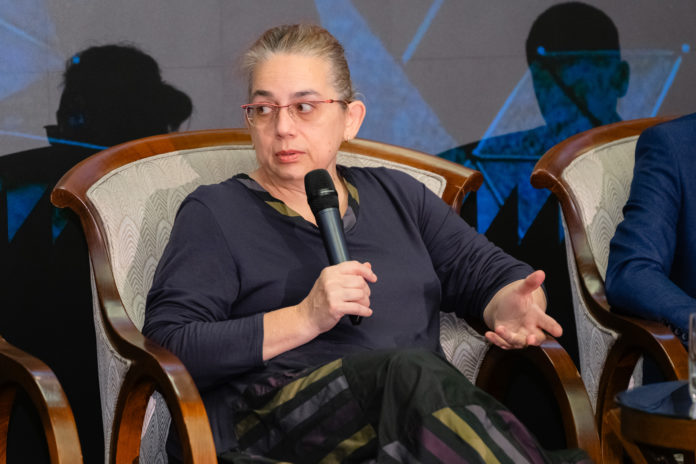
Organisations are entering a phase of redesigning their processes, procedures and job roles as artificial intelligence accelerates the pace of change, but existing employee skills should not necessarily be considered obsolete, according to Ruxandra Lupsa, HR Director at NXP Semiconductors Romania.
Speaking at the People Empowering Business Forum, organised by The Diplomat-Bucharest, Lupsa said companies should focus on repurposing existing competencies to meet changing business requirements, while ensuring that leaders remain connected to both technological developments and the human needs of their teams.
“I believe we are now at the stage of redesigning all our processes and procedures and reassessing all the roles within our organisations. I would not necessarily say that certain skills become invalid or no longer useful. I believe they can be reused and repurposed in the current context,” she said.
However, the frequency and speed of change are increasing, creating new challenges for leadership and workforce management.
“The waves of change are coming more and more frequently. We are running at an increasingly faster pace towards artificial intelligence, which can obviously help us. But I am not sure we are currently ready to go so far as to expect leaders to remain constantly connected to their resources and continuously reassess and redirect every team member according to their skills and the requirements of the moment,” Lupsa explained.
She noted that organisations are still trying to understand the full implications of this transformation, but the role of leaders in supporting employees through change is becoming even more important.
“The pace is extremely fast, and we are still going through this process, still trying to understand what is happening. But, as has always been the case, the role of a team leader is extremely important. Perhaps it is even more important now, because everything is changing. The leader’s main responsibility must be to help and support people as they navigate the changes required,” she said.
Adaptability is therefore essential, alongside the ability of leaders to maintain a connection with both technology and their employees.
“Adaptability is extremely important, and leaders need to stay connected to both technology and the human side. The human side of the team will never lose its importance,” the NXP Semiconductors Romania HR Director stressed.
AI adoption must be aligned with each company’s strategic objectives
Lupsa also highlighted that the impact of artificial intelligence on employment and workforce skills cannot be assessed without considering the individual strategic objectives of each company.
While some organisations may use AI primarily to reduce costs or change their skills mix, others may focus on increasing productivity and accelerating time to market.
She gave NXP as an example, explaining that the company’s objective is to move faster by combining employees’ existing competencies with the capabilities of artificial intelligence.
“It is very important to look at the strategic objectives of each company. Perhaps one company’s objective is to reduce costs or change its skills mix. In our case, for example, we want to get things done faster. This means using the skills of the people we already have while complementing them with artificial intelligence to gain speed and bring certain products to market faster than our competitors, faster than the pace of the times we live in, and ideally to be among the first in the race,” she said.
Commenting on recent announcements by major international companies that have laid off thousands of employees, often in connection with AI adoption, Lupsa cautioned against assuming that artificial intelligence is necessarily the direct reason for these workforce reductions.
“Several very large companies have laid off thousands of people recently, and everyone has associated this with artificial intelligence, suggesting that their skills have become obsolete and that this is why they were dismissed. I do not think it is necessarily that straightforward. It depends on the strategic objectives of each company,” she explained.
Corporate culture and leadership set the direction for change
Another important factor in navigating the AI transformation is organisational culture, which Lupsa believes has gained even greater importance.
While team managers will continue to play a key role, the tone set by senior leadership across the company is particularly important during periods of significant transformation.
“I believe organisational culture carries greater weight now. It is about the tone set by the company’s leadership team. The role of the team manager will certainly never lose its importance, but the direction and tone established by company leadership are extremely important during the period we are going through,” she said.
At the same time, she observed that the current enthusiasm surrounding artificial intelligence is making it easier for companies to encourage employees to embrace new technologies, acquire new skills and adapt to changes.
“I believe it has become much easier to encourage people to explore artificial intelligence and accept the changes it brings. There is even a certain excitement generated by AI because it is something new, and I think everyone is attracted to it in almost every context. For a while, it will probably be easier to encourage our colleagues to learn, reskill and accept change,” Lupsa concluded.