
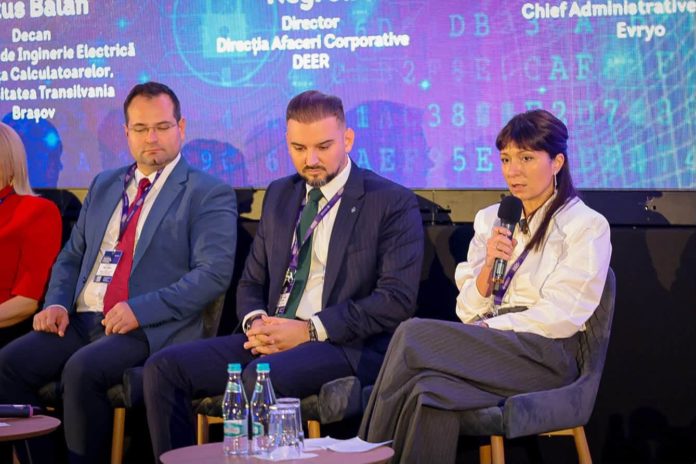
Energy companies and universities need to develop long-term partnerships that begin while students are still pursuing their degrees and continue throughout their first years of professional activity, in order to prepare specialists capable of addressing the challenges of the energy transition, according to Angelica Răducanu, Chief Administrative Officer at Evryo.
Speaking at the Energy Cybersecurity Forum, organised by Distribuție Energie Electrică România (DEER) in Cluj-Napoca, she stressed that graduates’ technical training should be complemented by the development of skills such as resilience, adaptability and the ability to integrate into constantly changing organisational environments.
“I would rather frame this as an invitation to academia, rather than a list of shortcomings we have identified. We should also focus on the aspects that enable technical skills to translate into real success within an organisational environment,” Angelica Răducanu said.
Resilience and adaptability are essential skills in a transforming energy sector
The Evryo executive pointed out that the energy transition and the rapid changes across the industry require a reassessment of the skills needed by young professionals entering the labour market.
“Resilience is indeed one of the skills young people need to develop if they want to build successful careers. However, resilience has taken on different meanings in today’s world compared with what we understood by it several years ago, because everything is highly volatile, and the energy transition brings considerable volatility of its own,” she explained.
In her view, responsibility for professional training should not rest exclusively with universities. Employers must also play an active role, as they have direct knowledge of the technological and operational challenges facing the energy sector.
“This does not mean that we, as companies, are stepping back from our role in training. My invitation to academia is to become partners throughout the student’s entire academic journey and continue that partnership during their first years within an organisation,” she said.
University-business partnerships exist but need to be further developed
Asked what such cooperation should look like and why it is not more widespread, Angelica Răducanu noted that successful examples already exist, but there is considerable room for expansion and improvement.
“I do not believe these partnerships are entirely missing, but I am not here to pass judgment. I believe everything can be improved. Perhaps this does not happen often enough, or everywhere it could. Perhaps we are not selecting or communicating the benefits effectively enough, including to students,” she said.
The Evryo representative believes closer cooperation could have a positive impact on university curricula, students’ ability to absorb and apply knowledge, and their overall professional readiness.
“If we could turn this into standard practice, I believe we would see a positive impact on student curricula, on how they absorb information and on their level of preparedness. It would essentially serve as preliminary onboarding, even before they join an organisation,” she explained.
Such an approach would enable companies to recruit graduates who are better prepared for the pace of work, responsibilities and specific challenges of the energy sector.
Salary is not the only factor in attracting and retaining young professionals
Angelica Răducanu also stressed that remuneration remains an important consideration when choosing an employer, but it is far from the only factor influencing recruitment and employee retention.
“I do not believe money is the only argument that convinces young people, just as it is not the only argument for experienced adults. A discussion focused exclusively on salary is an extremely limiting one,” the Evryo executive concluded.