
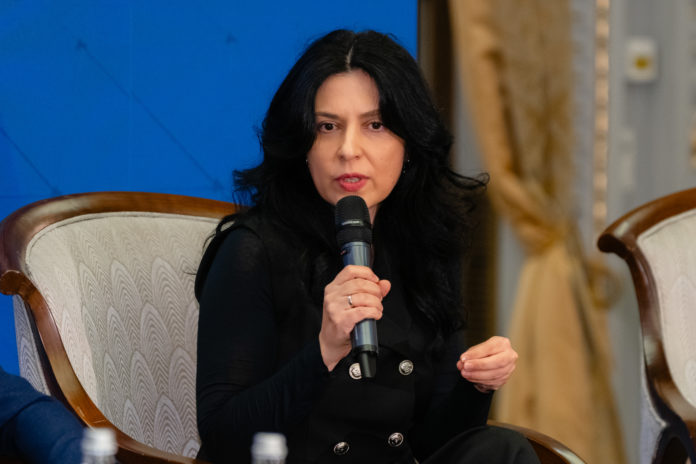
Organisations are moving beyond the initial phase of AI adoption towards a new era in which they will need to redesign their operating models, decision-making processes and ways of working around artificial intelligence, according to Iuliana Horsia, HR Partner Lead at Accenture.
Speaking at the People Empowering Business Forum, organised by The Diplomat-Bucharest, she said that while companies have so far focused primarily on introducing AI tools, training employees to use them, automating tasks and developing AI agents, the next stage will require a fundamental rethink of how organisations operate.
“I believe we are moving from the current stage, which involves using AI within organisations, towards a not-too-distant future in which organisations will actually begin redesigning their operating models and ways of working around AI. So far, the focus has been on adoption: providing tools, teaching people how to use them, automating tasks and creating agents,” she said.
According to Horsia, the next phase will require organisations to step back and reconsider their structures and processes from the ground up, asking what they would build today if they were starting from scratch.
“This new era, which we are entering, will be about taking a step back and thinking about what we would build now if we were starting from zero. We need to consider what this new structure would look like, from what people do and what AI does to support them, to how the entire organisation actually operates in this context: who makes decisions, how they are made and what they are based on,” she explained.
She also expects this transformation to significantly reshape leadership roles, bringing different dimensions to competencies that leaders are already expected to demonstrate.
Formal learning must evolve alongside AI
Horsia stressed that the speed of technological change makes continuous learning essential, meaning organisations cannot afford to abandon formal education and training. Instead, they need to rethink how learning is delivered and how knowledge translates into practical behaviour.
“With the speed at which things are changing today, I do not believe you can give up formal learning, whatever form it may take. What we are trying to do as an organisation is reinvent what formal learning means. We can no longer rely solely on having a training curriculum that people attend, after which we simply tick a box saying that learning has taken place,” she said.
Accenture continues to provide traditional training programmes but is complementing them with additional tools and approaches designed to reinforce knowledge and ensure that employees apply what they have learned.
These include coaching, mentoring and support for people leads, enabling them to create the right learning environment within their teams.
AI creates an opportunity, but also a risk for human interaction
Another important challenge identified by Horsia is the potential impact of AI on interpersonal learning and knowledge-sharing within organisations.
As AI becomes increasingly capable of providing answers and solutions, employees may increasingly turn to it as their first source of information, potentially missing valuable learning opportunities that emerge from interacting with colleagues.
“One area that I believe will become increasingly important is creating opportunities for people to connect with one another. As AI provides more and more answers – and it already does – this represents both an opportunity and a risk. The opportunity is obvious, but the risk is that people will turn to AI for questions and solutions because it is readily available and seems to be the fastest and easiest option. However, they may miss out on learning opportunities that come from connecting with other people, even if those interactions take longer,” she said.
To address this challenge, Accenture is redesigning its leadership development programme for people managers across the organisation, involving nearly 1,000 participants.
The initiative aims to create spaces where managers can exchange experiences, discuss challenges and learn from one another, rather than relying exclusively on digital tools for information and guidance.
“We are redesigning a leadership development programme for all people managers across the organisation, almost 1,000 people. What we want to achieve is to create spaces where people can talk to one another and share their experiences,” Horsia explained.
She emphasised that human interaction would remain an essential component of organisational learning, even as AI becomes more sophisticated and accessible.
“We still need to connect, discuss our experiences with others and receive support from one another. We need to keep human connection alive as well. It may not provide as much information at first as AI does, but I believe it is at least as valuable and will remain so,” Iuliana Horsia concluded.