
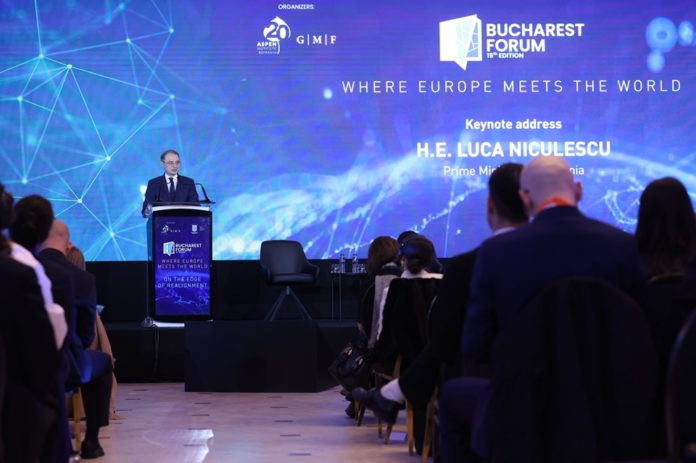
The 15th edition of the Bucharest Forum brought together, at the Palace of the Parliament on 19 and 20 November, representatives of governments, international organisations and the business community from Europe, North America, Africa and the Middle East.
Under the theme “On the Edge of Realignment”, participants discussed Black Sea security, the way in which conflicts are reshaping trade routes between Europe and the Middle East, and the impact of emerging technologies on competitiveness. The Forum was organised by the Aspen Institute Romania and the German Marshall Fund of the United States, under the High Patronage of the President of Romania.
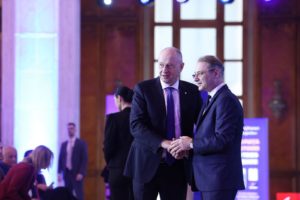 “At this edition, we brought to the same table people who make decisions in governments, international institutions and companies. Black Sea security shows why we need this dialogue. Decisions on the defence of the region have direct consequences for energy supply, trade and investment,” said Mircea Geoană, President of the Aspen Institute Romania.
Black Sea Security and Romania’s Role in the Region
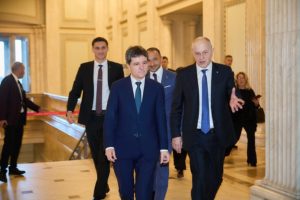
The President of Romania, Nicușor Dan, spoke about the pressure on critical infrastructure in the Black Sea and outlined three lines of action for Romania: investment in defence, strengthening energy independence, including through the Neptun Deep project, and developing road, rail and energy links. The Head of State reaffirmed that NATO, the European Union and the strategic partnership with the United States remain the three pillars of Romania’s foreign policy.
“The more Europe invests in its own defence, the stronger it will be, and the more solid the partnership with the United States will be,” said Nicușor Dan, President of Romania.
Prime Minister Luca Niculescu emphasised the importance of solidarity among allies and of the transatlantic relationship. The Prime Minister stated that a just and lasting peace must respect Ukraine’s sovereignty and territorial integrity.
“Ukraine’s security is closely linked to the security of Europe as a whole. That is why Europeans must be present at the negotiating table,” said Luca Niculescu, Prime Minister of Romania.
Legislation, Investment and Trade Corridors
In his address “A View from the Region”, Mircea Abrudean, President of the Senate of Romania, called for the updating of national legislation in line with European regulations and NATO objectives. He highlighted that investment in transport, energy and port infrastructure must be accompanied by better border management, and he included cybersecurity among the legislative priorities.
“When we speak about hybrid warfare, foreign interference or vulnerabilities in critical infrastructure, the legal framework must be as agile and as integrated as our operational defence,” said Mircea Abrudean, President of the Senate of Romania.
Sorin Grindeanu, President of the Chamber of Deputies, noted that the reconfiguration of supply chains offers Romania the opportunity to attract industrial investment and to become a regional manufacturing hub. He advocated diversifying funding sources and building partnerships with investors from the Middle East, the Gulf states and Asia.
“We have the geographical position, EU and NATO membership, resources and access to regions with enormous economic potential. But these preconditions are not enough,” said Sorin Grindeanu, President of the Chamber of Deputies.
From Fiscal Credibility to Technological Security
Annalena Baerbock, former President of the UN General Assembly, took part in the conversation on the relationship between multilateral economic cooperation and national security. Simon Coveney, former Deputy Prime Minister and Minister for Foreign Affairs of Ireland, took part in the debate on the effects of geopolitical competition on markets and supply chains. Gunther Krichbaum, Minister of State for Europe at the German Federal Foreign Office, linked trade policy to European security and supported the development of European semiconductor manufacturing.
Helge Berger, Deputy Director at the International Monetary Fund, Anca Dragu, Governor of the National Bank of Moldova, and Sergiu Manea, CEO of BCR, discussed fiscal credibility and the cost of financing alongside the Minister of Finance, Alexandru Nazare. The Minister of Economy, Daniel Zamfir, placed the emphasis on investment that brings technology and expertise into the domestic economy. Mihail Popșoi, Deputy Prime Minister of the Republic of Moldova, spoke about his country’s European path and about the projects connecting it with Romania, including the new bridges over the Prut.
General (Ret.) Philippe Lavigne, former NATO Supreme Allied Commander Transformation, and David Cattler, former NATO Assistant Secretary General for Intelligence and Security, discussed, in a session moderated by Radu Tudor, how institutions can respond more quickly to threats in the Black Sea region while preparing for future conflicts.
Steve Feinberg, representative of the U.S. Department of State, took part in the session “Connectivity and Power: Competing Through Strategic Dependencies”, dedicated to the influence that control over trade and energy routes and digital infrastructure confers on states.
Andrei Iancu, former Director of the U.S. Patent and Trademark Office, took part in the conversation “Who Owns Innovation Now?”, on how corporate decisions, regulation and public investment shape the development and adoption of new technologies.
The Middle Eastern perspective was represented by Dr Ali Rashid AlNuaimi, Chairman of the Defence, Interior and Foreign Affairs Committee of the Federal National Council of the United Arab Emirates. He took part in the debate “Europe’s Southern Gateway and the Middle East’s War Economy”, on the effects of regional conflicts on the trade and energy routes linking the Middle East to Europe.
The programme also included sessions on protecting energy infrastructure in the Black Sea, the reconstruction of Ukraine, cyber resilience and the adoption of artificial intelligence.
Bucharest Forum 2026 Partners
· Institutional Partners — Parliament of Romania – Chamber of Deputies, Ministry of Foreign Affairs of Romania, Ministry for Foreign Affairs of Sweden, Ministry of National Defence, Ministry of Energy, Bucharest City Hall, National Bank of Romania, National Cyber Security Directorate, ANRE, ANCOM, Financial Supervisory Authority, Employers’ Organisation of the Defence Industry, and the National University of Science and Technology POLITEHNICA Bucharest.
· International Aspen Network — The Aspen Institute US, Aspen Institute France, Aspen Institute Germany and Aspen Institute Central Europe.
· Principal Partner — European Center for Economic Security, Technology and Resilience (ECESTR).
· Expertise Partners — European Economic Forum by Lucerne Dialogue, ELIAMEP, Euro-Atlantic Resilience Centre (E-ARC), Konrad-Adenauer-Stiftung, IRIS Observatory of Multilateralism and the Future of International Cooperation, European Cybersecurity Competence Centre (ECCC), Agora Center for Democracy, McKinsey & Company and Clifford Chance Badea.
· Strategic Partners of the Aspen@20 Anniversary — Vodafone, Raiffeisen Bank, PPC România, BCR and Cencora Alliance Healthcare.
· Executive Partners — Qualcomm, OMV Petrom and UiPath.
· Strategic Partners — Rompetrol and UniCredit Bank.
· Lead Partners — Mastercard, Google, Investment and Development Bank, and EY.
· Supporting Partners — Leviatan Group, Otokar, Airbus and Banca Transilvania.
· Associate Partners — Orbotix, Oracle, Therme București and Vantor.
· Alliance Partners — Exim Banca Românească, ROPEA and the Concordia Employers’ Confederation.
· Signature Contributors — Conservation Carpathia Foundation, JW Marriott, Valvis Holding and Get-in.ro.
· Media Partners — Euronews România, Ringier, AGERPRES, HotNews, KISS FM, DC Media Group, Energynomics, Wall-Street.ro, The Diplomat, Business Review, G4Media, Mediafax, Economedia and Profit.ro.