
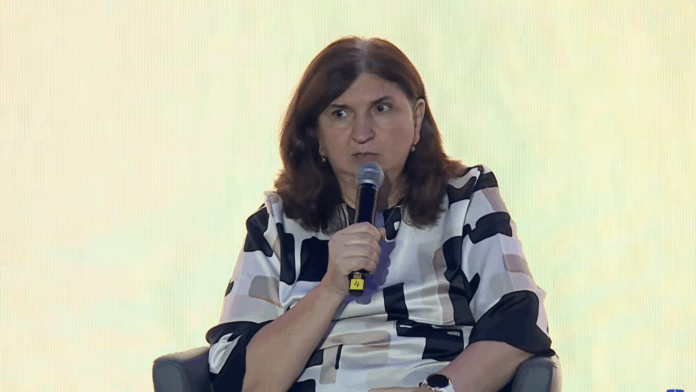
Completing the Suceava–Bălți power line will be a key step towards strengthening the Republic of Moldova’s energy independence and resilience, Corina Popescu, Chairwoman of the Board of Directors of Moldelectrica, said during the Energy for Romania event, organised by Electrica.
Popescu highlighted the importance of developing human resources and building expertise in Moldova’s energy sector, stressing that preparing future generations requires both knowledge transfer and practical examples.
“If you want to shape new generations, you need history. You need to show young people that things can be done differently. And I believe this is the most important aspect,” she said.
She acknowledged that Moldova faces greater challenges than Romania in terms of human resources but noted that efforts are underway to strengthen local expertise. In this regard, Moldelectrica has signed a partnership with Moldova’s Technical University, although further cooperation is needed, particularly in economic and energy market-related fields.
“Beyond engineering, they also need expertise in economics, because they have only recently launched the electricity market, trading platforms and the balancing market,” Popescu explained.
She pointed out that Moldova is developing new capabilities to balance its electricity system, including the use of flexible capacities and balancing mechanisms across different hourly intervals.
Popescu also emphasised that electricity interconnections benefit both countries, enabling mutual support and strengthening regional energy security.
“Even when there is an impact on Moldova’s transmission network, we also help Romania when the wind is blowing. Ultimately, this is what interconnected operation means: increasing regional energy security and becoming stronger and more resilient together,” she said.
Discussing the strategic importance of the Vulcănești–Chișinău power line, Popescu explained that, although it does not represent a new interconnection between Romania and Moldova, it provides an alternative route that bypasses the existing connection through the MGRES power plant node, located in the Transnistrian region.
“This line allows us to bypass the existing node at the MGRES power plant, which is located on the territory of Tiraspol. There has always been an element of uncertainty there. Fortunately, nothing has happened, but that uncertainty exists,” she noted.
She also referred to the vulnerabilities of the transmission infrastructure crossing Ukrainian territory, pointing to damage reported in February this year, cause by drone attacks on transmission towers along that section.
The Vulcănești–Chișinău line therefore provides an alternative transmission route and opens new prospects for Moldova’s energy system.
Suceava–Bălți, a key project for Moldova’s energy independence
Looking ahead, Popescu identified the Suceava–Bălți interconnection as a decisive infrastructure project for Moldova’s energy independence.
“I believe that true independence will be achieved when the Suceava–Bălți interconnection line is also completed. They call it the Resilience Line because adding another interconnection makes the energy system more resilient and stable,” she said.
She also mentioned the planned Strășeni–Gutinaș interconnection, highlighting that Moldova’s transmission infrastructure development programme extends well beyond the construction of cross-border power lines.
According to Popescu, Moldelectrica has a ten-year development plan that includes, alongside the three major interconnection projects – Vulcănești–Chișinău, Suceava–Bălți and Strășeni–Gutinaș – modernisation works at approximately 100 substations.
These investments are intended to strengthen Moldova’s transmission infrastructure, diversify electricity supply routes and improve the stability and resilience of the regional energy system.