
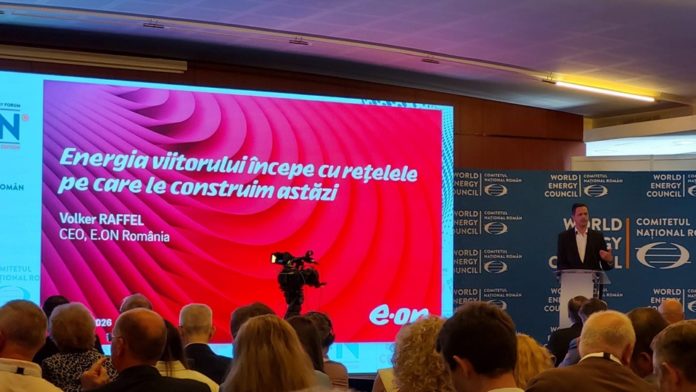
Romania can significantly reduce electricity prices over the coming decade by accelerating investments in renewable energy, storage capacity and grid infrastructure, according to Volker Raffel, Chief Executive Officer of E.ON Romania, speaking at the FOREN 2026 energy conference.
Raffel said that both Romania and Europe continue to face the challenge of high energy prices but stressed that electricity distribution networks are not responsible for rising consumer costs.
“Let’s look at today’s reality. Energy prices are no longer what they were before. Europe has a problem and Romania has a problem,” Raffel said.
“Energy is expensive, but it was not the energy grids that made energy expensive. Distribution tariffs are not what make energy costly for Romanian consumers.”
The E.ON Romania CEO argued that investments in renewable generation have already helped moderate electricity prices and prevented even higher costs for consumers.
“Imagine where energy prices would be today if we had not connected all these renewable projects, including wind farms and solar parks,” he said. “Energy prices would be significantly higher.”
According to Raffel, failing to invest in electricity networks would ultimately prove more costly than expanding grid infrastructure.
“The most expensive solution is not to invest in grids,” he said. “That would only drive prices higher.”
He warned that investments must be balanced across the entire energy system, including storage facilities, to fully capitalize on growing renewable generation capacity.
“The second most expensive solution is where we are today,” Raffel said. “We invest in grids to connect renewable projects, but then we do not have enough resources left for storage and for connecting new customers. If we do not connect storage, we can clearly see what happens to electricity prices in the evening hours.”
Looking ahead, Raffel said Romania has a clear pathway to reducing wholesale electricity prices through a combination of renewable energy deployment, energy storage and higher electricity consumption that would spread network costs across a larger customer base.
“If we want to reduce energy prices in Romania, we need more renewable energy because it is a low-cost source of electricity, more energy storage projects, and higher consumption that can help lower distribution costs,” he said.
“If we achieve these objectives, we can reduce wholesale electricity prices by more than 40% over the next ten years, with the most significant reductions becoming visible within the next four years.”
Raffel concluded by urging policymakers and industry stakeholders to act decisively to unlock the benefits of the energy transition.
“This is something we can do, and I am convinced that we must do it,” he said. “If we fail to act, we will not have a solution.”