
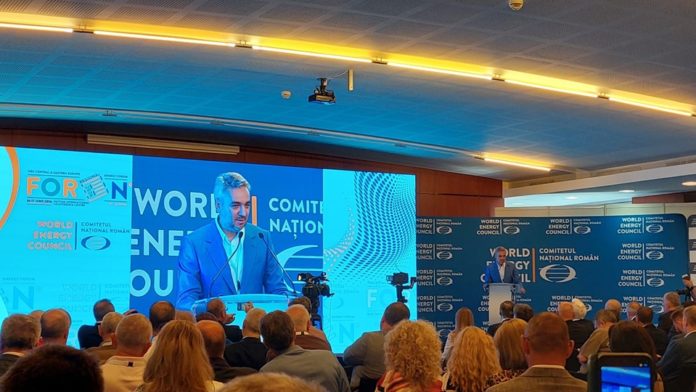
Romania has become a practical example of how renewable energy expansion and traditional energy development can advance simultaneously, according to George Niculescu, President of Romania’s National Energy Regulatory Authority (ANRE), speaking at the FOREN 2026 energy conference.
Niculescu said that discussions held during a recent visit to Washington highlighted a growing ideological divide between the United States and Europe regarding energy policy.
“I returned on Friday from Washington, where I attended one of the most important energy conferences. After discussions with representatives of both the current administration and members of the former Biden administration, my conclusion is that the ideological gap between the two continents is very large,” Niculescu said.
“Never before, in the energy sector, have issues been approached so differently. In the United States, the conversation is focused almost exclusively on oil and gas, while in Brussels we continuously hear about energy transition, decarbonization, renewables and electrification.”
The ANRE president also noted the emergence of a new institution within the U.S. government structure under President Donald Trump’s administration.
“A new player has appeared in Washington’s governmental architecture: the so-called Energy Dominance institution. The name itself gives us a preview of the United States’ plans in the energy sector,” he said.
Niculescu argued that Romania offers evidence that the two competing energy philosophies are not mutually exclusive.
“Romanians have managed to demonstrate that these two philosophies do not exclude one another,” he said. “On the one hand, Romania is installing a significant amount of renewable generation capacity, while at the same time authorizing the development of new natural gas distribution networks.”
He highlighted several examples of Romania’s dual-track approach.
“Romania is investing heavily in battery storage, while simultaneously drilling for natural gas in the Black Sea. Romania is the first country to have dedicated legislation for offshore wind activities, while at the same time it is building what is currently the largest gas-to-power plant in Europe.”
According to Niculescu, Romania could serve as a model for neighboring countries seeking to balance energy transition objectives with energy security and economic competitiveness.
“We are proof that these two approaches can be combined. We can become an example for all countries in the region, not just keep this experience to ourselves,” he said.
The ANRE president also stressed the importance of acknowledging shortcomings and accelerating project implementation, particularly within state-owned companies.
“We must recognize when we fail to make progress, and we must acknowledge when the private sector is moving far ahead of state-owned companies,” Niculescu said.
He pointed to the permitting process for renewable projects as evidence of the private sector’s ability to deliver investments rapidly.
“Private investors seeking authorization for medium-sized photovoltaic parks often return for licensing within 12 to 18 months, which shows that investments are progressing quickly,” he noted.
By contrast, some state-owned companie have struggled to meet development targets despite receiving funding and operating under restructuring commitments.
“We also have state-owned companies that, despite being financed and subject to restructuring plans, are not capable of installing even a few megawatts within three or four years,” Niculescu said.
Concluding his remarks, Niculescu emphasized that achieving Romania’s energy objectives will require sustained cooperation between industry experts, companies and public authorities.
“The energy sector requires a tremendous amount of effort from experts, companies and state institutions alike. Only through this kind of constant dialogue will we achieve the objectives we have set for ourselves,” he said.