
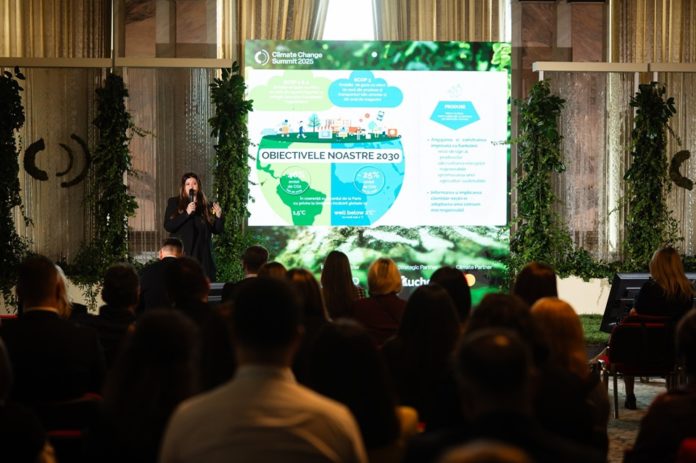
Auchan Romania brought together over 100 food producers and suppliers for the second edition of the Climate Supplier Event, a conference dedicated to accelerating decarbonization and strengthening resilience and competitiveness within the food supply chain in the face of climate change. Organized under the aegis of the Climate Change Summit, the event gathered sustainability experts, business representatives, and strategic partners to identify concrete solutions for a more efficient and sustainable food future.
At the opening of the event, Auchan representatives outlined the company’s decarbonization plans and the ways in which it supports its suppliers in adopting sustainable practices.
„Our mission is to gradually reduce our carbon footprint across all operations and provide our partners with a clear framework to do the same. Decarbonization is a growth driver for business efficiency — it directly reduces costs, and the natural outcome is lower emissions,” said Corina Dospinoiu-Imre, Sustainability Director, Auchan Romania.
Participants explored what decarbonization means in practice – how to measure carbon footprints, understand the economic benefits of emission reductions, and transform this transition into a competitive advantage. In addition, practical financing solutions were presented to help companies implement sustainability initiatives.
One of the key moments of the conference was the panel “Levers for Decarbonization”, moderated by Codruț Nicolau (Sustain Future), featuring Casiana Fometescu (Carbon Expert), Nicolae Albu (Enten Systems), Bogdan Chiripuci (Clubul Fermierilor), and Cristina Bodea (Comtim). The discussions focused on the role of agriculture and the food industry in reducing greenhouse gas emissions, in a context where, according to FAO, agri-food systems are responsible for nearly one-third of global emissions.
A relevant example discussed was that of bread – a staple food with a simple value chain, from wheat to flour, bakery, and shelf. In bread production, most emissions originate from agriculture. Chemical fertilizers are the main source, followed by fuel use, mechanized field work, and processing or transport activities. Transport and logistics alone can account for up to 10–12% of total emissions, largely due to diesel use and low efficiency in road freight. This illustrates how essential close collaboration between producers, processors, and retailers is in reducing the environmental impact of everyday foods.
A highlight of this year’s edition was the launch of a dedicated financing program, developed in partnership with BRD – Groupe Société Générale, offering Auchan suppliers preferential access to green loans and sustainability-linked loans for investments in sustainability, energy efficiency, and carbon reduction projects.Auchan also presented the progress made under its Climate Plan 2030, launched in 2019 with the measurement of emissions across all three scopes – Scope 1, 2, and 3.
Among the actions already implemented are:
● installation of over one kilometer of energy-efficient refrigeration units;
● the launch of Auchan Renewable Energy and trading of energy from renewable sources;
● expansion of renewable energy projects through solar panel installations on stores;
● multiple measures to reduce food waste.
The event concluded with a hands-on workshop, where suppliers worked alongside experts to outline their own decarbonization plans, based on EU legislation and real-world industry examples.
Through this initiative, Auchan Romania continues to build a cleaner, more efficient, and future-ready food supply chain — one in which sustainability becomes a shared pillar among all its partners.