
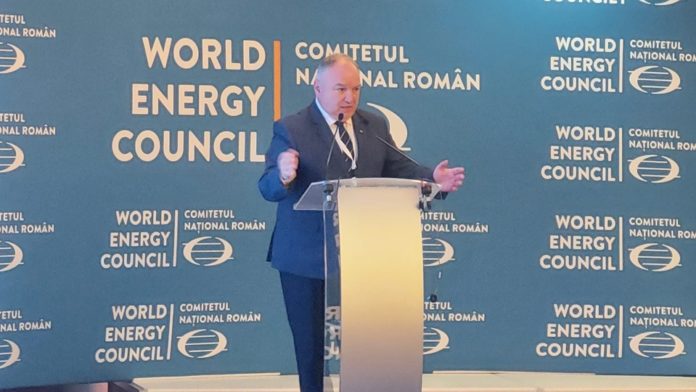
The future of the energy sector will be shaped by digitalization, sustainability, cybersecurity, interconnections and smarter infrastructure development, according to Florin Pop, CEO of EnergoBit, who outlined the key trends expected to define the energy transition through 2030 during FOREN 2026.
Speaking at the conference, Pop presented a global outlook for the energy sector, highlighting the rapid growth expected in energy storage, renewable generation, smart grids and microgrids over the next decade.
“How would the energy transition look by 2030? We are talking about a sixfold increase in installed storage capacity, a 30% rise in global electricity demand, renewables and nuclear covering 50% of electricity generation, 300 GW of new interconnections and transmission networks, a 15% annual growth rate for microgrids, and 60 billion USD in global investments in smart grids,” Pop said.
The EnergoBit CEO explained that after being challenged to summarize the future of energy in just five words, he identified five concepts that reflect both global trends and Romania’s reality: digital, green, EPC, security and modularity.
The first of these, digitalization, is an area where Romania is already making significant progress, according to Pop.
“Romania is aligned with international trends in digitalization, and companies such as ours provide solutions for distribution operators, the transmission system operator and private companies to make digital technologies part of everyday operations,” he said.
Addressing the green transition, Pop noted that Romania has achieved important milestones in renewable energy development and emphasized EnergoBit’s contribution to connecting renewable generation to the national grid.
“Of the approximately 7,000 MW of renewable energy currently installed in Romania, EnergoBit has contributed to the connection of 4,000 MW to the national power system,” he said. “That means 4,000 MW of green energy are connected to the grid through substations and power lines built by EnergoBit.”
According to Pop, sustainability goes beyond renewable generation and includes adopting environmentally friendly solutions while complying with European regulations.
Discussing the role of engineering, procurement and construction (EPC) contractors, Pop argued that energy projects are becoming increasingly complex and require integrated approaches.
“In many countries, contractors are simply builders. What I see in Romania, and in the projects we deliver, is that projects are becoming increasingly complex and require full EPC capabilities,” he said.
Cybersecurity was another major theme of his presentation, reflecting growing concerns about the resilience of critical infrastructure.
“In the past, cybersecurity requirements were not always treated with the level of attention they deserved in tenders and projects,” Pop said. “Given the current geopolitical context and the lessons shared by our Ukrainian colleagues, cybersecurity will become a critical component of future energy projects.”
He added that Romanian companies are already capable of delivering cybersecurity solutions to support critical energy infrastructure.
The final trend highlighted by Pop was modularity, which he described as essential for addressing workforce shortages and accelerating project delivery.
“There are ideas, there is financing and there are more and more projects. What remains limited is human capital,” he said. “We need to become more inventive, build faster, build more efficiently and spend less time on construction sites. Modularity is one of the solutions that can help us achieve that.”
Pop concluded by stressing that energy interconnections, environmental sustainability and digital technologies will remain the defining themes of the sector’s evolution over the coming years.
“The future of energy is linked to interconnections, to environmental responsibility and to digitalization,” he said. “These megatrends have been shaping the industry for years. I believe Romania can become a hub for energy interconnections, and I hope this objective will be achieved by 2030.”
EnergoBit currently employs around 950 people, including approximately 300 electrical energy specialists and 400 employees with higher education qualifications. The company’s activities are structured around three main business pillars: the manufacturing of low- and medium-voltage electrical equipment, electrical engineering services, and acting as a general contractor for energy infrastructure projects.