
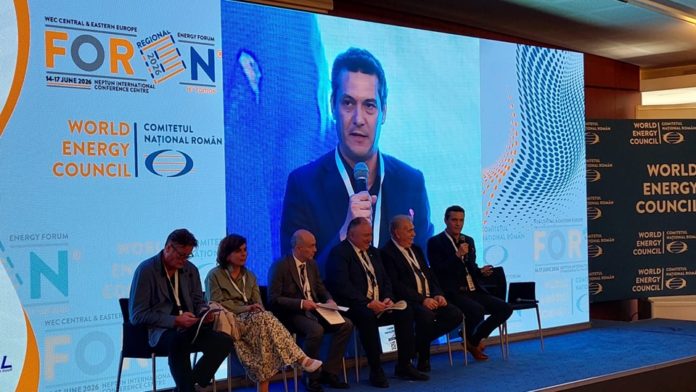
The energy transition has moved beyond simply installing renewable generation capacity and is entering a more sophisticated phase focused on grids, digitalization, storage and cybersecurity, according to Cristian Pîrvulescu, CEO and co-founder of ENEVO Group, speaking at FOREN 2026.
Addressing participants at the energy forum, Pîrvulescu reflected on the rapid pace of change in the sector over the past few years, noting that discussions that once centered on whether battery storage would become viable have evolved dramatically.
“Two years ago, when we were having this forum, we were discussing the quantities of renewables that were going to be installed. At that stage, somebody said that maybe we would see the first battery storage projects. Today, we are witnessing an entirely different reality,” he said.
Pîrvulescu argued that recent geopolitical developments have highlighted the strategic importance of energy independence and exposed vulnerabilities in global supply chains.
“In the past four years, we discovered that we have dependencies,” he said. “In 2022, Europe realized its dependence on Russian gas and accelerated renewable energy deployment. Europe did not freeze, as Mr. Putin was expecting at that time.”
He added that new geopolitical tensions have revealed additional vulnerabilities.
“This year, we discovered another dependency – that the world economy is dependent on the Strait of Hormuz,” Pîrvulescu said. “At the same time, we must acknowledge another form of dependency created during the energy transition. Trillions of euros were invested in renewables in Europe over the past few years, but around 90% of that investment effectively went to other continents to secure equipment. This is a technological dependency that we need to address.”
According to Pîrvulescu, the energy transition has evolved from a climate-driven initiative into a strategic tool for enhancing resilience and reducing geopolitical risks.
“What started as a response to the climate crisis has become a geopolitical instrument and a tool for reducing dependencies,” he said.
He described the current transformation as an industrial revolution unfolding at unprecedented speed.
“In just two years, the world installed more photovoltaic panels than ever before in history,” Pîrvulescu said. “We have also made commercially viable a technology that many of us were taught was not possible – storing energy at scale. Today, energy storage is becoming a reality through massive investments.”
The ENEVO Group CEO said the transition offers Europe an opportunity not only to strengthen energy security but also to develop domestic technological capabilities.
“We should use these investments wisely and develop our own technologies. This is a chance to solve other dependencies as well,” he said.
Pîrvulescu also highlighted cybersecurity as a critical issue for the future energy system.
“I hope history will not have to show us how important cybersecurity is through a major event,” he said. “We should prepare proactively, develop programs and invest resources now rather than waiting for a crisis to expose new vulnerabilities.”
Looking ahead, he argued that the next stage of the energy transition will focus on integrating renewable generation efficiently into increasingly complex power systems.
“The phase of the energy transition that was primarily about installing megawatts is coming to an end,” Pîrvulescu said. “Renewables have become a dominant energy source in many power systems. Now it is time to add digitalization, cybersecurity and smarter grid infrastructure.”
He stressed the need for stronger European interconnections capable of transporting large volumes of electricity across the continent.
“When I talk about long-distance transmission, I do not mean from Constanța to Bucharest. I mean from Constanța to Madrid and from Helsinki to southern Greece,” he said.
Pîrvulescu noted that the unprecedented pace of renewable and storage deployment is creating significant operational challenges for transmission system operators across Europe.
“Only our company installed more than two gigawatts of photovoltaic capacity and two gigawatts of battery storage over the past year and a half,” he said. “For the colleagues who operate the grids, this is a very stressful situation. The same challenges exist in Germany, Spain, the Nordic countries and elsewhere.”
He concluded by calling for greater attention to grid modernization and system operation as Europe continues its energy transformation.
“The challenge now is how to run these new power systems efficiently and safely,” Pîrvulescu said.