
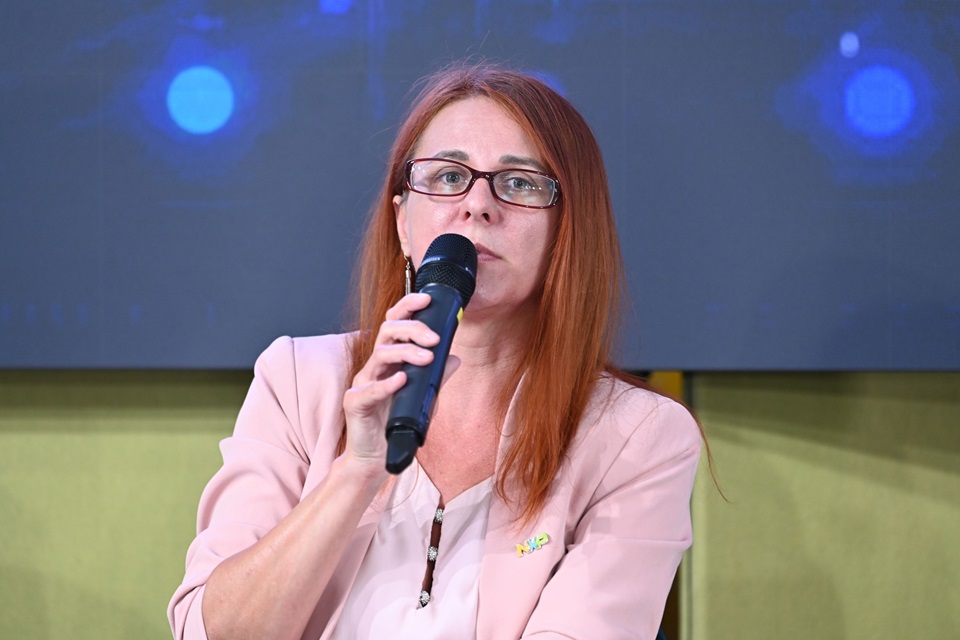
“The most important aspect for our employees is flexibility. They don’t want something like 3 days working at the office and 2 days working from home. This is the company’s corporate policy, but we adapt it to the local environment, and we must adapt to the Romanian market.
We see a change and hope it is not just an isolated case. Within NXP, we see an increasing trend regarding office presence. At the moment, in the headquarters in Bucharest, the attendance is on average 40 percent in the office. We also have weeks where attendance is 45-50 percent when we have trainings, for example,” Simona Almajan, Country Manager NXP Semiconductors said at Workplace of the Future conference organized by The Diplomat-Bucharest.
“We also had challenges related to workspaces. Flexible offices have not been well received by employees. People get attached to certain places, spaces, “my chair”, “my cup”, etc.
We implement a flexible way of working, but this flex is partial, not total. For example, a team of 20 people has a work area with 17 desks. These 17 offices are divided into fixed or flex by each team, depending on the wishes of the employees, who want flexibility.
We grew a lot during the pandemic, and we continue to grow, and our challenge was to expand our offices. It took almost a year to rent a new floor. All employees have available places and I hope that their presence at the office will increase in the next period.
There are specific situations and projects in which working from home is not allowed. It is about products that implement advanced cyber security functionalities where everything develops in those red zones. Think of a red zone as half a floor that is super secure, and access is very strict, only with approval, etc.
How do we manage to convince employees to come to the office apart from offering flexibility? We try to be creative; we implement different programs and offer them volunteer activities.
Many of our employees, especially the younger generations, want to be involved, to contribute to the development and success of the company. About 10-15 percent of NXP employees are part of the volunteer team.
AI comes with an internal data protection challenge. Another challenge is that this code ends up in different IoT devices, but it can also end up in cars, airplanes, etc. Here we are talking about our life which is at stake. So, this generated code must be reviewed well, it must pass the tests and comply with the standards. Here is an area that is still being analysed.
AI will help us write that code that will be inserted into the cars of the future, because there is not enough labour on the market to write that huge code.”