
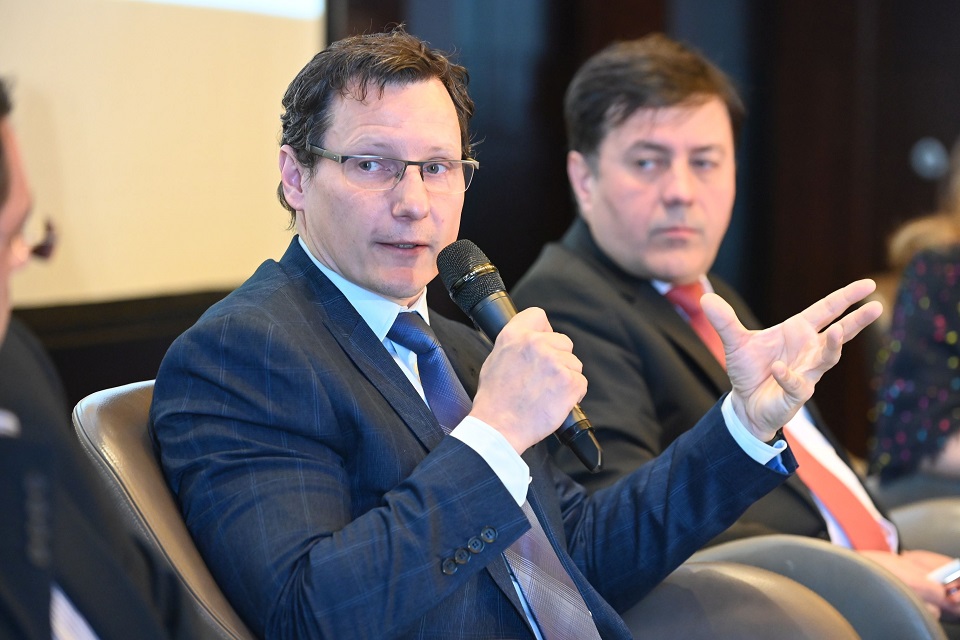
“There are many challenges for the public sector, but I’d name only three. First: change in expectations. Second: demographic changes. Third: funding gaps.
To be more specific, we have seen some studies and 85 percent of citizens expect that the governmental services will have the same standard or even higher as they have now from commercial organizations.
The change in the mindset of citizens also needs to change the mindset of governments. What we have seen now around Europe is that governments are treating citizens as customers and that’s becoming the mantra of a new approach. The governmental services need to go through various channels,” Martin Dolny. EMEA Public Sector Industry Strategy and Transformation Director at Oracle said during Romania’s National Recovery and Resilience Plan Conference 2022 organized by The Diplomat-Bucharest.
“We need to understand the needs of the citizens in a multichannel way. By 2050, more than two thirds of European population will be living in cities. Local governments will have more power. Central governments will become more regulatory, while local governments will become more executive. Now we have this kind of convergence of industries.
It’s not necessarily a very robust change in the processes. It can start with minor components. First thing would be the multichannel access. In the 21st century there are no more terms like opening hours. 24/7 regime is becoming more and more accessible.
We actually have three types of services: self-service, semi-assisted and fully assisted. Of course, some of these services need some sort of assistance.
Governmental organizations should have three more roles: designers, enforcers and communicators.”
According to an Oracle study, there are four key lessons governments learned during the pandemic that can serve as best practices going forward.
Lesson 1: Think Small
Traditionally, governments have focused on a big bang approach to development, which led to them adopting inflexible, monolithic legacy systems that are difficult to modernize and don’t evolve with the changing needs of their organizations. However, the pandemic taught governments a valuable lesson: Focus on bite-sized chunks and get them done fast.
Lesson 2: Think Nimble
State and local governments also must be nimble if they want to improve service delivery. This means they must break down traditional silos both internally and externally
Lesson 3: Focus on Business Continuity
Business continuity planning is vital to prepare for the next disruption, whether it’s a pandemic, an extreme weather event, an economic downturn or another crisis that threatens ongoing operations and service delivery. The cloud is a vital part of business continuity because it can facilitate remote work and digital service delivery from anywhere, which is critical as many public sector organizations continue to operate in hybrid work environments.
Lesson 4: Take an Enterprise Approach
With ongoing budget constraints, many governments may not be able to migrate all their systems and applications to the public cloud. However, in a hybrid cloud environment, they can still take advantage of a holistic, secure and scalable solution to meet their organizations’ evolving needs. They can focus on four key things to successfully execute a hybrid strategy: 1) analytics and reporting; 2) technology integration; 3) IT infrastructure management; 4) enterprise security.
Full recording of the conference here: https://www.youtube.com/watch?v=t5f1JNCEe-I&t=5504s