
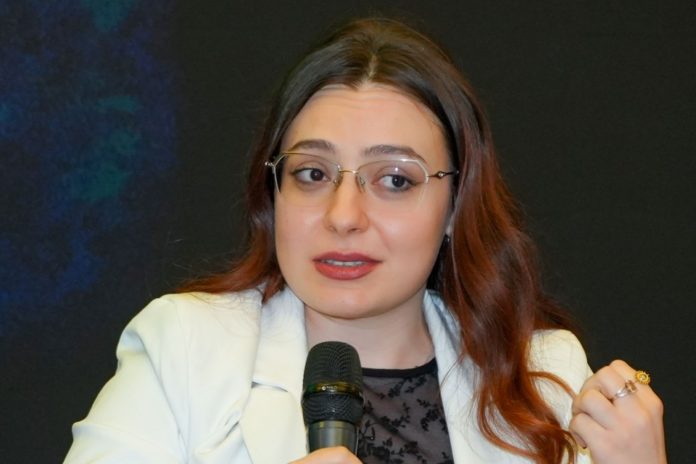
Solar power has played a key role in ensuring Romania’s energy security this summer, while the country’s battery storage capacity has more than doubled since the beginning of the year, Irene Mihai, Policy Director of the Romanian Photovoltaic Industry Association (RPIA), said at the Green Energy Conference, organized by The Diplomat-Bucharest.
“Solar was the main pillar that ensured energy security this summer. At the beginning of the year, we had approximately 500 MW of storage, around 1 GWh. We are now at more than 1 GW of installed capacity, with the prospect of reaching up to 2 GW of storage by the end of the year,” Mihai said.
According to Mihai, investment in storage is accelerating, but further regulatory improvements are needed to maintain the pace of development.
“Investments are happening. We simply need to accelerate the pace. We see regulation also moving towards simplification, but there are still some gaps that need to be addressed so that we can accelerate the pace,” she said.
Irene Mihai pointed to recent changes concerning permitting and the issuance of establishment authorizations, arguing that the regulatory framework should better reflect the different economics of storage projects.
“I am mainly looking now at the regulatory change regarding permitting and establishment authorizations. A guarantee for the issuance of establishment authorizations was introduced, and it applies indiscriminately, also affecting storage projects,” Mihai said.
“We cannot have the same logic for generation projects, which have much higher CAPEX and different dimensions and return on investment, compared with storage projects,” she added.
“Therefore, we should make some further adjustments so that storage projects themselves can remain competitive,” Mihai said.
At the same time, she welcomed the launch of a support scheme for standalone storage investments, which she said could help accelerate the development of new battery capacity.
“We are also seeing something encouraging: the launch of the support scheme for investments in standalone storage. So, we also have this lever to incentivize the addition of new capacity that can absorb energy from the grid and shift the energy produced to periods of peak consumption,” Mihai said.
However, she cautioned that the impact of these measures will take time to materialize.
“These things take time. The pace is accelerating, but it will still take until the beginning of next year before we can make up the gap,” she said.
Irene Mihai said Romania has an advantage over some other European markets because storage can increasingly be incorporated into renewable projects from their early development stages.
“Compared with other countries in Europe, Romania has the advantage of being able to add storage from the early stages of a project. If we look at the European markets, we can see that the gap between installation and absorption is not that large,” she said.
She also highlighted the rapid growth of hybrid renewable projects combining solar generation with battery storage. “We are seeing accelerated hybridization of investments. Indeed, we have not been as fast as our Bulgarian counterparts, but we continue to increase the pace,” Mihai said.
Irene Mihai described Romania as one of the most attractive markets for renewable energy investment, while emphasizing that investors need greater stability and predictability.
“Romania is one of the most attractive markets, but we need stability. I believe this is the most important thing for investors: political stability, regulatory stability and predictability,” she said.
She noted that regulation has moved towards simplification in recent years and that dialogue between the investment community and policymakers has improved.
“Regulation in recent years has moved towards simplification, and we have had moments of openness. It seems that relations between the investment environment and the political environment are beginning to develop much better, and structured dialogue is much better and more coherent,” Mihai said.
“Going forward, we still need openness from the authorities, because there are many things that can be done together with the market to make sure everything is coherent and compliant from the outset,” she added.
Mihai also called for greater consultation with the industry before major legislative changes are adopted.
“We would benefit greatly from roundtables before laws are adopted or legislative changes are made that have a significant impact on the market, so that everything is right from the beginning and does not negatively affect the investment environment and the market,” she said.
Romania’s solar market is continuing to expand rapidly, with installed and developing capacity expected to cross the 10 GW threshold in the near term.
“Our projections indicate that by the beginning of 2027 we should already exceed the 10 GW target for solar projects. We are currently at approximately 9.1 GW,” Mihai said.
“Things are progressing very rapidly on our side. We expect to reach somewhere around 10–11 GW by the end of the year. There are large and very large projects under construction that are due to be completed,” she added.
“The market is consolidating and is set to develop much further,” Mihai said.
Looking further ahead, she expects continued growth towards 2030, followed by a possible stabilization or decline, while stressing that investor interest in Romania remains strong. “We see growth towards 2030, when we will reach a plateau and eventually see a decline. However, the investment environment is strong, and I am pleased to see so many companies continuing to support the industry,” Mihai said.