
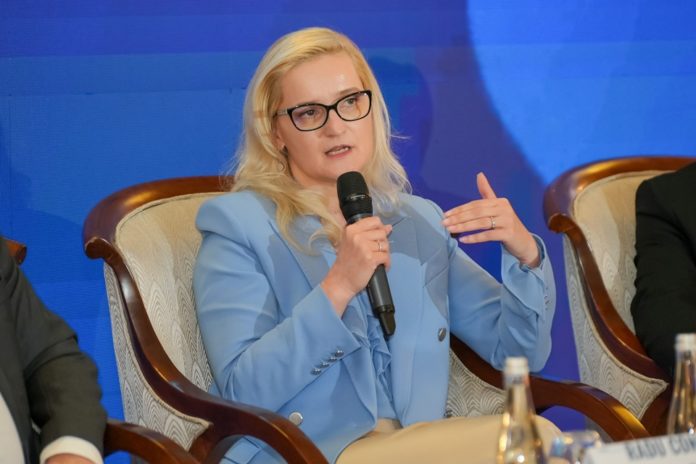
Romania’s energy market remains highly sensitive to geopolitical developments and continues to require regulation, but the priority should now be creating a more liquid and predictable market that encourages investment, according to Claudia Griech, CEO of E.ON Energie Romania.
Speaking at the Energy CEO Forum organized by The Diplomat-Bucharest, Griech said that instability has been a constant feature of the energy sector throughout her career.
“I have been working in this industry for 20 years, and I cannot remember a time when the market was stable and predictable—and it’s not because I have memory problems,” Griech said. “Yes, it is a market that needs regulation.”
She noted that Romania is emerging from a period of extensive state intervention in the energy market, implemented to shield consumers from the effects of successive crises.
“We all know that we are coming out of a period in which the market was heavily regulated. State intervention was necessary, but the question is whether those interventions needed to last so long and apply to all customers. However, these are the realities we have been living with,” she said.
According to Griech, energy markets have become increasingly vulnerable to geopolitical shocks, resulting in heightened volatility.
“The energy market is extremely sensitive to geopolitical developments, and we cannot ignore the volatility that comes with them. We have lived through the COVID crisis, the war that began in Ukraine, and now another conflict. It almost feels as though we are becoming accustomed to crises, which I believe is a bad thing,” she said. “Because we are facing one crisis after another, we should at least ask ourselves whether we are doing everything within our power to prepare and respond.”
A key priority for Romania, she argued, is improving market liquidity.
“The one thing that absolutely must happen is ensuring a liquid market. We have to acknowledge that Romania has never truly had a fully liquid market, neither for natural gas nor for electricity. At best, we have had semi-liquid markets,” Griech said.
She defended the role of energy traders, arguing that they are essential to efficient market functioning.
“It has become fashionable to say that traders speculate, but traders play an important role in any market. They are the ones who provide liquidity. We should continue removing trading barriers, something that has partially happened through recent regulations,” she added.
Griech stressed that greater predictability is crucial for both consumers and investors.
“For end customers to truly feel the benefits, we need predictability, and predictability can only come from a liquid market—one where investments take place in infrastructure and renewable energy, and where investors have confidence to commit capital. If we are honest with ourselves, we must admit that we are not there yet,” she said.
The E.ON executive also highlighted energy efficiency as an underutilized tool for reducing consumer costs.
“We need to look at energy efficiency calmly, seriously, and with less emotion. Energy efficiency is not about reducing comfort; it is about achieving the same level of comfort while using fewer resources,” Griech said. “If we consume less energy, consumers can ultimately benefit from lower bills.”
On energy security, she described Romania as being in a relatively strong position thanks to its domestic resources and ongoing investments, including the Neptun Deep offshore gas project. However, she cautioned against complacency.
“Romania is certainly in a favorable position when it comes to energy security, but we must also remain prudent. Having resources is not, by itself, a guarantee of energy security,” Griech said.
She emphasized the need for continued development of interconnections, grid infrastructure, and renewable energy capacity.
“Many things still need to happen. We need stronger interconnections, particularly in electricity, and a coherent approach to renewable energy development. Too often, when something does not work as expected, we conclude that something is flawed. We need a more balanced and long-term perspective,” she concluded.