
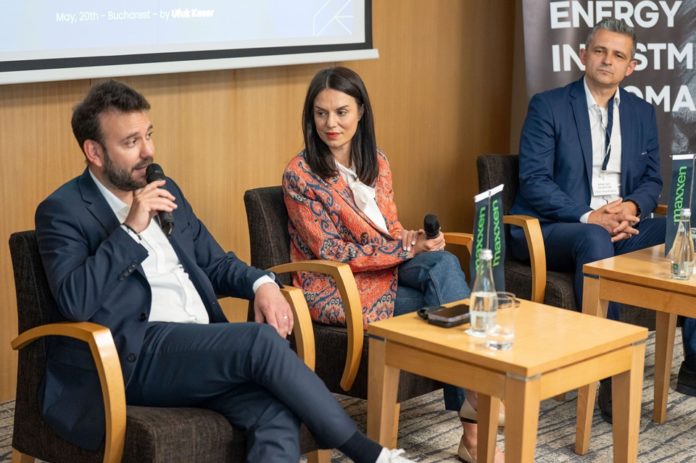
The battery investment boom risks turning the local storage market into a much more competitive space than many developers currently anticipate. Romania does not lack announced BESS projects but still needs more clarity on how many of them can be financed, built and operated profitably over the long term, according to representatives of Maxxen Energy, TDP Partners and BESCA, the organizers of a roundtable dedicated to the next maturation phase of Romania’s BESS market.
At a certain level of installed capacity, the balancing market may become increasingly crowded, while BESS project returns could start to compress, making financial modelling and long-term revenue assumptions increasingly important for developers and investors. In a fast-growing market, what matters is no longer only installed capacity, but also what the revenues of a BESS project will look like in five or ten years, how cash flow can be protected in an increasingly crowded market, and how technology solutions are selected while bankability criteria are still taking shape.
Since not every BESS project will automatically become profitable just because the market is growing, the three organizers approach this topic from complementary angles. Maxxen Energy brings the perspective of an equipment supplier, with battery production capacity in Türkiye and alternative financing models developed to reduce capital pressure on developers. TDP Partners contributes expertise in financial modelling, investment strategy and the structuring of energy projects. BESCA adds the regional perspective, through its role as a platform connecting investors, developers, technology suppliers and consultants active in the Black Sea region.
The perspective of equipment suppliers becomes important in a market where the battery is no longer evaluated only as a technical investment, but as an economic asset. For developers, the choice of technology is becoming directly linked to how the project generates revenue, amortizes the investment and can be financed over the long term. In this context, Maxxen Energy’s production capacity in Türkiye is relevant for the Romanian market through shorter delivery times, faster service and a regional alternative to supply chains dominated by Asia.
“The market conversation needs to move from the cost of the battery to revenue structure, investment amortization and financing flexibility. With models such as Storage as a Service, the battery can become a gradually paid service, not only an upfront CAPEX investment. This can help developers reduce initial capital pressure, strengthen projects in front of banks and make them more resilient to long-term market volatility. For developers, it is becoming increasingly important to have not only a competitive battery, but also a partner able to deliver fast, provide local or regional service and contribute to the economic structure of the project,” said Ufuk Keser, Business Development Director for Eastern Europe and Türkiye at Maxxen Energy.
From the consultants’ perspective, the next stage of the market will be defined by the difference between announced projects and those that can remain profitable and financeable in a more competitive environment. As more batteries enter the system, revenues from the balancing market and services provided to Transelectrica may evolve differently from initial assumptions, and projects will need to be assessed against more prudent return and cash-flow scenarios.
“The local storage market is entering a stage in which the advantage will no longer come from simply being present in a growing sector, but from the ability to structure projects that can withstand a competitive environment. In the coming years, the real selection criterion will become risk-adjusted profitability. This means realistically built financial models, including scenarios around balancing market saturation, revenue evolution as more batteries enters the system, and the ability of projects to remain bankable after the initial market enthusiasm cools down,” said Marian Dobrila, CEO of TDP Partners.
Romania is entering a phase in which the gap between announced projects and projects implemented will become an important signal for investors and financiers. In a regional market undergoing transformation, capital will increasingly focus on projects built on solid economic logic, not only on short-term opportunity.
“Across the Black Sea region, there is strong interest in storage capacities, but strategic capital is becoming increasingly selective and is looking for projects capable of generating sustainable value. It is encouraging for the Romanian market to see regional battery producers and technology providers becoming part of this conversation, including companies with production capabilities in Türkiye and direct experience in the economics of storage projects. Storage is no longer just a technical component of the energy transition; it is becoming critical infrastructure for the region’s energy competitiveness,” said Alina Ștefan, Executive Director of BESCA.