
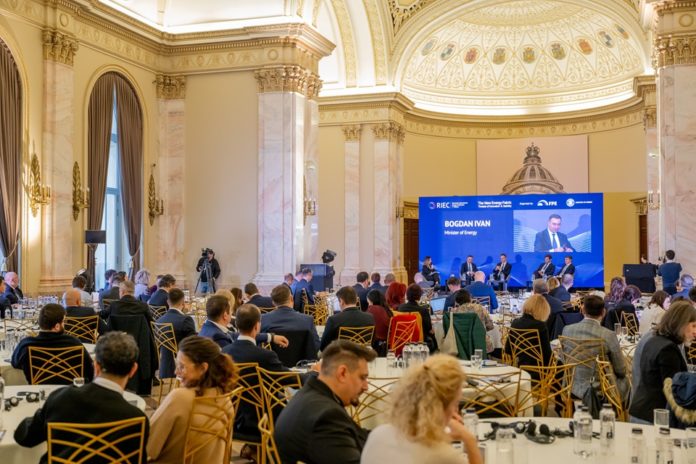
The Federation of Energy Employers (FPE), representing strategic companies across Romania’s national energy ecosystem, hosted the 7th edition of the Romanian International Energy Conference (RIEC) on 25 November in Bucharest. Formerly known as the Romanian International Gas Conference (RIGC), this year’s event was held under the high patronage of the Ministry of Energy and welcomed over 200 participants throughout the day.
The 2025 edition, organized under the theme “The New Energy Fabric | Threads of Innovation & Stability. Weaving security, cooperation, and growth through high-level dialogue,” brought together high-level guests including government officials from Romania and abroad, leaders of major Romanian companies, regulatory authorities, and regional energy experts.
Recognized as one of the most important energy sector events in Central and Eastern Europe, RIEC continues to create strategic dialogue opportunities, connecting policymakers, industry leaders, technology innovators, and public policy specialists, thereby facilitating cross-border cooperation and high-impact regional projects.
Regional cooperation, the organizers emphasized, relies on aligning ideas and negotiating divergent viewpoints. The conference therefore provided a forum for discussion on key topics for both current challenges and long-term European objectives: investment, critical infrastructure, energy security, technological innovation, and the achievement of climate targets. National perspectives and sector-specific interests were channelled toward building a shared regional agenda.
This year’s edition placed a strong focus on strengthening collaboration among Central and Eastern European states to enhance regional energy security and support industrial competitiveness. Through contributions from ministers, industry leaders, and international experts, RIEC 2025 highlighted Romania’s role in regional energy dialogue, its openness to cooperation, and its solid position within the broader energy architecture of the region.
Franck Neel, President of the Federation of Energy Employers, stated:
“RIEC has once again demonstrated that Central and Eastern Europe is a region of both challenges and solutions—solutions that can be identified and implemented through cooperation among the countries in our area. This region, still young in terms of policies and governance mechanisms, proves its maturity by setting its objectives, interests, and steps forward. Today Romania has shown it is capable of building a strong energy future. I want to thank all speakers and guests—your engagement and partnership strengthen the event’s relevance at regional and European level.”
Key Messages from Conference Speakers
Bogdan Ivan – Minister of Energy, Romania
“At this moment, we must clearly address CO₂ and ETS regulations, which heavily affect the competitiveness of our countries and companies. We need more time to work in the oil and gas sector to maintain our productivity objectives. Until we have the technology and supply chains for alternatives that can offer better energy prices, we must retain oil, gas, and certainly nuclear energy. Romania has a strong position in nuclear energy; together with our neighbours, we could provide affordable energy for the entire region. Speed is essential—as the world changes, we must ensure enough energy to power the technologies of the future and artificial intelligence, because we are in a global race built on AI and new technologies.”
Diana Buzoianu – Minister of Environment, Romania
“The Environment Ministry must be realistic but must also maintain its standards. In discussions with the EU Climate Commissioner, I was the first to argue that Romania must fulfil its nuclear commitments. I also explained that the EU-level 20% CO₂ storage target under NZIA cannot be met by Romania within the current deadlines. I supported—and secured—a one-year postponement of ETS 2. As hydropower is a hot topic, I believe scientific studies are essential to avoid having only ‘paper energy security’ while in reality risking insufficient generation and water shortages for communities.”
Ion Sterian – CEO of Transgaz
“Transgaz’s timely, well-planned investments are delivering results. Our consolidated net profit is up 476% compared to the first nine months of last year. Around 14 TSOs, including Austria’s Gas Connect, are now negotiating on gas quality standards, and we are close to signing a memorandum to harmonize these standards. Once finalized within the CESEC framework, we will continue negotiations on gas quality regarding biomethane and biogas injection into transmission networks.”
Răzvan Popescu – CEO of Romgaz
“We have evaluated several investment opportunities, and one is the Azomureș chemical plant. We are currently in an extended environmental, technical, and economic due diligence process to assess its integration into the Romgaz group. If feasibility is confirmed, we may soon submit an offer. Gas from Neptun Deep, produced under European regulations and environmental standards, creates opportunities for Romania’s industrial ecosystem. More companies should view this gas as an advantage and find ways to add value.”
Oana Ijdelea – Managing Partner, Ijdelea & Associates; Board Member, Black Sea Oil & Gas
“Interconnection plays a crucial role in Europe’s new context. I believe interconnection is the new geopolitics of the EU and of our region. Unity and cohesion in networks and access to networks are more important than ever. Energy of all types must be able to circulate efficiently. The energy transition is essential, but we must learn from the past: the EU is extremely diverse, and a one-size-fits-all approach will not work for all member states.”
Andreas Guth – Secretary-General of Eurogas
“The energy transition will not rely solely on electrification. Electrification is central, but it cannot be our only objective. From the Brussels perspective, the drive toward maximum electrification dominates policy discussions. While essential, electrification must be complemented by other vectors. Gas—whether natural gas, biomethane, hydrogen, or carbon capture and storage—remains fundamental. We need all these solutions to ensure a successful energy transition.”