
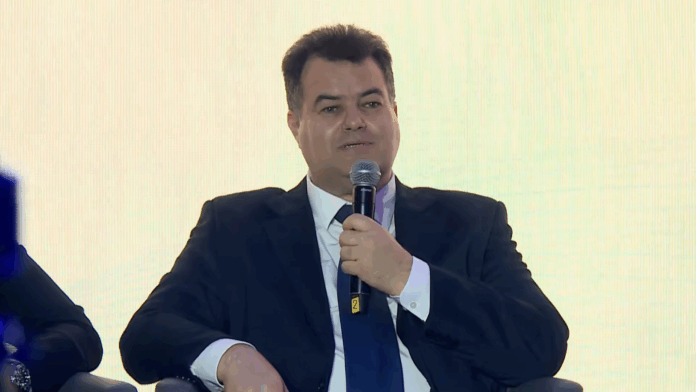
Romania’s energy system is operating more steadily, with improved reserves and lower reliance on electricity imports following the restart of Unit 1 at the Cernavodă Nuclear Power Plant, Virgiliu Ivan, Director of the National Energy Dispatcher at Transelectrica, said at the Energy for Romania event organised by Electrica.
“Today is a quieter, less tense day for me because, as we all know, Unit 1 at the Cernavodă Nuclear Power Plant was brought back online over the weekend,” Ivan said.
With both nuclear units now operational, alongside some wind power generation expected throughout the week and rising Danube water levels, the immediate outlook has improved, he noted.
“Based on the latest data, the system is operating stably, with somewhat better reserves and less dependence on energy imports, which we relied on so heavily in the recent period,” Ivan said.
Nevertheless, he warned that the coming winter would remain challenging.
“I see the winter, or this cold spell we have entered, as difficult. But just as we got through the summer together, I believe we will also get through this cold season,” he said.
Ivan also highlighted the importance of Europe’s interconnected electricity and natural gas networks, describing them as Romania’s main source of support in maintaining energy system stability.
“The fact that we operate within an interconnected European system, both for electricity and natural gas, helps us enormously. It is the main support we benefit from through interconnected system operations,” he said.
More than 4,000 MW of new capacity expected by year-end
Romania has connected nearly 3,500 MW of new capacity to the grid so far this year, through the combined efforts of investors, developers and electricity transmission and distribution operators, according to Ivan.
He expects the figure to exceed 4,000 MW by the end of 2026, including different types of energy sources and battery storage capacity.
The outlook for next year is equally positive, with another 4,000 MW of new electricity generation capacity expected to come online.
“Based on what we are seeing, I am convinced that next year we will exceed another 4,000 MW in new electricity generation capacities,” Ivan said.
He argued that the rapid expansion of generation capacity should translate into tangible benefits for consumers, including improved energy availability and potentially lower prices and bills for both industrial and household customers.
“If we bring 4,000 MW of new capacity online this year and another 4,000 MW next year, things simply have to improve in terms of the energy available to us, prices and the bills paid by end consumers, both industrial and household customers,” he said.
Grid development and energy storage are also advancing
Beyond new generation capacity, Ivan pointed to progress in energy storage and the development of electricity transmission and distribution networks.
He said the energy system was evolving positively across all these areas, providing grounds for optimism about the coming year.
“I am here today to share good news and positive developments that we at Transelectrica, particularly at the National Energy Dispatcher, can see taking place,” he said.
Ivan expects the situation to change significantly starting next spring, following what he described as a challenging second half of the year.
“I am convinced that next year, starting in the spring, things will look completely different from what we have experienced during the second half of this year,” he concluded.