
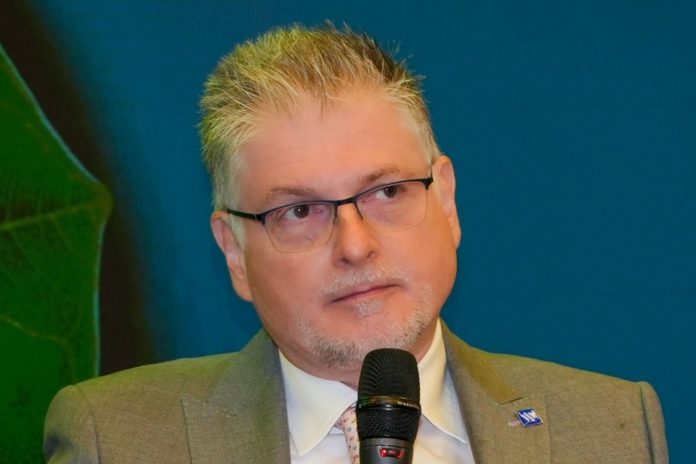
Permitting remains one of the main obstacles to the development of floating photovoltaic projects in Romania, preventing the technology from fully translating its efficiency and profitability advantages into lower energy prices, Alessandro Amato, CEO of Waldevar Floating PV, said at the Green Energy Conference, organized by The Diplomat-Bucharest.
“Our clients are facing problems when it comes to permitting. They expect to see a benefit from this segment as well. In floating PV projects, however, we can see that, even when construction costs remain stable, the burden associated with permitting leads to higher energy prices,” Amato said.
According to Amato, floating photovoltaic systems can provide strong returns while also offering technical advantages compared with conventional ground-mounted solar installations.
“Our systems are capable of delivering high returns. In particular, those installed on water have higher efficiency because they are cooled by the water, while also requiring less space per hectare,” he said.
“However, this does not translate into a lower price yet, because there are still major barriers when it comes to permitting,” Amato added.
He stressed that the regulatory framework will be increasingly important as Romania seeks to expand renewable energy capacity, noting recent progress in the regulatory treatment of floating solar projects.
“The legislative framework is becoming extremely important. Romania has made some progress. Speaking specifically about floating solar, in 2025 an order was introduced that regulated, for example, the use of water surfaces managed by the state for photovoltaic energy,” Amato said.
At the same time, the development of hundreds or thousands of smaller renewable power plants will require an electricity grid capable of accommodating increasingly decentralized generation, he said.
“We have to consider that all these hundreds or thousands of smaller power plants also need a grid that is properly developed or designed for such a situation,” Amato said.
He acknowledged the strategic importance of state control over water resources, while arguing that the regulatory framework needs to become more flexible in order to address the technical challenges involved.
“In this case, the state needs to have — and it is very good that it does have — strategic control over this resource, which is probably the most important resource we have. But it also needs to be more flexible and take into account the fact that it is dealing with technical issues that are extremely difficult to solve. We cannot wait any longer,” he said.
Amato described floating solar as a relatively small but increasingly important segment of the renewable energy market.
“Floating is a small but extremely important niche. Floating PV on its own is not a greater challenge than a ground-mounted photovoltaic park. It is already a proven technology. It started in 2007, and there are plants that were installed on water almost 20 years ago and are operating well,” he said.
The greater opportunity, according to Amato, lies in combining floating solar with existing hydropower infrastructure and battery storage.
“The idea becomes interesting when we manage to hybridize hydroelectric resources with solar resources and, together with them, batteries,” he said.
“This synergy allows not only an increase in energy production, because a photovoltaic park is added, but also better and more flexible management of the water resources,” Amato added.
Battery storage could also help reduce the operational stress on hydropower equipment while providing additional flexibility to the electricity system.
“Batteries are extremely important and will also allow for less wear and tear on the generating units when responding to grid regulation requirements,” he said.
“There is this possibility of hybridization, and Romania has a very large asset base in this respect. From a hydropower perspective, I believe more difficult periods are ahead. We understand that water flows will decrease, and therefore I believe there will be growing interest in floating photovoltaic parks,” he said.