
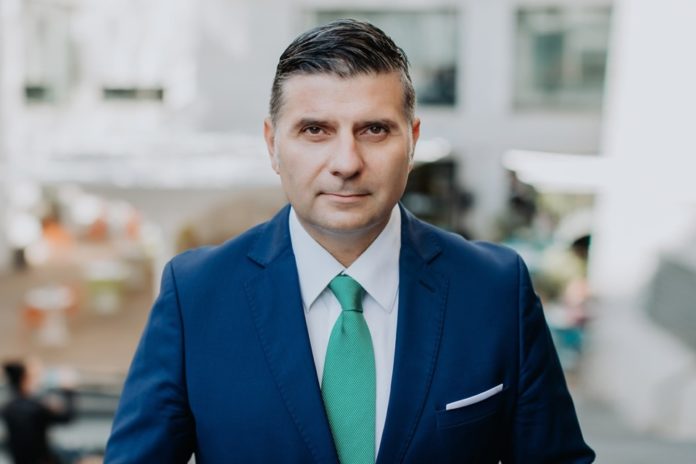
Economic diplomacy and Romania’s ability to transform its European membership, international partnerships and external relations into concrete development opportunities are increasingly important to the country’s future, ASF President Alexandru Petrescu said, highlighting the role of strong financial institutions in strengthening Romania’s economic position.
Speaking in the context of the Annual Meeting of Romanian Diplomacy, Petrescu emphasized that modern economic diplomacy is not limited to diplomatic relations, but also depends on the strength and predictability of national institutions and on the confidence an economy inspires among investors and international partners.
“Twenty-first-century economic diplomacy is also built on the solidity of institutions, on the predictability of rules and on the confidence an economy inspires in its investors and partners,” Alexandru Petrescu said.
Against this backdrop, the development of Romania’s financial markets and their deeper integration into the European financial architecture represent important elements of the country’s economic positioning.
Non-bank financial markets have a particularly important role to play. Capital markets can channel savings into financing for companies and development projects, while private pension funds create long-term domestic capital. At the same time, the insurance market provides mechanisms for managing economic, social and investment risks in a modern and sustainable manner.
Petrescu pointed to the international activity of the Financial Supervisory Authority (ASF) as an important component of this process.
“The ASF is present in the European structures where the standards and future directions of financial supervision are shaped, through its participation in the ESMA and EIOPA Boards of Supervisors and through the contribution of the Authority’s experts in technical committees and working groups,” he said.
The ASF is also involved in international organisations including the International Organization of Securities Commissions (IOSCO), the International Association of Insurance Supervisors (IAIS) and OPS, where financial risks are assessed and international standards for the future development of financial markets are discussed.
“We also take part in the work of international bodies such as IOSCO, IAIS and OPS, where global risks are analysed and the standards that will shape the financial markets of the coming years are developed,” Petrescu added.
European and international discussions currently focus on a wide range of issues affecting the competitiveness and resilience of financial markets, including digitalisation, crypto-assets, operational resilience, investor protection, sustainable finance, capital-market development and the future of pensions and insurance.
For Romania, participation in these forums provides more than institutional representation. It gives Romanian experts an opportunity to contribute to the development of European and international regulatory frameworks, while ensuring that the specific interests and characteristics of the Romanian market are taken into account in the decision-making process.
“Romania’s presence in these forums means expertise brought home, the ability to contribute to the drafting of the rules and the possibility of defending the interests and the specific features of the Romanian market in the European decision-making process,” Petrescu said.
The ASF’s international role is also connected to Romania’s efforts to join the Organisation for Economic Co-operation and Development (OECD), a process that involves assessing the quality of institutions, regulations and supervisory mechanisms against demanding international standards.
“At the same time, the ASF is involved in Romania’s path towards OECD accession, a process that entails an assessment of the quality of institutions, regulations and supervisory mechanisms against some of the most demanding international standards,” Alexandru Petrescu said.
For Romania, strengthening the financial sector is therefore closely linked to the broader objective of building a more competitive and resilient economy. Deeper financial markets, stronger domestic capital, closer European integration and an institutional voice in international regulatory forums can all contribute to improving Romania’s economic standing and its ability to attract investment.
“A more competitive economy needs deeper financial markets, stronger domestic capital, European connectivity and a respected institutional voice in the places where the rules of the future are defined,” Petrescu concluded.