

Authors: Alexandru Petrescu, President of the Financial Supervisory Authority (ASF), Marius Acatrinei, Head of the Financial Stability Unit, ASF
A global-calibre performer
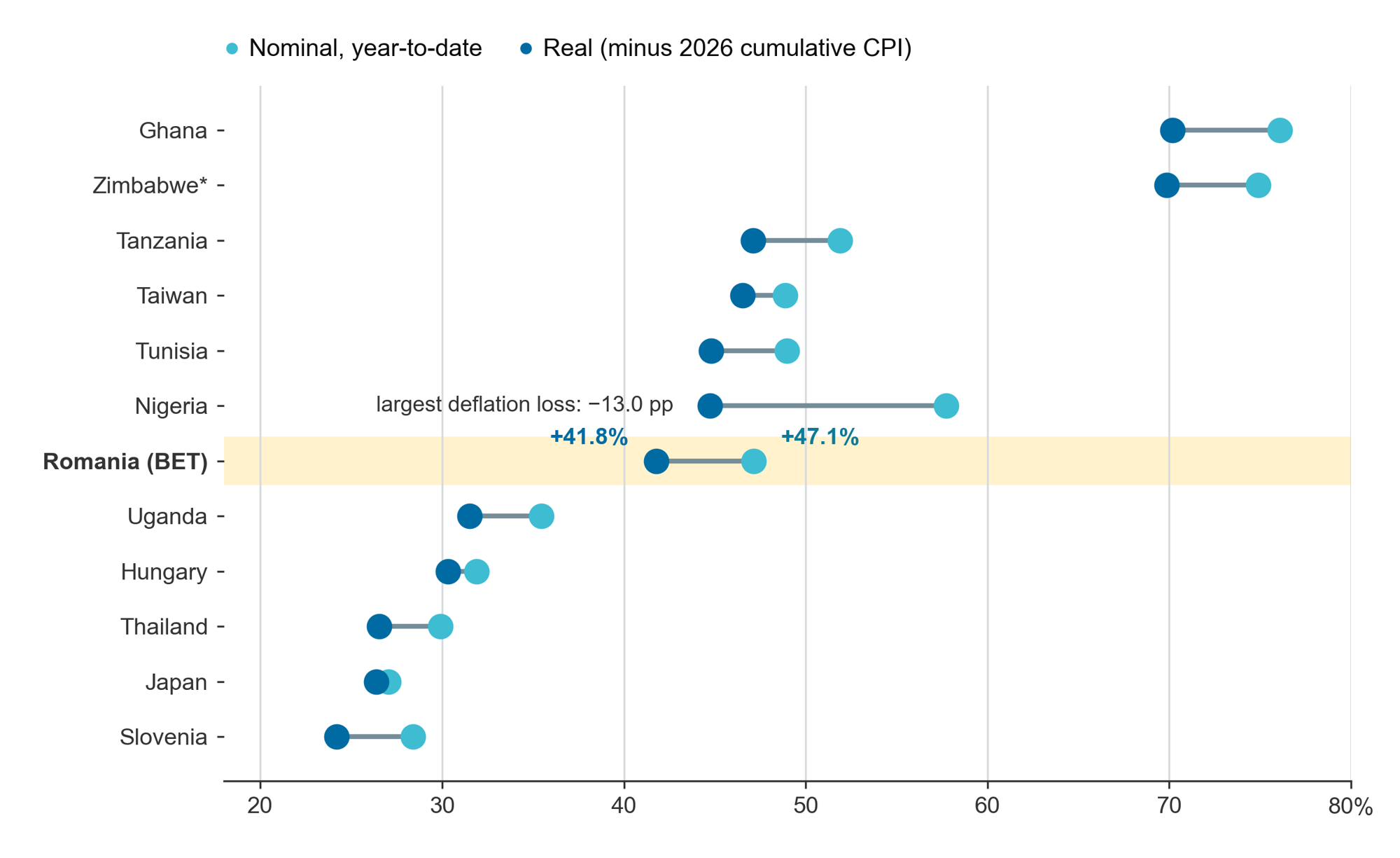
In 2026, the Romanian capital market is going through one of its strongest periods in terms of equity returns. Since the beginning of the year, the BET index has posted a nominal gain of 47.1%, and after adjusting for inflation accumulated over the same period, the real return remains at 41.8%. In this international comparison, Romania ranks seventh worldwide, in both nominal and real terms.
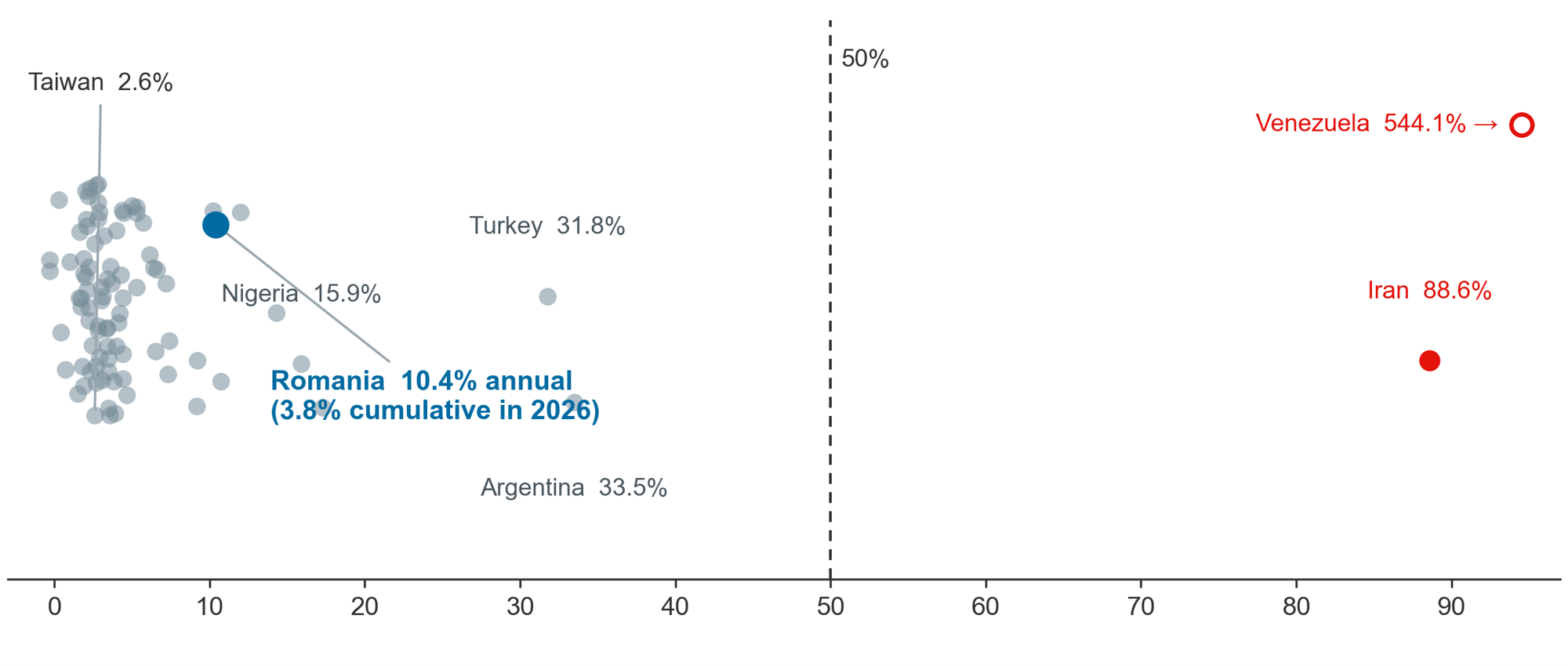
Such an assessment, however, requires methodological rigour. For the calculation of real returns, the relevant measure is inflation accumulated since the start of the year, taken over the same time window from the CPI index (December 2025 – June 2026). In Romania’s case, annual inflation stands at 10.4%, whereas inflation accumulated in 2026 is 3.8%. After this adjustment, BET’s real performance remains 41.8%, and Romania keeps its seventh place among the 104 markets with complete data.
The global comparison was built by removing markets with annual inflation above 50%, a threshold that excludes only Venezuela, at 544%, and Iran, at 89%. Argentina, Turkey, Lebanon and Nigeria stay in the ranking, and after this filter 112 indices from 90 countries are analysed. This detail matters, because it keeps the comparison broad enough and avoids the distortions produced by extreme inflation cases.
Top returns in Europe
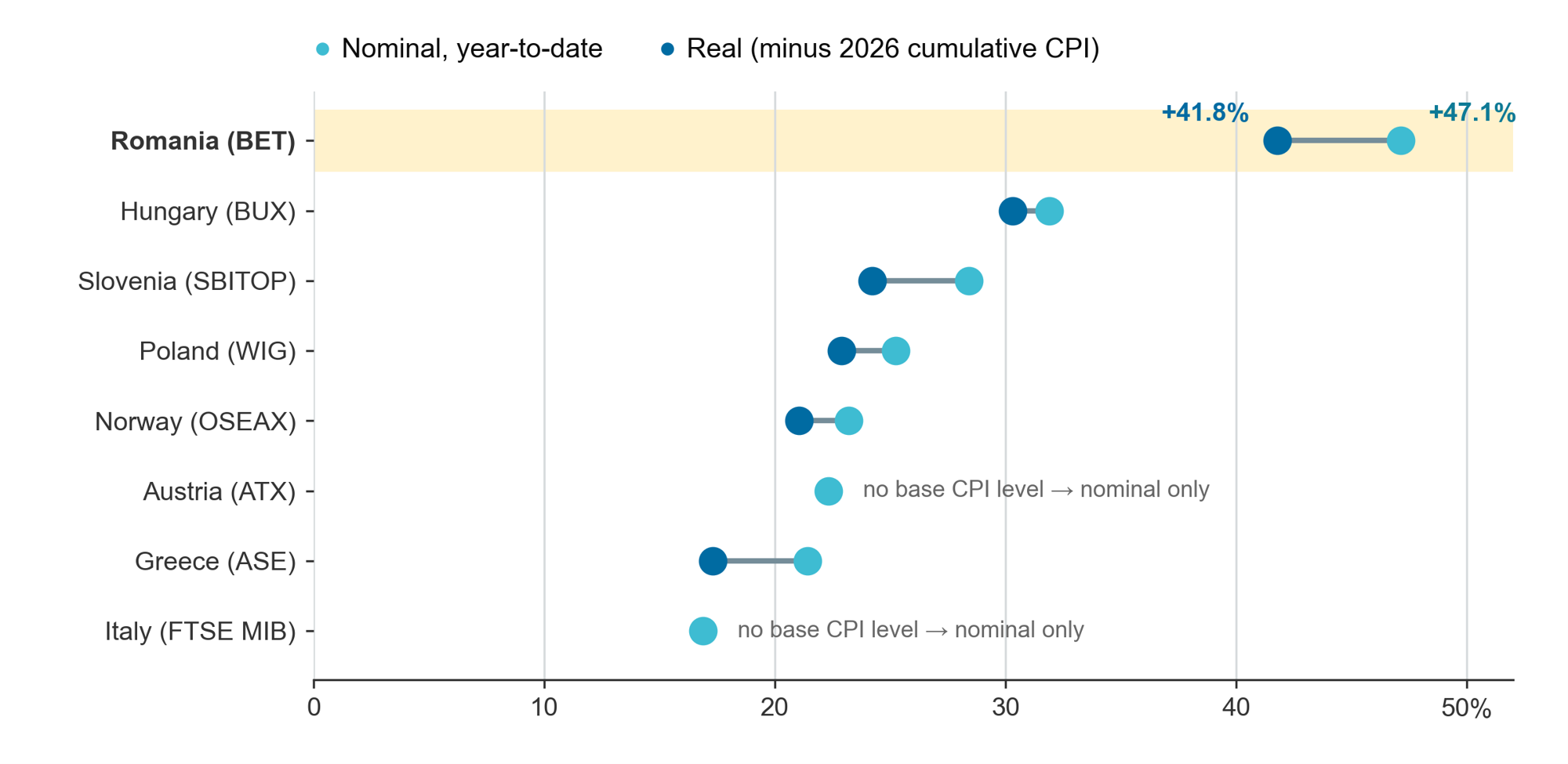
In Europe, the Bucharest Stock Exchange’s position is even stronger. BET leads with a 47.1% nominal and a 41.8% real return, more than fifteen percentage points ahead of the next-ranked market, Hungary, at 31.9% nominal and 30.3% real. Slovenia, Poland, Norway, Austria, Greece and Italy follow, all with nominal returns below 29%. With cumulative inflation low across the continent — from 1.2% in Hungary to 3.8% in Romania – the inflation adjustment does not change the European hierarchy. BET stays in first place.
A market at all-time highs
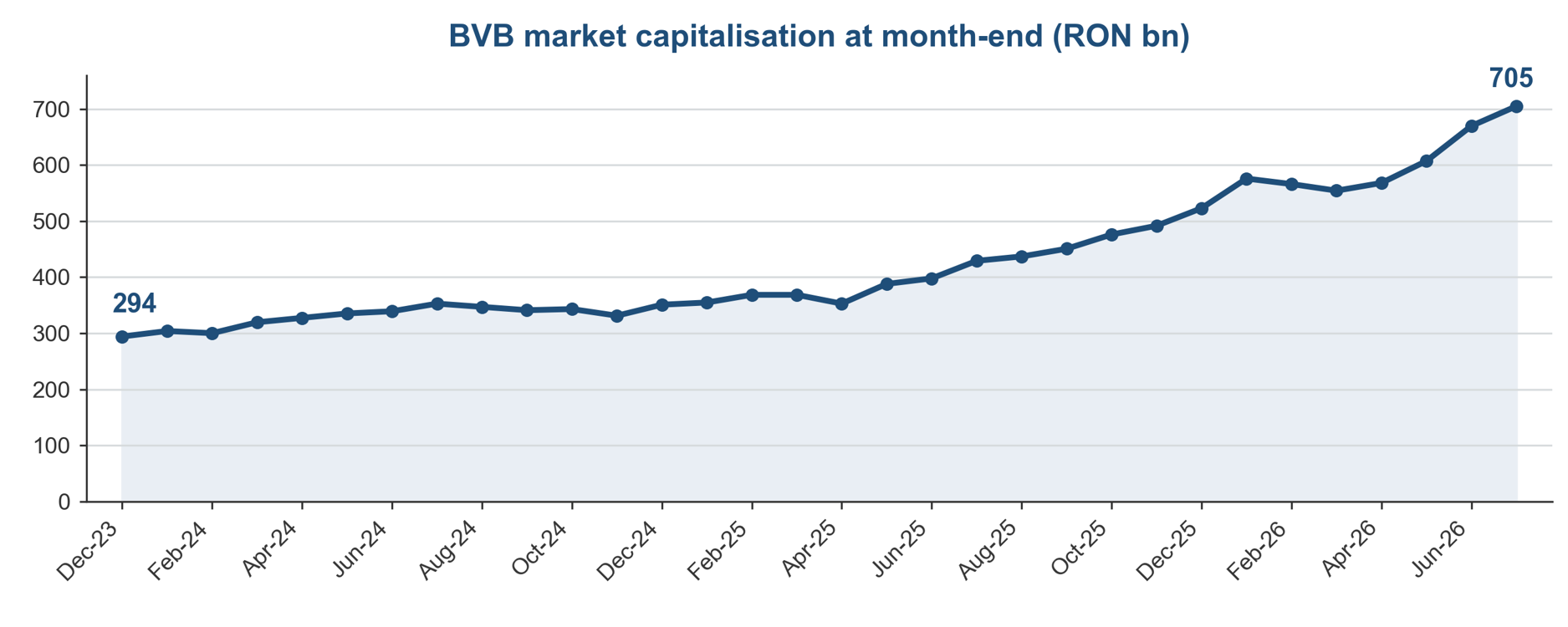
On 31 July 2026, the market capitalisation of the Bucharest Stock Exchange reached RON 704.8 billion, a new all-time high. The level represents an increase of roughly 35% over end-2025 (RON 523.1 billion) and a more than 2.4-fold multiplication since December 2023 (RON 294.3 billion). The trajectory has been steadily upward, with a marked acceleration in the second half of 2025 and the first part of 2026.
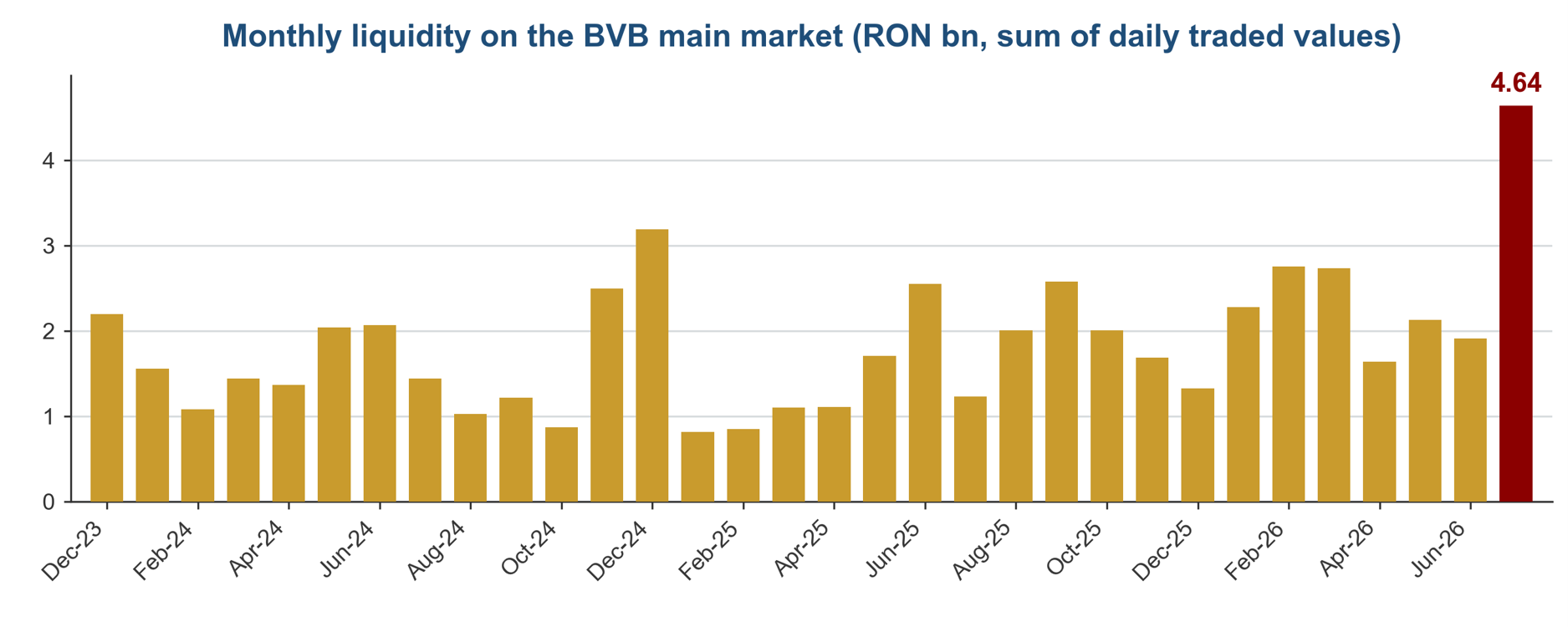
Liquidity on the main market has likewise followed an upward trend, with natural month-to-month volatility. July 2026 was exceptional in terms of turnover, RON 4.64 billion, more than twice the usual average, but the jump was concentrated in a few sessions with large trades (notably 16 July, at over RON 1.4 billion), so the level should be read as a one-off spike rather than a structural change of regime.
The performance of BVB indices
Index returns confirm the breadth of the advance. The benchmark BET index gained 79.1% over 12 months, 33.0% over 6 months and 11.3% in July alone. The strongest performer was the energy sector index, BET-NG (+90.0% over 12 months), followed by the total-return indices (BET-TR +86.0%). At the other end, BET-FI (financial investment companies) lagged behind (+69.3% over 12 months), while BETAeRO, the index of the AeRO market for smaller companies, rose far more modestly (+15.9%).
| BVB index | 1 month | 3 months | 6 months | 12 months |
| BET | 11.29% | 27.92% | 32.97% | 79.08% |
| BET-XT | 10.97% | 27.08% | 31.17% | 80.04% |
| BET-NG | 13.44% | 31.33% | 38.43% | 90.02% |
| BET-BK | 7.90% | 23.33% | 22.56% | 75.35% |
| BETPlus | 11.32% | 27.61% | 32.51% | 76.45% |
| BET-TR | 11.61% | 31.64% | 36.83% | 86.00% |
| BET-XT-TR | 11.29% | 30.55% | 34.76% | 86.38% |
| BET-TRN | 11.56% | 31.02% | 36.19% | 84.96% |
| BET-XT-TRN | 11.24% | 29.97% | 34.16% | 85.41% |
| BET-FI | 3.43% | 10.04% | 4.45% | 69.28% |
| BETAeRO | 3.79% | 13.59% | 9.51% | 15.86% |
| ROTX | 11.15% | 28.22% | 33.68% | 82.04% |
The market’s growth engines
BVB’s growth is closely tied to the sectoral structure of the market. In July 2026, two sectors accounted for roughly three quarters of the value traded on the main market: energy (oil, gas and electricity, ~49%) and banks (~27%). The companies with the largest turnover were Banca Transilvania (24.5%), Petrom (14.6%), Romgaz (13.6%) and Hidroelectrica (8.9%).
| Sector | Representative companies | % of traded value (Jul 2026) |
| Oil and gas | SNP (Petrom), SNG (Romgaz) | 28.3% |
| Banks | TLV (Banca Transilvania), BRD | 27.4% |
| Electricity (generation) | H2O (Hidroelectrica), SNN (Nuclearelectrica) | 12.2% |
| Energy transmission/distribution | EL (Electrica), TGN (Transgaz), TEL (Transelectrica) | 8.2% |
| Telecommunications | DIGI | 5.3% |
| Healthcare | M (MedLife) | 3.3% |
| Investment funds | FP (Fondul Proprietatea) | 1.7% |
This structure also explains the hierarchy of returns: the 90% advance of the BET-NG energy index reflects the rally in energy companies, while the large weight of banks (Banca Transilvania in particular) in the BET index was the main driver of the headline index’s rise. At the same time, concentration remains a risk feature of the market: overall performance depends significantly on a small number of issuers in energy and banking.
Investors: growing support
The market’s advance is not just a price phenomenon but also one of participation. Between March 2019 and March 2026, the number of active client accounts at investment firms (SSIFs) rose from 15,726 to 148,491 – an almost 9.4-fold multiplication (a compound annual growth rate of about 37.8%). In parallel, the value of assets held in custody at SSIFs climbed from RON 8.73 billion to RON 63.75 billion (an increase of more than 7.3 times, CAGR ~32.8%). The fact that assets grew together with the number of accounts points to larger invested amounts and a maturing Romanian capital market.
Conclusions
On 31 July 2026, the Bucharest Stock Exchange stood at all-time highs on every relevant dimension – capitalisation, returns and investor base. Over 12 months, the BET index outperformed all major international benchmark markets, supported by the energy and banking sectors. The rise has been accompanied by a structural broadening of investor participation, which points to genuine development beyond price dynamics. The main point of attention remains the high degree of concentration by sector and issuer; on the whole, however, BVB’s indicators give the true measure of an exceptional stock market year for Romania.