
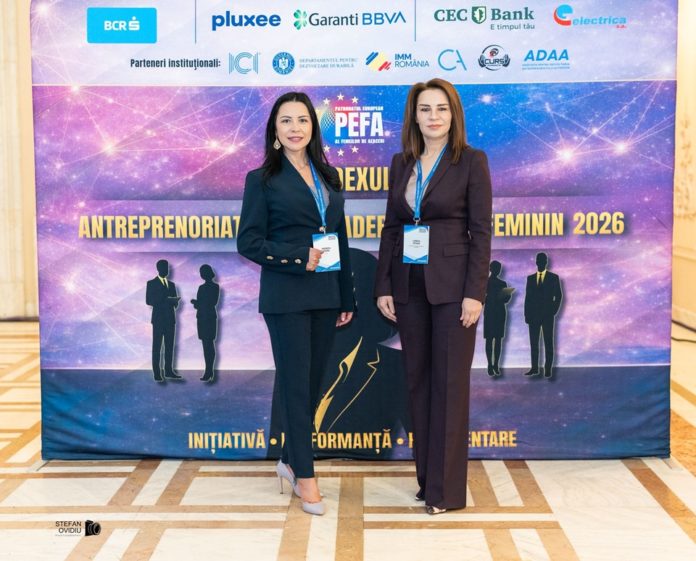
The European Businesswomen’s Federation (PEFA) launched at the Digital Innovation Summit Bucharest, at the Palace of Parliament, the Women’s Entrepreneurship and Leadership Index 2026 — the first systematic economic analysis tool dedicated to the contribution and potential of women in the Romanian economy.
The document quantifies for the first time the real cost of gender inequality in the labor market and formulates a robust economic argument: the full involvement of women in the formal economy would add up to 1.9% to GDP by 2036.
Andreea Negru, President, PEFA — European Businesswomen’s Federation: “The index is not a statistical exercise — it is a strategic tool that puts before policymakers, the business community and society a simple truth: where women are actively involved, organizational performance increases, economic sustainability becomes stronger, and Romania moves forward. Our data shows that we cannot afford to ignore this potential any longer.”
The 2026 Index examines the situation of women in the Romanian economy on four main dimensions: labor market participation, fiscal contribution, cost of inactivity and medium-term growth potential.
- 53% Women’s employment rate in Romania — compared to the EU average of 65%
- 1% STEM graduates — the highest percentage in the EU, highlighting that the barriers are not educational
- 509 billion lei Total fiscal contribution of women to the state budget in the period 2020–2024
- 6% GDP Annual economic cost of gender inequality — compared to the 3% EU average
- +1.9% GDP Potential gain by 2036 by mobilizing 1.3 million inactive women
ROMANIA’S GENDER PARADOX
The index highlights a fundamental contradiction: Romania is the European leader in female STEM graduates (42.1%), and women occupy 50.2% of management positions in central public administration. However, the female employment rate remains at 53%, with a gap compared to men of 16–17 percentage points — four times higher than the European average.
This contradiction demonstrates that the exclusion of women from the formal economy has not educational causes, but structural ones: the lack of care infrastructure, the norm of unpaid domestic work and the persistence of cultural stereotypes in the corporate and entrepreneurial environment.
IDENTIFIED STRUCTURAL BARRIERS
▸ Unpaid domestic work: women bear a disproportionate burden of household chores, limiting their availability for a career. The associated economic cost amounts to 93.4 billion lei annually (14.5% of GDP).
▸ Care service deficit: Romania ranks among the EU countries with the lowest coverage of nursery and kindergarten services, blocking professional reintegration after maternity.
▸ Cultural norms and stereotypes: Traditional expectations discourage women from accessing leadership and entrepreneurial positions, especially in technical and financial sectors.
Andreea Negru, President, PEFA — European Businesswomen’s Federation : “When we talk about gender equality in the economy, we are not talking about favors given to women — we are talking about a national resource of almost a million qualified people, who are outside the labor market for a reason that we can solve through smart public policies. The 2026 Index provides exactly the map for these solutions.”
Lorena Stoian, First Vice-President, PEFA — European Businesswomen’s Federation: “Romania today has a mature and dynamic female entrepreneurship, and the data confirms it. From the results of the survey conducted by PEFA together with partners at CURS ESOMAR at a national level on 803 female entrepreneurs, one thing stands out: 88% declare themselves optimistic despite all the barriers — and they are right to be. The data confirms that women in Romania do not lack skills or ambition, but a framework that allows them to realize their potential. PEFA remains committed to helping transform these conclusions into concrete policies: favorable taxation for female entrepreneurship, expanding the network of care services and mentoring programs that accelerate women’s access to decision-making positions.”
CONVERGENCE SCENARIO 2030–2036
Based on a convergence model with the European average, the Index projects the female employment rate to increase to 65% by 2030 and to 70% by 2036 — targets aligned with Romania’s European commitments. Estimated impact:
- Reduction of the employment gap from 18 percentage points (2024) to 8 percentage points (2036)
- Annual GDP gain of 4.3–4.4 billion lei in the period 2030–2036
- Potential activated labor force: 551,000 people by 2036, compared to 998,000 available today
- Cumulative share in GDP: 1.9% added over the entire analysis period
The launch event took place within the Digital Innovation Summit Bucharest, organized by ICI Bucharest at the Palace of Parliament, in the presence of representatives of the business environment, public administration, the financial sector and civil society.
The Women’s Entrepreneurship and Leadership Index 2026 is produced with the support of BCR, as lead partner, Pluxee Romania and Garanti BBVA Romania, as partners. The Index launch is taking place with the support of CEC Bank and Electrica. Institutional partners: ICI Bucharest, Department for Sustainable Development, IMM Romania, Consilium Policy Advisors Group, CURS Foundation and the Association for the Development of Indigenous Entrepreneurship ADAA.