
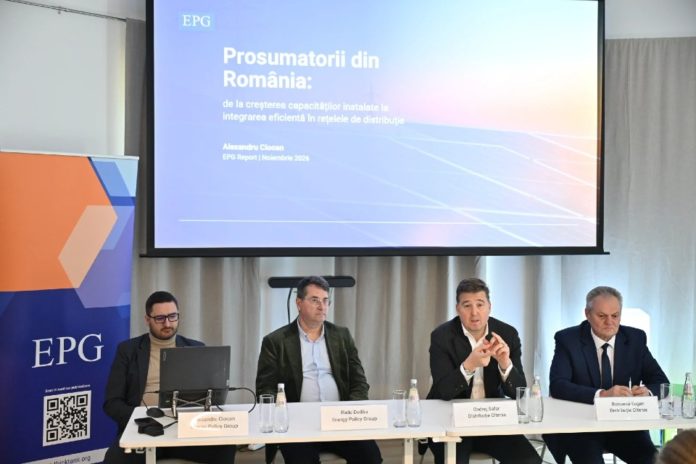
The number of prosumers in Romania has grown from just 289, with an installed capacity of approximately 2.5 MW at the end of 2019, and is expected to exceed 400,000 by the end of 2026, with total installed capacity surpassing 4.4 GW. This rapid expansion creates new opportunities for renewable energy generation, but also poses challenges for electricity distribution grids, which must adapt to efficiently integrate increasing volumes of locally generated electricity.
A new report by the Energy Policy Group (EPG), commissioned by Distribuție Oltenia, highlights the need for an integrated approach combining investments in grid modernisation with monitoring, voltage regulation, injection management and flexibility measures inspired by European best practices.
The growing installed capacity of prosumer photovoltaic systems is changing the way electricity distribution grids operate, particularly at low-voltage level. Distribution networks must increasingly manage large volumes of electricity fed into the grid during periods of high solar generation. This can lead to reverse power flows, voltage levels exceeding permitted limits, phase imbalances and overloading of certain grid components. These challenges are particularly pronounced in areas with a high concentration of prosumers and in networks with limited capacity to accommodate distributed generation.
The EPG report highlights that the impact of prosumers on electricity grids varies depending on infrastructure characteristics, the location of installations and the volumes of electricity injected into the network. Consequently, solutions must be tailored to local conditions to ensure that investments are effective and that prosumer development is not constrained.
As the initiator of the report, Distribuție Oltenia contributed by providing data and technical analyses developed within the Orizont 30 project. These highlight the challenges associated with prosumer integration, as well as solutions that have been implemented or tested to address them, taking into account the specific characteristics of local distribution networks.
Delgaz Grid also contributed data from its own technical analyses, while Rețele Electrice România participated in the consultation process and discussions on the challenges of prosumer integration, helping to provide a broader perspective on developments across distribution networks.
These contributions underline the importance of comparing available solutions and basing investment decisions on technical and economic assessments. This would enable distribution system operators to identify the most effective combinations of measures and achieve the desired benefits at justified costs.
“The growing number of prosumers is a clear sign that the energy transition is already underway, with more and more Romanians choosing to actively participate in renewable energy generation. This is a development we support and one for which we are continuously preparing our networks. At Distribuție Oltenia, our goal is to facilitate the integration of as many prosumers as possible while ensuring the safety and quality of distribution services. This requires both investment in infrastructure modernisation and smart solutions tailored to the needs of each area. The EPG report provides valuable insight into how we can make better use of existing infrastructure and identify effective solutions for the future. We believe the energy transition is a collective effort, built through cooperation between distribution operators, public authorities and consumers,” said Ondrej Safar, CEO of Distribuție Oltenia.
Experience from other European countries, including Germany, the Netherlands and Poland, shows that the rapid growth of prosumers must be accompanied by adjustments to support and compensation mechanisms, as well as measures to facilitate the more efficient integration of photovoltaic generation into electricity grids.
These measures include shifting from net metering to financial compensation, introducing limits on the amount of power that can be fed into the grid, and developing flexible connection arrangements, depending on each country’s regulatory framework.
These examples demonstrate that the effective integration of prosumers depends not only on infrastructure investment, but also on making smarter use of existing grid capacity through monitoring, digitalisation, automation and flexibility solutions.
“Based on our analyses, we have identified several priority areas for the effective integration of prosumers into Romania’s electricity grids. These include introducing flexible connection mechanisms, including limits on the power injected into the grid; making use of advanced photovoltaic inverter functionalities, where technically feasible; developing monitoring and digitalisation infrastructure for low-voltage networks; and establishing the framework needed for distribution system operators to procure flexibility services. At the same time, tariff mechanisms need to be adjusted to ensure a fairer distribution of grid costs.
Implementing these measures requires better coordination between ANRE, distribution system operators, Transelectrica and the authorities responsible for energy policy. The regulatory framework must also be adapted to enable the use of technical and economic solutions that can reduce pressure on existing infrastructure. All of this must be achieved without unjustifiably restricting the development of prosumers,” said Alexandru Ciocan, Senior Researcher at EPG.
The EPG report emphasises the importance of developing electricity grids in line with the growing number of prosumers. Through investments tailored to local needs, digitalisation and smart energy management solutions, distribution networks can support the integration of an increasing number of prosumers and contribute to accelerating Romania’s energy transition.