
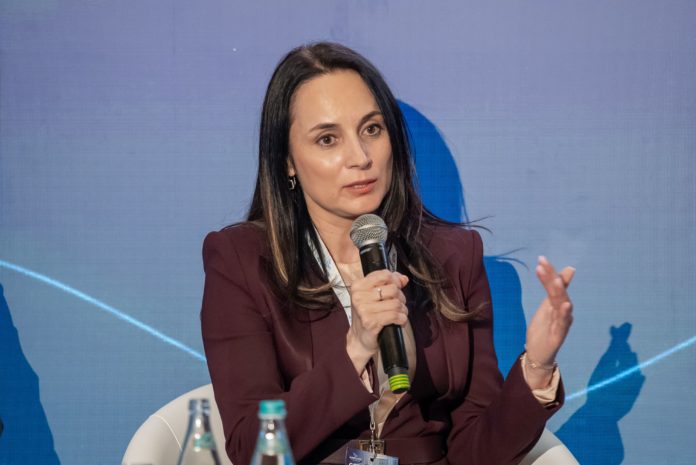
Delivering renewable energy and battery energy storage projects on schedule, within budget and under the highest health and safety standards is essential to project success, Roxana Gureanu, CEO of Parapet, said at a conference organised by Alive Capital and dedicated to battery energy storage systems.
“I would start by identifying the three essential components of a successful project. First, it must be delivered on time, in line with the agreement with the client and the grid connection schedule. Second, it must stay within budget, which is extremely important for the financier, whether public or private funds are involved. Third, and just as important as the first two, it must be delivered under the highest health and safety standards,” Gureanu said.
She highlighted Parapet’s experience in the renewable energy sector, where the Romanian-owned company has been active for more than a decade, since the first wave of renewable energy development.
Gureanu said the company operates in Romania, Germany and Italy, drawing on international best practices and integrating them into its projects in the Romanian market.
Since the beginning of the year, Parapet has been building more than 1 GW of projects across photovoltaic, wind and, battery energy storage segments, she said.
In battery storage alone, the company is involved in three projects for three different clients across three counties in Romania, with a combined capacity of 514 MWh.
As a full engineering, procurement and construction (EPC) contractor, integrating both design and procurement, Parapet has faced challenges related to geopolitical developments and their impact on supply chains.
Gureanu said the company had to identify alternative shipping routes and additional manufacturers, particularly for specialised equipment and cables, in order to mitigate anticipated delivery delays.
Another major challenge has been recruiting specialised professionals with the skills required by an evolving renewable energy industry.
“Finding highly skilled people in engineering and economics is one thing. The challenge is finding specialists whose competencies match the changing needs of the industry, particularly in commissioning and monitoring, including SCADA systems,” she said.
According to Gureanu, Parapet has addressed these challenges by integrating digitalisation into its operations, turning them into a competitive advantage both in Romania and at European level.
Parapet has developed an internal digital platform that integrates planning and controlling functions across its operations in three countries, providing stakeholders with real-time visibility into project progress.
“We have an internal platform that integrates both planning and controlling, bringing together all of Parapet’s systems across the three countries and giving our stakeholders the ability to see the status of a project in real time. Also, our teams no longer depend exclusively on reports that can reach managers hours or even days late. Decisions are made while the works are under way,” Gureanu said.
She added that standardization is another key benefit in BESS project: once a workflow proves efficient on one project, it can be replicated in every country where Parapet operates, while maintaining the same quality and safety standards.
“Once a process has proven itself on one site, we can replicate it across markets through a common operational system. This is what allows us to deliver with the same discipline wherever we work,” she said.
She stressed that real-time project monitoring is particularly valuable in an industry where construction schedules and grid connection milestones can be affected by external factors, including geopolitical developments and supply chain disruptions.
“This is extremely important because it provides predictability in the construction process and, especially, predictability regarding grid connection, at a time when geopolitical developments are having a significant impact on the entire industry and, in particular, on supply chains,” she said.