
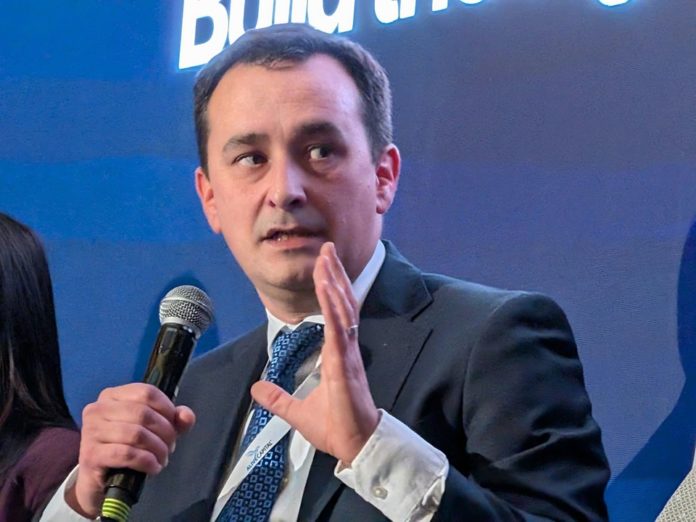
Grid connection infrastructure, procurement of high-voltage equipment and project design are among the main factors that can delay battery energy storage system (BESS) projects in Romania, as battery deliveries themselves can take around six months, according to Radu Vasile, General Manager of Eximprod Engineering.
Speaking at a conference organised by Alive Capital and dedicated to battery energy storage systems, Radu Vasile said that the rapid development of renewable energy and storage projects has intensified pressure on project timelines, making coordination between equipment procurement, engineering and grid connection increasingly important.
“First of all, it is also a question of expectations. The development of renewables has always been a race against the clock. Whether we were talking about wind, photovoltaics or now, batteries, there has always been a race against time,” Vasile said.
He explained that battery storage projects are accelerating this trend because investors expect to move quickly from securing financing and ordering equipment to installation and commissioning.
“Once you have secured financing and selected a battery supplier, in principle, within six months of placing the order, you expect the batteries to arrive and be installed,” he said.
Unlike wind turbines, which require complex transportation and lifting operations, battery systems are relatively straightforward to install once delivered to the site.
“For BESS projects, the equipment arrives in six months. The problem seems to be that the construction of the grid connection substation and the user’s substation takes longer,” Vasile said.
He identified the procurement of high-voltage equipment, particularly power transformers and 110 kV switchgear, as a significant source of delays.
“A power transformer can take nine months to deliver. You also have high-voltage equipment, including the 110 kV switchgear if you are connecting to the distribution network,” he explained.
Purchasing equipment manufactured in Romania can help shorten delivery times, he added, while sourcing other equipment may require investors to wait longer.
Project design is another critical factor. Delays can occur before procurement orders are placed, particularly when engineering activities and equipment purchasing are not properly coordinated.
As an example of what can be achieved with effective project execution, Vasile cited the Studina photovoltaic project, which he said was energised within 14 and a half months of contract signing.
Vasile advised investors developing battery storage projects to select engineering, procurement and construction (EPC) contractors with in-house design capabilities. This allows equipment procurement to begin progressively as different parts of the project design are completed, rather than waiting for the entire design process to finish.
“My advice to those starting renewable projects is to look for an EPC contractor that has design and detailed engineering capabilities in-house, so that procurement can be launched as the project design progresses,” he said.
He also highlighted the importance of understanding the procedures of distribution and transmission system operators, noting that each has its own processes that developers must learn to navigate.
“Each distribution system operator and each transmission system operator has its own procedures that you have to learn to navigate. It is better not to go through that learning curve on your own project,” Vasile said.
For investors, early preparation and access to experienced engineering teams are therefore essential to reducing delays and keeping projects on schedule.
He added that investors should involve consultants or engineering teams well before the project is formally launched, particularly during the design phase, when early decisions can have a significant impact on procurement schedules and the overall timeline for connecting a battery storage facility to the grid.