
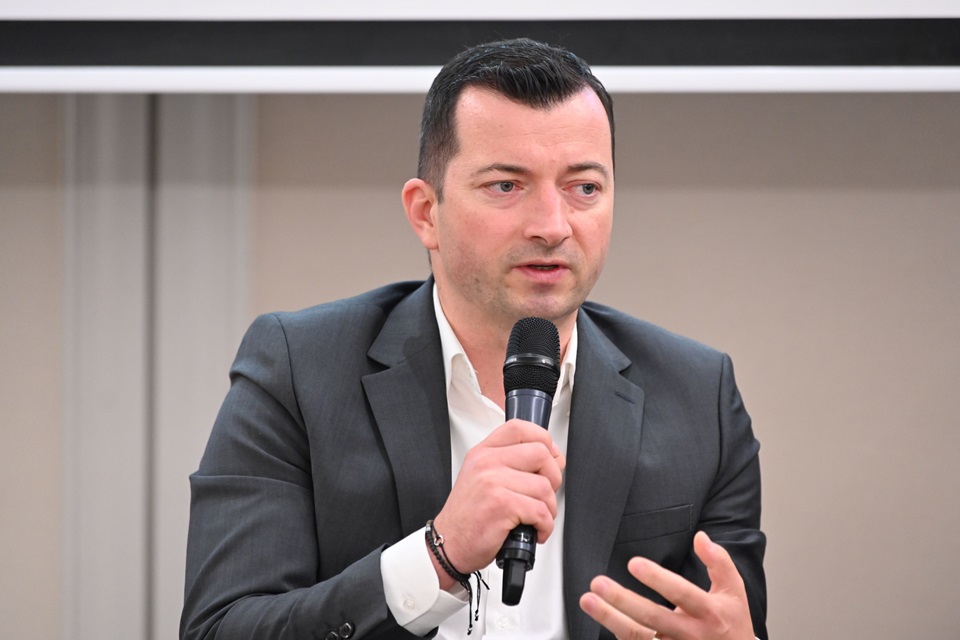
Romania’s energy sector is entering a period of significant investment, with new generation capacity, grid developments and electrification expected to reshape the country’s energy market, according to Liviu Gavrilă, Head of Romanian operations at Enery.
Speaking at the annual InvesTenergy Conference, Gavrilă said that the availability of grid capacity represents an important factor for investors, while pointing to a broader perspective of growth across Romania’s energy sector.
“I believe that, for any type of investor, the fact that we currently have grid capacity that can be put to use is important,” Liviu Gavrilă said.
He added that the investment outlook is positive as long as investments continue across the entire energy value chain and across different technologies.
“When I talk about the outlook, there is a growth perspective. If we see investments taking place across the entire value chain and across all technologies, I believe that, difficult as the situation may be, we should welcome the fact that Hidroelectrica is investing, Romgaz is investing, renewables are investing, and so on,” Gavrilă said.
He noted that these investments are taking place despite a challenging environment marked by multiple overlapping crises, including the climate crisis and regional geopolitical tensions.
“There are things happening. And, thankfully, they are happening after a period when practically nothing was happening, which is probably one of the reasons why we are in the situation we are in today,” he said.
Gavrilă also stressed the importance of looking at Romania’s energy market from a broader European perspective, particularly as the country becomes increasingly integrated into the European electricity market.
“I think we also need to understand that the market is European. We are talking about interconnections, measures that are already on the agenda, and a trajectory towards electrification. From a strategic perspective, these appear to be the right things to do,” he said.
According to Gavrilă, market mechanisms and instruments such as contracts for difference (CfDs) can also play an important role in managing price volatility and supporting investment.
“From an investment perspective, CfDs and similar mechanisms can also give the state the possibility to manage price spikes or atypical situations that may arise. I believe we are in a good context,” he said, while adding that the fact that some of these measures should have been implemented years ago is “a completely different discussion.”
He argued that the current wave of investment should be welcomed, with market forces ultimately determining how new capacity will be absorbed.
“I believe we should welcome the fact that there are so many investors. We should welcome these projects, and ultimately trust the market mechanism. It is about supply and demand,” Gavrilă said.
Gavrilă estimates that Romania currently has around 15 GW of new generation capacity with establishment permits, with a further increase possible in the coming months.
“At this moment, we have 15 GW of new capacity with establishment permits. By April, when the investment system is reset, another 10 GW will most likely be added. That is a fairly conservative forecast,” he said.
Even assuming a success rate of only 50% for projects that ultimately reach implementation, the resulting increase in available generation capacity could be substantial.
“If we look at a success rate of at least 50% — and I am referring to projects that are actually implemented and have establishment permits, although the rate should probably be higher because these projects have already put up guarantees — we could have a surprise in terms of capacity,” Gavrilă said.
The scale of this potential capacity increase, however, also raises questions about how the additional electricity will ultimately be used and integrated into the system.
“What will we do with it? How will we use it and where will it go? Will there be data centres? Will there be the electrification that we are hoping for? Will the operators be able to integrate it?” Gavrilă asked.
Gavrilă stressed that Romania will need substantial investment in its electricity grid to accommodate both the growth in generation and the expected increase in electricity consumption associated with electrification.
“We should invest massively and prepare the grid both for electrification and for these climate-related changes. There will be extreme weather events, and we will already have to think about the system from that perspective,” he said.
In the short to medium term, Romania may continue to face the consequences of delayed investment and past structural challenges, Gavrilă said. Over the longer term, however, he sees significant potential benefits from the new generation capacity being developed.
“In the short to medium term, we will probably continue to pay a price for what should have been done earlier and for the context we are in. In the medium to long term, I believe we will be in a better position because we will have those gigawatts,” he said.
Gavrilă concluded by emphasising the need to assess Romania’s energy strategy in the context of broader climate, macroeconomic and regional trends.
“This is such a long story. We need to take a step back and look at the climate, the trends, the macroeconomic environment and what is ultimately happening in the region — and decide what role we want Romania to play within our energy mix,” he said.