
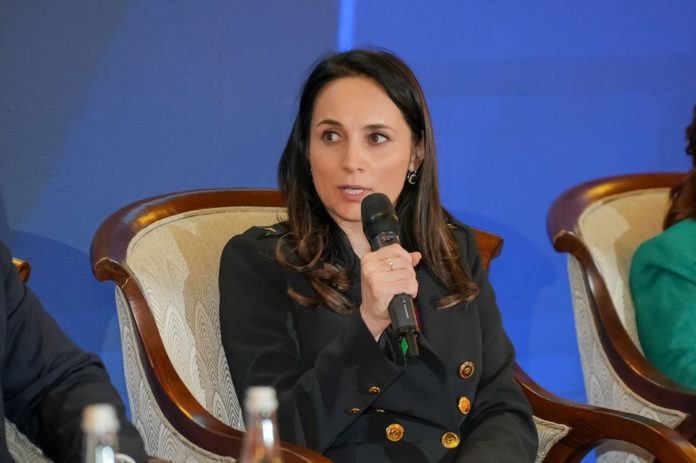
Parapet is shifting its focus beyond installed renewable energy capacity, aiming to evolve from a full EPC contractor into a strategic, long-term partner integrating renewable energy and energy infrastructure solutions across Europe, Roxana Gureanu, CEO of Parapet, said at the annual conference organized by InvesTenergy.
“The next step for Parapet is less about the number of megawatts installed and more about moving from a business model in which we are currently seen as a full EPC contractor to becoming an integrator of all renewable energy solutions and a strategic long-term partner for the delivery of energy infrastructure projects at European level,” Gureanu said.
At the beginning of 2026, Parapet announced a portfolio of signed contracts totaling 1 GW. According to Gureanu, all these projects have now entered the execution phase, while the company has significantly expanded its presence in the energy storage segment.
“If at the beginning of 2026 we announced a portfolio of signed contracts totaling 1 GW, we now have all these projects under execution. I am also very pleased to announce that we have 514 MW of storage projects, across three storage projects in three different counties in Romania, with coverage in Piatra Neamț and Sibiu,” she said.
Gureanu emphasized the strategic importance of energy storage in integrating renewable generation and improving the availability of electricity.
“Storage is extremely important because it allows us to use the energy produced by photovoltaic and wind systems during the day in the evening, also helping to improve availability and reduce electricity costs for the end consumer,” the Parapet CEO said.
Parapet is continuing to consolidate its position across its three core markets — Romania, Germany and Italy — while expanding its range of services and project capabilities.
“We are continuing to consolidate our position across all three markets where we are present: Romania, Germany and Italy,” Gureanu said.
In Germany, the company has recently added two photovoltaic projects to its portfolio, with capacities of 20 MW and 25 MW, respectively.
“In Germany, we recently added two photovoltaic projects to our portfolio, one of 20 MW and another of 25 MW,” Gureanu said.
In Italy, Parapet has expanded into full turnkey EPC projects, including grid connection.
“In Italy, we have transitioned towards the full turnkey EPC segment, meaning that we deliver full EPC projects, including grid connection,” she said.
The company’s strategy is increasingly centered on integrating photovoltaic, wind and battery energy storage solutions, while strengthening its full EPC capabilities.
“From a strategic perspective, we are focusing heavily on integrating the three solutions — photovoltaic, wind and battery storage — as well as on the full EPC segment,” Gureanu said.
Technology and artificial intelligence are also becoming increasingly important areas of investment for the company.
“We continue to invest significantly in technology and in integrating AI, both at the level of our technical solutions and in developing the capabilities of our teams,” she said.
Parapet has developed an internal platform integrating planning and controlling functions across its operations in all three countries.
“We have an internal platform that integrates both planning and controlling, bringing together all of Parapet’s systems across the three countries and giving our stakeholders the ability to see the status of a project in real time,” Gureanu said.
According to the Parapet CEO, real-time visibility is particularly important in a sector where project execution and grid connection can be affected by complex external factors.
“This is extremely important because it provides predictability in the construction process and, especially, predictability regarding grid connection, at a time when geopolitical developments are having a significant impact on the entire industry and, in particular, on supply chains,” she said.