
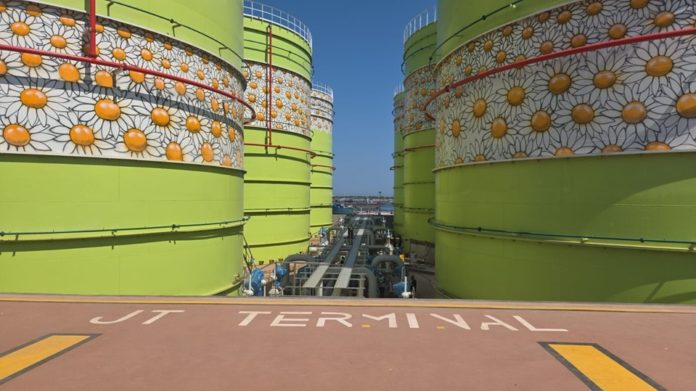
JT Grup Oil, a Romanian company active in the fuel distribution market, announces the completion of JT Terminal and moves towards an integrated business model that combines trading, logistics, storage, and distribution of oil products. The project, developed following an investment of approximately 30 million euros, is entering the operational phase and adds an annual operating capacity of up to 1 million metric tons of oil products to the market.
The completion of this investment comes at a time when supply security, diversification of logistics routes, and access to storage and distribution infrastructure have become central issues for the European energy market. Located in the Port of Constanta, with access to the Danube–Black Sea corridor and connecting maritime and fluvial flows to rail and road infrastructure, the JT Terminal offers a significant logistical advantage for Romania, the Republic of Moldova, Serbia, and Ukraine. The Terminal creates a new entry, storage, and distribution point for oil products and helps strengthen the Port of Constanța’s role in logistics flows to the Republic of Moldova, Serbia, and Ukraine.
Bogdan Aldea, Chairman of the Board of Directors and CEO of JT Grup Oil, adds: “The inauguration of the JT Terminal marks the successful completion of the most complex investment project carried out by JT Grup Oil to date. We began this investment based on a concrete market need—Romania requires additional capacity to import, store, and distribute larger volumes of oil products. Today, this infrastructure is in place, and the investment goes beyond the development of a new line of business for JT Grup Oil—the terminal introduces additional import, storage, and distribution capacity to the market and contributes to the diversification of the infrastructure through which Romania can secure its supply of oil products.”
Completion of the JT Terminal represents the foundation for the next phase of JT Grup Oil’s development, as the company continues its strategy of expanding logistics infrastructure by building a new bitumen terminal. In this way, the Group aims to expand its existing infrastructure and enter into a segment that will be complementary to its current activities.
At the same time, JT Grup Oil is working on the Dubova project, located at a strategic point at the entrance/exit of Romania. The project is currently under development and will have an operational capacity of 20,000 metric tons per month, complementing the Group’s logistics infrastructure and supporting cross-border flows of petroleum products.
JT Terminal comprises eight storage tanks with a total storage capacity of 31,500 metric tons and is designed to handle an annual volume of up to 1 million metric tons through stock rotation. The infrastructure allows the management of barges with capacities ranging from 3,000 to 9,000 metric tons, the simultaneous operation of 16 wagons on two parallel railway lines, and the handling of up to 100 tanker trucks per day.
JT Terminal’s loading and unloading capacity reaches 700–1,000 metric tons per hour for ships, 300–700 metric tons per hour for trains, and 250 metric tons per hour for tanker trucks. The terminal’s full automation enables the coordination of traffic flows from the control center and reduces operating times—a significant advantage in an industry where product turnover directly impacts logistics costs.