
- 66% of drivers say they feel safe in traffic – the highest value recorded historically to date, up 9 percentage points from the previous interval.
- The main risk perceptions are associated with speed, food consumption or using a phone while driving.
- Over 50% of drivers believe that no amount of alcohol is safe for consumption while driving.
- The study also reveals that 51% of drivers signal the presence of road controls by flashing lights, a gesture perceived as helpful, but which in reality poses a risk to traffic conduct and safety.
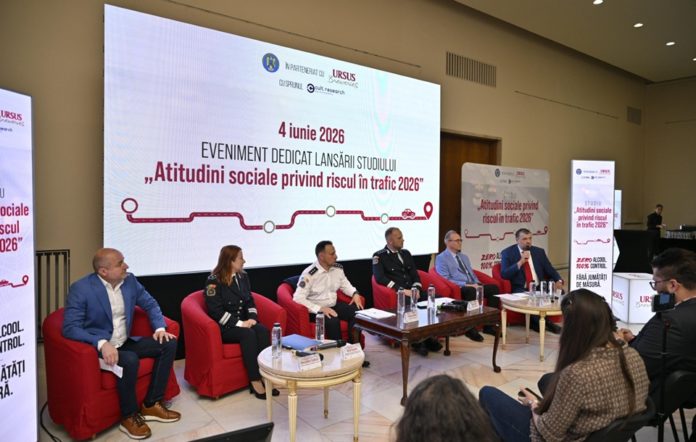
The Romanian Police and Ursus Breweries announce the results of the study “Social Attitudes towards Traffic Risk 2026” and the comparative analysis of the data collected and processed in the six stages of this study, between 2008 and 2026. The research approach analyzes the evolution of risk perceptions and behaviors in road traffic in Romania.
The sociological research was supported by Ursus Breweries and carried out by Cult Research, in partnership with the Romanian Police, through the Road Directorate and the Institute for Crime Research and Prevention. The study has been carried out every four years since 2008 and provides a comprehensive picture of how the perceptions and attitudes of traffic participants have changed, as well as the new risks that influence road safety.
Road safety perception at record high in Romania
Compared to the 2022 edition, the results indicate a positive evolution in the perception of road safety: compared to 57% in 2022, in 2026, 66% of drivers declare that they feel safe in traffic, this percentage being the highest level recorded to date in Romania.
The evolution is associated with the measures implemented in recent years by the Romanian Police and the introduction of the e-SIGUR system (Integrated Road Traffic Monitoring System), considered one of the main factors contributing to the increase in the perception of road safety. The results of the study support this perception: 94% of drivers support the installation of fixed cameras for traffic monitoring, and over 80% consider it necessary to enforce road legislation more firmly.
In parallel, the road safety education programs carried out by the Romanian Police, the use of crash simulators and the provision of traffic laboratories in counties have contributed to increasing awareness of traffic risks. At the same time, the modernization of infrastructure and the opening of new road segments have played an important role in strengthening this perception.
“Conducting this periodic study gives us a clear picture of the evolution of traffic behaviors and the efficiency of the implemented measures. The results confirm that interventions such as video monitoring and stricter controls contribute to increasing road safety, but also highlight the need to continue efforts to strengthen traffic discipline”, stated Radu Gâtan, Chief Police Commissioner, Deputy Director of the Road Directorate.
“Changing behavior is a long-term process, and improving perceptions of road safety is part of this process. We have undertaken to contribute to this change together with our institutional partners, both at the company and industry level. We are glad that the results of this study confirm that we are on the right track”, said Robert Uzună, Vice President of Corporate Affairs, Ursus Breweries.
Although the general perception of road safety is increasing, one in three drivers continues to feel unsafe in traffic, mainly citing the risky behavior of other participants, dangerous maneuvers and infrastructure problems.
The results of the study highlight the existence of a contradiction between the way drivers perceive road safety and their own actions in traffic. Although the majority declare that they comply with traffic rules for safety reasons, the practices of avoiding controls continue to be widespread and socially tolerated.
Inattention and speeding remain the main vulnerabilities in traffic
Compared to previous editions of the study, a reduction in some risky behaviors, such as speeding or aggressive behavior in traffic, is observed, an evolution associated with the intensification of controls and the use of mobile video monitoring systems. However, avoidance behaviors and justification of deviations continue to reflect a culture of tolerance towards certain risks in traffic.
At the same time, using the phone while driving, eating and inattention are becoming some of the most common behaviors
Responsible alcohol consumption is on the rise, but perceptions of risk persist
The data indicate a predominantly responsible orientation among drivers in relation to alcohol and driving: when they choose not to drink before getting behind the wheel, 9 out of 10 opt for non-alcoholic beverages, and in situations where they have consumed alcohol, 60% choose alternative transportation such as taxis or ridesharing services.
However, the study reveals that certain perceptions of risk persist. Although over half of Romanian drivers consider that no amount of alcohol is safe before driving, 23% consider the consumption of a beer safe, 19% that of a glass of wine, and 8% that of up to 40 ml of spirits.
At the same time, the study data confirms that there is openness for digital prevention tools: 22% of Romanian drivers have heard of the ZeroLaMie application, which allows users to find out the estimated time in which the blood alcohol level returns to 0‰. The application, developed by Ursus Breweries in partnership with the Romanian Traffic Police and the Institute of Forensic Medicine, is appreciated by 85% of respondents as useful or very useful. The ZeroLaMie application supports drivers to make responsible decisions before getting behind the wheel, providing information and recommendations on the risks of alcohol consumption and the importance of planning a safe transport alternative.
The “Good Samaritan” and the “flash” phenomenon remain widespread in traffic
The “flash” phenomenon remains one of the most common forms of warning among drivers, often perceived as a gesture of solidarity or “good Samaritan” in traffic. Thus, 51% of drivers say they signal the presence of road controls by flashing lights, and 22% use navigation applications, such as Waze, to avoid control areas. At the same time, 69% say they have been the target of flashing lights or honking horns, while 37% admit to using such behaviors.
However, only 32% consider these practices dangerous. The data indicate a tendency for road users to attribute risks to the behavior of others rather than their own actions: drivers support the importance of respecting the rules and road safety, but tolerate or adopt behaviors that can diminish the effectiveness of control and prevention measures.
The main data revealed by the study in brief:
- 66% of drivers say they feel safe in traffic, but 1 in 3 continue to feel unsafe, mainly citing the risky behaviors of other participants;
- 94% of Romanian drivers support the installation of fixed cameras for traffic monitoring;
- 31% of drivers say they talk on the phone without a hands-free system, and 12% access social networks while driving, thus phone use and inattention become some of the most frequent risk behaviors;
- Although over half of drivers believe that no amount of alcohol is safe, 23% consider it acceptable to consume a beer, and 19% a glass of wine, before driving;
- Almost a third of drivers declare themselves frequent victims of aggression in traffic, but only 12% recognize their own aggressive behaviors, which indicates a discrepancy between perceptions and behaviors;
- 51% of drivers signal the presence of road controls with flashing lights.
The full results of the study “Social attitudes regarding risk in traffic” are available on www.desprealcool.ro in the projects section for preventing alcohol consumption while driving.
Methodology
The study conducted by Cult Research is based on a comparative analysis of 6 surveys conducted nationwide since 2008, using the CATI method (telephone interviews), among driving license holders. In 2026, the research was conducted through a quantitative sociological survey, on a sample of 1,200 active drivers, between March 24 and April 10. The questionnaire used is an update of the research instrument developed in 2018, covering topics such as perceptions of traffic, speed, risk behaviors, wearing a seat belt, drinking and driving and aggression in traffic, as well as socio-demographic aspects and aspects related to driving experience. For the 2026 edition, certain results are reported to the entire sample of respondents, to facilitate public interpretation of the data and their comparability. In addition, the 2026 edition includes additional questions on the behavior of cyclists and scooter users, as well as the use of psychoactive substances while driving.