
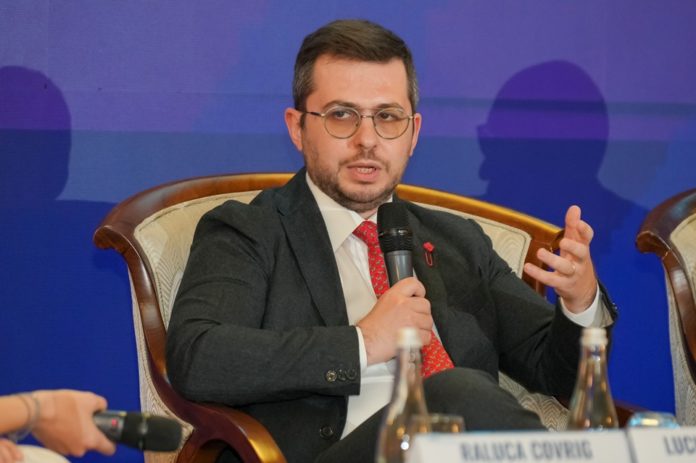
Geopolitical developments are increasingly shaping fiscal policies across Europe, particularly in the energy sector, as governments seek new revenue sources amid economic and security challenges, according to Lucian Dumitru, Partner, Tax, at Forvis Mazars in Romania.
Speaking at the Energy CEO Forum organized by The Diplomat-Bucharest, Dumitru said that energy and geopolitics have historically been closely linked because energy remains a fundamental strategic resource.
“When we talk about geopolitics and energy, it has always been about politics, state resources, how they are distributed, and ultimately who holds power,” Dumitru said. “What has changed since 2022 is the speed at which these transformations are taking place, alongside multiple other challenges. It is what I would call a perfect storm.”
According to Dumitru, a major turning point came after the outbreak of the war in Ukraine, when the European Union introduced mechanisms to tax excess profits generated by oil and gas companies amid the energy crisis.
“The significant influence on fiscal policies, especially within the European Union, began in earnest in 2022 following the start of the conflict in Ukraine,” he said. “Faced with the energy shock, the EU implemented a framework to impose additional taxation on the oil and gas industry, which has historically been one of the main beneficiaries of volatility in energy markets.”
He argued that ongoing instability in the Middle East is reinforcing a broader trend toward increased taxation by governments.
“We are now seeing another conflict layered on top of existing challenges in the Middle East,” Dumitru said. “In essence, this geopolitical environment is accelerating the tendency of states to introduce new taxes. Historically, once a tax is introduced, there is tremendous inertia and resistance when it comes to removing it.”
Dumitru also pointed to discussions at the European level regarding the potential taxation of extraordinary profits generated outside the EU by European oil and gas groups, describing such measures as an unprecedented development from a tax perspective.
“This would effectively amount to extraterritorial taxation, which from the perspective of tax professionals is an extraordinary development,” he said. “It also illustrates how fiscal policy can become an instrument of geopolitical influence when implemented uniformly across the European Union.”
Turning to Romania, Dumitru said the country’s fiscal framework for the energy sector is not necessarily more burdensome than those of other jurisdictions. However, he identified unpredictability as a major concern.
“In many respects, Romania has not been particularly different when it comes to the fiscal framework for the energy industry,” he said. “The real issue is the lack of predictability.”
He criticized what he described as a recurring pattern of pro-cyclical fiscal measures, citing recent tax increases affecting the energy industry.
“We have consistently found ourselves in a situation where fiscal policy has been pro-cyclical,” Dumitru said. “Last year we introduced measures such as additional turnover taxation for the oil and gas industry and the new solidarity contribution framework, which effectively represents progressive taxation for holders of oil agreements.”
According to Dumitru, fiscal instability remains one of the most frequent concerns raised by foreign investors.
“In discussions with foreign investors, particularly those from Western Europe, it is always difficult to explain why fiscal rules can change virtually overnight,” he said.
To improve investor confidence, he advocated a longer-term policy approach for strategic sectors such as energy.
“I would support the idea of a long-term vision, at least at a sectoral level,” Dumitru said. “For example, policymakers could adopt a political commitment stating that the current taxation system will remain unchanged for the next three years for this industry.”
He highlighted the scale of regulatory change in Romania, noting that businesses must navigate a large volume of legislative amendments each year.
“In the fiscal sphere alone, we can see dozens or even hundreds of changes,” he said. “In 2024, there were close to 200 amendments to the Fiscal Code and related tax legislation. In addition, there were more than 110 orders issued by the energy regulator, reflecting the volume of secondary legislation.”
Despite Romania’s opportunities in the energy sector, Dumitru suggested that the country has often struggled to fully capitalize on its potential.
“I believe Romania has always had opportunities, and it continues to have them,” he said. “But we have never quite managed to put the ball in the net.”