
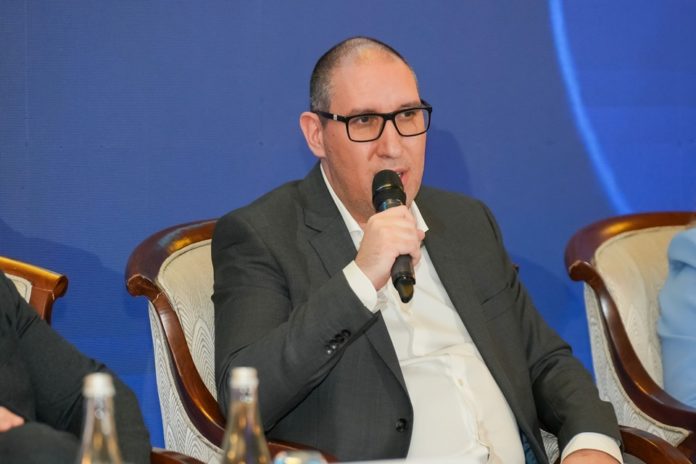
Hidroelectrica is pursuing a record investment program and expanding into energy storage and hybrid renewable projects as part of its long-term strategy to support Romania’s energy security and energy transition, according to Radu Constantin, Chief Administrative Officer of Hidroelectrica.
Speaking at the Energy CEO Forum organized by The Diplomat-Bucharest, Constantin emphasized the importance of cooperation between policymakers and market participants in shaping Romania’s energy future.
“Without this connection between those who make policies in Romania and market participants, we cannot achieve the energy transition or develop a clear vision of how to move toward energy security,” Constantin said.
He noted that the ultimate beneficiary of energy-sector decisions is the consumer, who should have access to reliable, increasingly green energy with greater predictability in pricing and other key market factors.
Constantin said Hidroelectrica has adopted an ambitious management plan aimed at delivering stability to Romania’s National Energy System.
“At Hidroelectrica, we have committed ourselves to a particularly ambitious management plan, with the ultimate goal of providing the National Energy System with the stability that leads to energy security,” he said.
The executive highlighted the company’s record investment budget of RON 1.5 billion for 2026, describing it as the largest annual investment program in Hidroelectrica’s history.
“This is a record for the company,” Constantin said. “It comes after we signed contracts worth more than RON 3 billion over the past three years for major refurbishment projects. These investments will provide new life cycles of 20 to 30 years for Romania’s hydroelectric units operated by Hidroelectrica.”
While acknowledging the challenges facing large-scale energy projects, Constantin stressed that investment remains the industry’s top priority.
“Risks exist at every step, but if you have an exact and measurable structure for assessing those risks, you can move forward and make these investments,” he said. “Today, investment is the key word in the energy sector. This is what all market participants want.”
Radu Constantin pointed to delays affecting strategic projects, including legal challenges brought by environmental organizations.
“Some of these objectives have been discussed within Romania’s Supreme Council of National Defence (CSAT),” he said. “When strategic investment projects for ensuring Romania’s energy security are being discussed at that level, one naturally asks what role these blockages should still play.”
Looking ahead, Constantin said Hidroelectrica is focusing on hybrid renewable generation and energy storage as part of its management plan for 2023–2027 and beyond.
“We are making plans that will impact the energy market and shape how Hidroelectrica develops its business over the next 20 to 30 years,” he said.
The company is already developing two storage projects, including battery storage systems linked to the Crucea wind farm and the Portile de Fier 2 hydropower plant.
“We will invest in storage as well,” Constantin said. “We already have two projects under development: storage at the Crucea wind farm and a battery storage project at Portile de Fier 2. We are bringing storage solutions to all hydropower plants where this type of hybridization can ensure greater stability and optimize the use of hydropower resources.”