
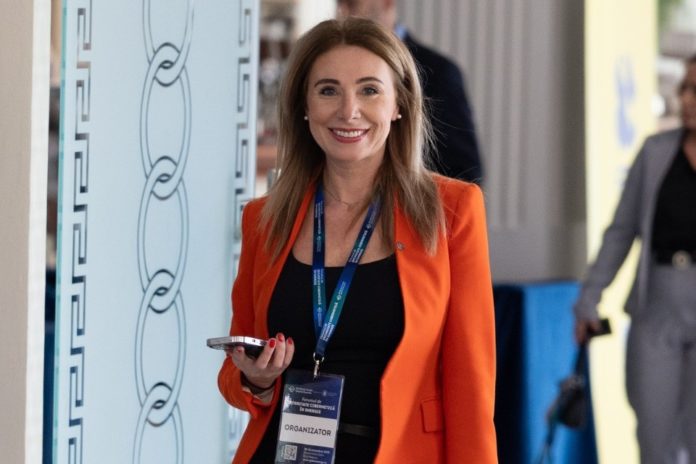
The Architects of Perception and Trust | Editorial Series by The Diplomat-Bucharest
“The winning strategies in 2026 will be those built on a consistent commitment to information and public education — accessible, clear, and relevant across all stakeholder segments. This is, in fact, a principle we apply systematically at DEER. We maintain ongoing, structured communications with our grid users, institutional partners, media, and our people — covering our grid modernisation and development investment programme, our financial and operational performance, the projects transforming energy infrastructure across the 18 counties we serve, and the people, vision, and values that define the organisation,” Loredana Tiu, Head of Communications/ Spokesperson, Distributie Energie Electrica Romania (DEER) told The Diplomat-Bucharest.
“The brands that will capture audience attention in 2026 will be those perceived not merely as service providers, but as informed, transparent, and engaged partners — brands that explain, attract, and captivate, rather than simply announce.”
How would you describe the most significant shifts in brand communications over recent years?
Brand communication has undergone a profound transformation, and the most visible marker of that shift is speed. We live in a world where a message can reach millions of people simultaneously within seconds — and be dismantled or amplified with equal velocity. This reality has fundamentally reshaped the way we conceive and execute communications strategy. Having a well-structured framework is no longer sufficient if you are not simultaneously capable of adapting it, anticipating disruption before it overtakes you, and building teams and operational mechanisms resilient enough to withstand the unpredictable. Agility has become a baseline requirement, not a competitive differentiator.
Another defining characteristic of recent years is the demand for genuine authenticity — not a simulated version of it. Audiences have become acutely sensitive to artificially constructed messaging. People no longer want to engage with perfect brands — they want honest ones: brands with real people behind them, with values reflected in concrete action rather than proclaimed through slogans.
In the energy sector, this evolution has been particularly compelling, as we operate in a highly technical and heavily regulated environment, with a specialized professional language that does not always translate easily to a general audience. We had to find the right balance between the rigour of corporate communication and the need to be clear, relevant, and close to people. This meant turning technical complexity into accessible, easy-to-understand messages – sometimes even into genuine emotional resonance. It has been, and continues to be, one of the most intellectually rewarding challenges of my professional journey.
What do you believe will define successful brand communications strategies in 2026?
I believe the winning strategies in 2026 will be those built on a consistent commitment to information and public education — accessible, clear, and relevant across all stakeholder segments. This is, in fact, a principle we apply systematically at DEER. We maintain ongoing, structured communications with our grid users, institutional partners, media, and our people — covering our grid modernisation and development investment programme, our financial and operational performance, the projects transforming energy infrastructure across the 18 counties we serve, and the people, vision, and values that define the organisation.
But we also communicate on broader public interest topics: the risks associated with electricity theft, the strategic advantages of smart metering, what the energy transition actually means in practice, and the specific mandate of a distribution system operator. These are technical subjects — but when explained in plain language and grounded in real-world examples, they become genuinely compelling. The brands that will capture audience attention in 2026 will be those perceived not merely as service providers, but as informed, transparent, and engaged partners — brands that explain, attract, and captivate, rather than simply announce.
In your view, how has consumer trust in brands evolved recently?
Trust has become simultaneously the most fragile and the most valuable asset in any brand’s equity portfolio. Where it was once built through sustained, positive communications, today it is stress-tested at every touchpoint — through every customer interaction, every crisis response, every gap between what a brand declares and what it actually delivers.
In the energy sector, this dynamic carries a distinctive dimension. As a distribution system operator, we play an essential role in society — but one that is largely invisible to the general public. The network infrastructure, the stations, the field interventions — by their very nature, they go unnoticed when everything is functioning as it should. At DEER, we have consistently invested in transparent communications precisely to make visible what happens behind the socket: the capital investments, the people, the operational decisions. It has been, and remains, a long-term endeavour — but one that is fundamental to building a relationship grounded in genuine understanding and authentic trust.
What are the three most important priorities for brand communications teams in 2026?
The first is coherence — between message and reality, between internal communications and external positioning, between declared values and organisational behaviour. Incoherence is immediately detected and erodes credibility that takes significant effort to build. Audiences — whether customers, journalists, or institutional stakeholders — identify contradictions faster than ever before.
The second priority is adaptability. The communications landscape is evolving at a pace we can no longer afford to underestimate — new formats, new platforms, new audience expectations. A high-performing communications team must be capable of transitioning seamlessly from a formal press release to an authentic field video, from a management briefing to an educational campaign for children. This flexibility is not about losing your voice — it is about knowing how to calibrate it without diluting it.
The third priority — and perhaps the most critical in my view — is the full strategic alignment of the communications function with the organisation’s overarching business strategy. Communications cannot operate in parallel to the company’s direction; it must be its direct expression, its authentic voice. When these two dimensions are perfectly synchronised, messaging acquires force, consistency, and genuine credibility.
How should communications teams demonstrate their strategic value to senior leadership?
Through genuine collaboration, measurable outcomes, and accountability. I believe the most powerful asset of an effective communications department is not the creativity it generates or the visibility it achieves — it is its capacity to simultaneously serve as the voice of management and the connective tissue between leadership and all key stakeholders.
Internally, communications translates the executive vision into messages that employees understand, internalise, and adopt. Externally, it gives coherent form to the organisation’s strategic direction vis-à-vis customers, institutions, partners, and the press. Without this dual function, communications remains an execution unit. With it, it becomes a genuine strategic partner.
I can speak to this from direct experience. I joined the company immediately following the merger of three distribution subsidiaries — Transilvania Nord, Transilvania Sud, and Muntenia Nord — which, on 1 January 2021, gave rise to the largest national electricity distribution operator in Romania. It was a moment of exceptional complexity: 6,500 employees with distinct organisational identities, three separate corporate cultures, differentiated procedures and working methodologies — all of this overlaid on the Covid-19 pandemic, the energy crisis triggered by the conflict in Ukraine, and the consequent cash flow pressures.
In that context, communications was not a reputation management instrument — it was a strategic tool: the internal mirror of management and the external shield of the organisation.
Working closely with the leadership team, we built — step by step — an integrated internal and external communications strategy to support the organisational transformation. Messages such as “DEERteam”, “the largest national distribution operator”, and “ambitious investment in grid development, modernisation, and digitalisation” were not slogans — they were, and remain, strategic commitments: communicated, assumed, and delivered upon.
Today, when I see colleagues from all 18 counties speaking with genuine pride about the company they work for — or singing the DEER anthem, sometimes visibly moved — I know that strategy delivered results.
And if I were to identify one essential ingredient behind that success, it would be collaboration — real, day-to-day collaboration with the management team. Not formal alignment, but authentic consultation, active presence at all key decision-making moments, and open dialogue. Effective communications is not built in isolation — it is built in proximity to the decision. I have had, and continue to have, the privilege of working with a management team that understands this, and that treats the communications function as a strategic partner rather than an operational executor.
Which communications channels are currently the most effective for building brand equity?
There is no universal answer, because channel effectiveness depends on the target audience and the nature of the message. What I can say from my own experience is that for a brand operating in the energy sector, the combination of social media and proximity communications — the kind that showcases the real people behind the organisation — has consistently delivered the strongest results.
I saw this in concrete terms: an authentic post featuring real images of our colleagues carrying out emergency interventions under extreme conditions in the Apuseni Mountains in January 2026 reached nearly 300,000 views and generated thousands of online engagements, as well as significant mainstream media pickup. No press release, however well-crafted, would have produced the same impact. That moment demonstrated that authentic emotion and tangible proof of action are, at times, the most powerful instruments in brand communications.
What initially drew you to a career in communications?
The truth is that I always knew whatever I did professionally would involve the power of language. It was not a revelation at any particular moment — it was a certainty that grew alongside me. I have been fascinated by communications in all its forms, from the most straightforward to the most sophisticated. It is a field of extraordinary breadth, with a profound impact across every dimension of our lives — personal, professional, and social. Once you truly understand it, I don’t believe you can remain indifferent to it.
My academic studies in communications confirmed and structured that passion, and my early years in integrated communications and advertising agencies added a dimension I had not fully anticipated: I came to understand that beyond creativity and aesthetics, communications done well is, fundamentally, a matter of strategy. That every message has a purpose, an audience, a context, and a responsibility. Results in communications do not depend solely on strategy and tools — passion and the way you communicate matter enormously. You can have all the resources in the world, but if you don’t feel what you are transmitting, and if you don’t know how to reach your audience — speaking to their specific needs, at the right moment — the message is lost.
That belief has accompanied me throughout more than 15 years of professional practice, and it continues to guide me today.
What is the single most important lesson you have learned working in communications?
There are several formative moments I could draw on, but if I were to distil it to one lesson, it would be this: things that appear to be going wrong almost always have a logic that only becomes clear in retrospect. I have experienced moments when a project I believed in wholeheartedly came to a standstill, when a carefully designed plan had to be abandoned, when a decision I had not anticipated redirected my professional trajectory. In each instance, looking back, I realised that the “no” or the “otherwise” had opened a door better than the one I had been pursuing.
The second lesson — closely connected to the first — is that with the right people alongside you, you can navigate any situation, however complex. Crisis communications, organisational transformation, institutional uncertainty — all become manageable when you have a team in which you place genuine trust, and which places genuine trust in you. I have also learned that there must always be a contingency plan. The unexpected can materialise at any moment, and a prepared, cohesive team is one that is never caught without a solution.
What keeps you motivated and inspired in your day-to-day work?
I am a high-energy person, and I have a sense of enthusiasm that I hope I never lose. When I believe in an idea, I commit to it fully — with energy, creativity, time, and genuine conviction. My colleagues sometimes encourage me to pace myself, because there are periods when I want to do everything at once. I will readily admit that what I think through at night, I want to implement by morning.
But the most honest answer to this question is a very simple one: every morning, when I switch on a light or make coffee, I know it is possible because of my colleagues. And I feel fortunate that my professional role allows me to communicate about energy — this remarkable resource that my colleagues deliver to every corner of our lives.
I am also inspired by impact — by results. By seeing colleagues from all 18 counties speak with pride about the team they belong to, about DEER. By seeing the faces of children at presentations within our educational project, Micul Energetician — one of the initiatives closest to my heart — which has so far engaged over 10,000 primary school students, introducing them to the world of energy. By knowing that our work contributes to the development of communities, and that behind every light that comes on — in more than four million homes — it is us, the DEER team.
And there is something else that gives my work deeper meaning: the awareness that everything we are building today is for a better future. For our children and grandchildren. Every investment in the electric grid, every modernisation project, every decision we communicate transparently contributes to the construction of a robust, future-ready energy infrastructure — one adapted to current demands and prepared for a secure and sustainable energy future.
All of this — and much more — gives me purpose every morning.
If you could change one thing about today’s communications landscape, what would it be?
I would address the impersonality that has gradually settled into contemporary communications. I am not referring specifically to the energy sector — where, given the regulated nature of the industry, an objective and precise tone is often both necessary and appropriate. I am speaking about communications more broadly, about a kind of standardisation that makes messages sound virtually identical regardless of brand, industry, or moment.
Artificial intelligence has democratised access to technically sound, aesthetically refined, and near-perfect content — but it has also contributed to the erosion of distinctive voices. I believe it is the responsibility of every communications professional to preserve authenticity, to insist on that unique signature that no technology can genuinely replicate. Sincere communications — that conveys real emotion and truth — will always reach its intended audience, regardless of the ambient noise.
Three defining concepts for brand perception and trust in 2026:
Transparency. Authenticity. Evolution.