
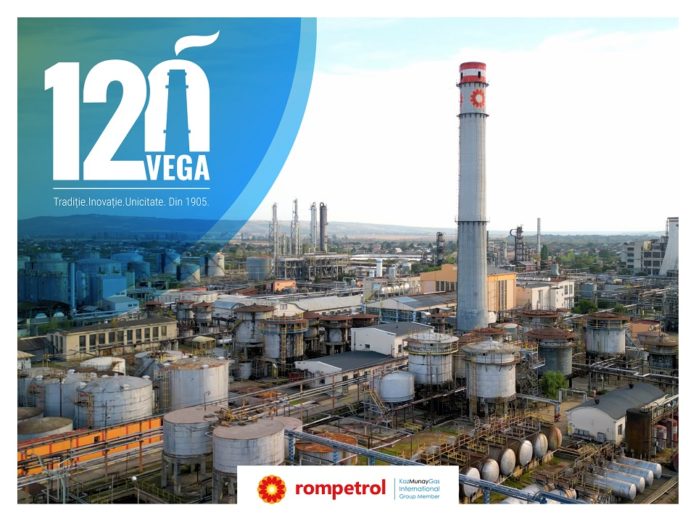
Vega Refinery, the longest-operating processing unit in Romania, celebrates this year 120 years of continuous existence and activity in the oil industry. Founded in March 1905, “Vega” – The Romanian Joint Stock Company for Oil Refining – counted among its founding members notable figures such as Titu Maiorescu, a prominent Romanian personality of the time; Dumitru Nenițescu, former director of the National Bank of Romania and father of Costin Nenițescu, the father of Romanian organic chemistry; and Otto Petersen, director of the General Bank of Romania. Another emblematic figure, Grigore Antipa, then general inspector of the fisheries services, served as one of the auditors.

The board of directors decided to build a refinery on a 40-hectare plot in the northern part of Ploiesti. Strategically located on the outskirts of the city but near a railway line connecting Ploiesti to Valenii de Munte, the site allowed for future expansion. Its proximity to the railway enabled the rapid transport of Vega’s products to the port of Constanța and, from there, to buyers worldwide.
Construction began shortly thereafter, and by November, Vega Refinery—with an initial processing capacity of 200,000 tons of crude oil per year—started technological trials using crude oil delivered by ox-drawn carts. On February 13/26, 1906, the first petroleum products left the refinery gates.
In 1908, the renowned chemist Lazăr Edeleanu joined the Vega team and developed the process that still bears his name and is used to produce gasoline. His method of refining kerosene with sulfur dioxide to obtain motor fuel was first implemented in Ploiesti laboratories and later adopted by refineries worldwide.
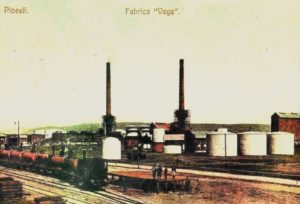
Traces of history on the anti-aircraft walls
By 1919, Vega ranked second in production capacity among 46 refineries in Romania. During World War II, the refinery was damaged by bombings and required major reconstruction. Preserved in the refinery’s courtyard are the anti-aircraft defence walls built around the installations and tanks, still bearing shrapnel marks as witnesses of history.
During the communist era, Vega operated in an integrated system with all the country’s refineries, reaching a processing peak between 1972 and 1980, when it handled just over one million tons of raw materials—over 95% of which was crude oil. However, during the same period, the refinery was nearly turned into a park, saved only by the ingenuity of its employees.
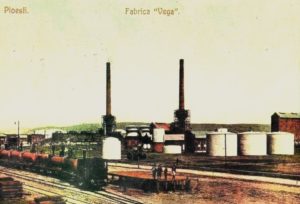
After the fall of communism in 1990, the Ploiești unit was on the brink of collapse, but was rescued by Rompetrol’s acquisition in 1999. The 2000s brought massive investments, leading to the development of new installations for dearomatized products and polymer-modified bitumen.
A new wave of modernization began in 2007 under new ownership (KazMunayGas). The hexane, bitumen, and vacuum distillation units were upgraded, and in 2018, the refinery surpassed 400,000 tons of processed raw materials for the first time since 1989.
Built at a time when oil refining was a global novelty, Vega Ploiești stands as a model of resilience, maintaining its uniqueness from its founding to the present day. If Lazăr Edeleanu paved the way for high-quality petroleum products, 117 years later, Vega Ploiești continues to stand out as Romania’s sole producer of bitumen and hexane, gaining recognition at the European level. Considering all this, it’s fair to say that this small refinery is a valid symbol of adaptability and professionalism.
Romania’s only producer of bitumen and hexane
Over its 120 years of activity, Vega has processed more than 42 million tons of raw materials. With a tumultuous history, Vega is now an atypical refinery—it no longer refines crude oil or produces fuels. Instead, it has evolved into a producer and supplier of specialty products made exclusively from semi-finished materials delivered by Petromidia – Năvodari. The two units operate in perfect synergy.
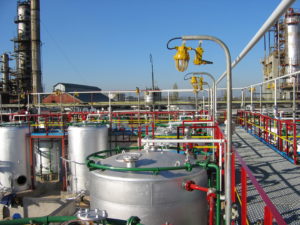
Vega Refinery is currently operated by Rompetrol Rafinare, which also manages Petromidia Năvodari, Romania’s largest refinery. Rompetrol Rafinare’s major shareholders are KMG International (54.63% – direct and indirect) and the Romanian State, through the Ministry of Energy (44.7%).
The two refineries operate in an integrated system to achieve technological performance and improve the quality of petroleum products. Since 2004, Petromidia has fully supplied Vega with the raw/semi-finished materials needed to produce high-value-added specialty products. Since then, Vega has focused solely on niche production—eco-solvents, specialty bitumen, eco-friendly heating fuels, and other dedicated products such as white spirit and n-hexane.
These results have been supported by over $45 million in investments over the past 15 years, aimed at expanding capacity and modernizing installations.
Bitumen producer since 1930
Vega Ploiesti is currently Romania’s only bitumen producer. Its polymer-modified bitumen stands out for its high resistance to wear and temperature variations, increased elasticity, and 50% longer lifespan compared to other bitumen types. Additionally, roads paved with this bitumen produce less noise from vehicle traffic. All production is directed to the domestic market, with Vega supplying about 20% of Romania’s bitumen needs. The remaining 80% is imported from countries such as Turkey, Italy, and Austria.
Vega has been producing bitumen for Romanian roads since 1930, with an initial capacity of 2,000–2,200 tons/month. In the past 19 years, it has created around 2.3 million tons of bitumen, with a record output of 122,629 tons in 2020.
Hexane that powers all oil factories in Romania
Hexane production is another area where Vega excels. It is the only producer of this solvent in Romania and the largest in Southeastern Europe, among the top producers in Europe.
Hexane is used in the food industry (for oil production) and in the pharmaceutical industry. All oil factories in Romania use hexane from Vega, which fully covers national demand, with surplus exported abroad.
The solvent is produced in Romania’s only such facility—the Normal-Hexane Unit—by distilling refined products delivered from Petromidia.
Between 2005 and 2024, the unit produced over 1.1 million tons of hexane, with a record of 91,866 tons in 2019, thanks to increased output at Petromidia, which supplied more raw materials to Vega.
Vega also produces eco-friendly solvents. The highest output was in 2018—43,530 tons—and nearly 600,000 tons have been produced over the past 19 years. Total solvent production between 2005 and 2024 exceeds 3.8 million tons, with a peak of 272,185 tons in 2019.