
Three in four Romanians (76%) say the energy transition is urgent for their country (EU: 75%). Asked what they expect the energy transition to bring, with several possible answers, 79% mention steadier or lower prices, 75% less dependence on imported oil and gas and 67% slower climate change. In every Member State, a majority expect it to slow climate change, from 58% in Estonia to 87% in Hungary. That is one of the key findings of the eighth Climate Survey, published today by the European Investment Bank (EIB).
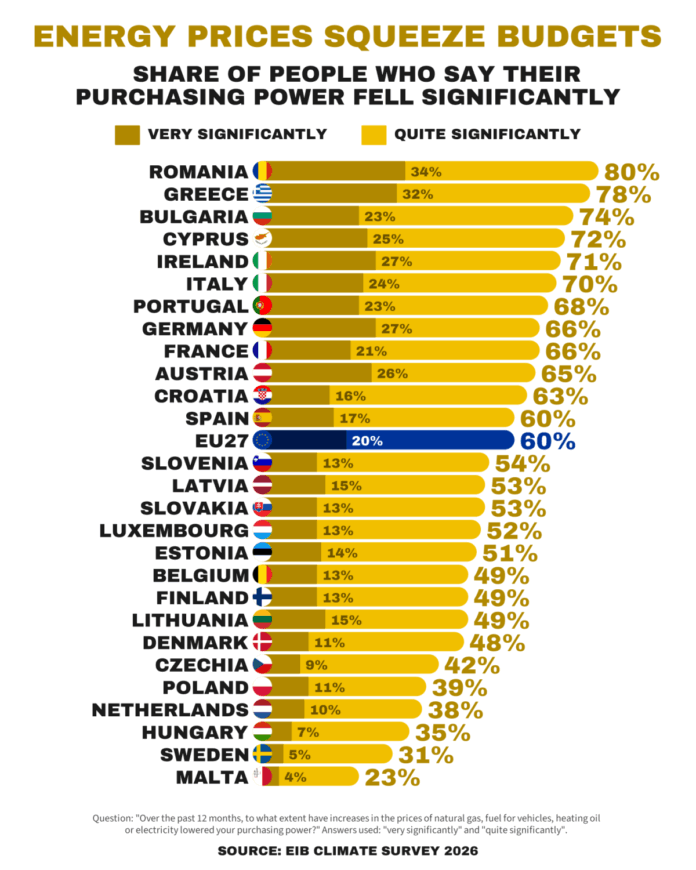
Conducted by Ipsos bva among 23 000 people across all 27 EU Member States, the survey comes as rising energy prices have significantly cut the purchasing power of eight in ten Romanians. All three expected benefits of the energy transition are cited by a majority, but their ranking has changed since 2022. Four years ago, slowing climate change was the most-cited benefit in Romania and in 18 other Member States, reducing imported oil and gas in eight and steadier or lower prices in none. Today, steadier or lower prices come first in Romania and in seven other Member States, reduced dependence in 16 and climate in three.
“Romanian households have felt the impact of rising energy prices on their purchasing power more acutely than any others in Europe,” said EIB Vice-President Ioannis Tsakiris. “Strengthening security of supply and producing more clean energy at home can help deliver more reliable and affordable energy for Romanian families.”
Asked what would happen if the EU moved too slowly on its energy transition, Romanians put their bills first: 80% see a long-term rise in energy prices and the cost of living as a risk (EU: 79%), ahead of the 74% who mention greater dependence on imported oil and gas. The upside is pride: two in three Romanians (66%) say they would feel prouder to be European if the EU became energy-independent (EU: 62%).
Why prices matter
Rising prices for gas, vehicle fuel, heating oil or electricity have “significantly” reduced the purchasing power of eight in ten Romanians (80%) over the past 12 months (EU: 60%), the highest share in the EU, including 34% who report a “very significant” impact (EU: 20%), the highest share in the EU.
To make ends meet as prices rose, 55% say they have cut everyday spending on food or health (EU: 38%), the highest share in the EU, while 27% have turned down the heating. For some, rising energy prices went beyond cutting back: 27% say they went into debt, asked for financial help or delayed paying an energy bill (EU: 16%), one of the highest shares in the EU.
On the road, seven in ten Romanians (71%; EU: 60%) say rising prices have changed how they use their car, one of the highest shares in the EU: 29% have cut journeys for basic needs such as shopping, medical appointments or administrative errands; 47% have given up a weekend away, a holiday or a visit to family and friends (EU: 30%), the highest share in the EU; 19% now drive more slowly to save fuel; and 32% have replaced individual car journeys with carpooling, public transport or cycling (EU: 22%), one of the highest shares in the EU.
Made in Europe
To make the transition happen, 79% of Romanians want low-carbon energy prioritised (EU: 87%). Solar comes first (46%), ahead of wind energy (26%), while natural gas (24%; EU: 10%) gets one of the highest shares in the EU.
Asked which approach the EU should prioritise for its energy transition, 55% of Romanians would rather build a competitive European clean-technology industry, even if that takes longer (EU: 55%); 34% would roll out clean technologies faster, using imported equipment (EU: 29%). Building in Europe is the preferred approach in all 27 Member States.
A majority of Romanians (54%) would rather see EU countries pool their resources to finance the investments. In all 27 Member States, Europeans prefer to pool resources.