
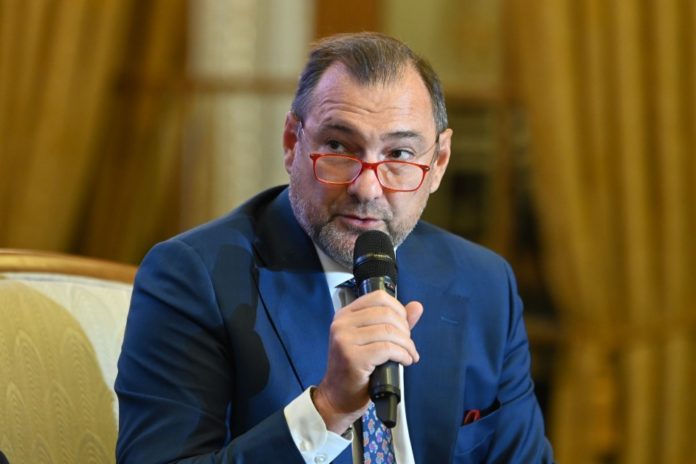
Romania’s domestic natural gas production should represent a major political asset for the country in discussions at European level, Daniel Apostol, Director General of the Energy Employers’ Federation (FPE), said at the Eurogas Annual Regional Conference.
“National natural gas production should be a major political capital for the Romanian state in all discussions in Brussels,” Apostol said.
He argued that the European regulatory framework needs to be adjusted to ensure that it does not become an obstacle to the development of European industry and the energy sector.
“The European regulatory framework needs to be modified so that it does not become a barrier to the development of European industry and the energy sector. We have an objective here: the competitiveness of European industry in line with the development of the energy sector,” Apostol said.
According to Apostol, Romania and the Black Sea region should no longer be viewed as Europe’s periphery, but as an increasingly important hub for strategic energy corridors.
“I believe we can look at Romania and the Black Sea region not as what they have been until now, namely a border of Europe. The Black Sea has suddenly become a center, if you will, of strategic energy corridors,” he said.
“Romania is becoming an important point in these energy corridors. In practical terms, Romania is building an anchor of flexibility and an anchor of energy security,” Apostol added.
He said Romania could also play a stabilizing role in a region facing significant geopolitical and geoeconomic uncertainty.
“An anchor of balance in a region that we see being subjected to unprecedented upheavals and in a geopolitical and geoeconomic context that is at least concerning,” Apostol said.
Romania’s position within the European energy system has changed, according to Apostol, who argued that the country is no longer simply an energy consumer or an isolated market.
“Romania is no longer just an energy consumer. But it is no longer an isolated player either. It is part of these European energy corridors,” he said.
Apostol said Romania’s shift from the periphery towards the center of strategic energy corridors has been supported by investments and diversification efforts undertaken by energy companies.
“I believe we should understand that this repositioning within the European paradigm, from the periphery towards the center of strategic corridors, is taking place because of the considerable efforts made by energy production companies to diversify, to choose new technological solutions and to develop major investment projects,” he said.
He also highlighted the importance of reducing Europe’s dependence on energy imports, which he described as a source of vulnerability for the European energy sector.
“These companies are working to eliminate the import dependencies that have created vulnerabilities in the European energy sector until now,” Apostol said.
Apostol also cautioned against expectations that European competitiveness could be restored in the short term simply through lower energy prices.
“If Europe promises a return of European competitiveness in the short term, based on low energy prices, attention, that will be a false political promise,” he said.
“We need to look very realistically at what is happening in Europe and what is happening around it,” Apostol added.
He stressed that the transition towards lower-emission technologies and greener energy resources requires significant investment from companies, which must also assess the economic viability of such projects.
“Investments in new technologies, aimed at reducing emissions and adopting green resources, require very significant efforts from companies. And companies have a duty to assess whether these potential projects have an economic foundation,” he said.
At the same time, Apostol said European institutions have a responsibility to ensure that the regulatory framework does not create unnecessary barriers to investment.
“Europe has a duty to assess whether the framework it is building for these companies is free of barriers,” he said.
According to Apostol, a closer partnership between national governments, European institutions and the authorities of EU member states is needed to support the energy sector.
“What we need, and what I believe is still missing, is an honest, fair and real partnership between the authorities. And when I say authorities, I am not referring only to the authorities in Bucharest, but also to those in Brussels, and, in general, between all the authorities of the EU member states,” he said.
“What we need is integrated European support. That is what I believe we need. And, why not, I repeat what I have said before: the removal of regulatory barriers,” Apostol concluded.