
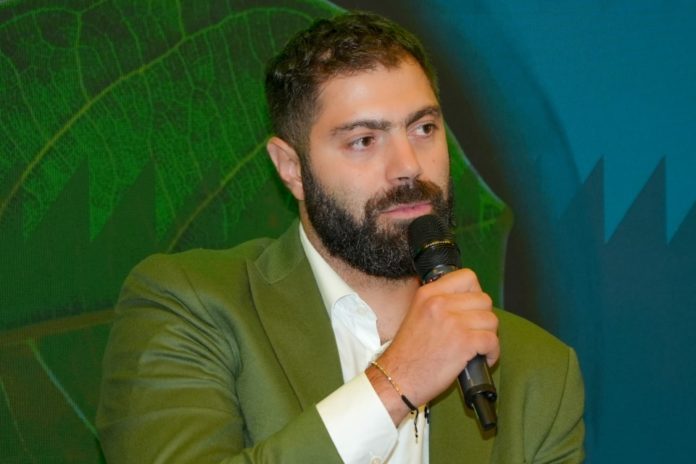
Battery storage has become an important part of PPC Renewables Romania’s investment strategy, with the company pursuing both co-located storage for operational renewable projects and standalone battery systems designed to better match electricity supply with customers’ consumption profiles, Adrian Dugulan, Managing Director of PPC Renewables Romania, said at the Green Energy Conference, organized by The Diplomat-Bucharest.
“Batteries have an important role in our strategy. Over time, we have tried to maintain flexibility in our investment plan. At one point, we even tried to find a balance between investments, for example, in photovoltaic plants and batteries, to maintain as sustainable a mix as possible,” Dugulan said.
He said the objective is ultimately to build a sustainable portfolio capable of serving customers with different electricity consumption profiles.
“What we are aiming for with these investments is precisely the sustainability of the portfolio, keeping in mind that ultimately we reach a final customer, whether industrial or residential, with different needs, each having their own expectations from this energy product, which has become an essential need for all of us,” he said.
According to Dugulan, battery storage can help reduce some of the risks associated with renewable generation and potentially contribute to lower prices for consumers.
“Investments in storage systems come to reduce that risk component and can lead to lower prices. Indeed, the production cost of renewable energy is the lowest cost. The problem is that the production cost is not what reaches the final customer, but many other things that we add on top and that we also have to manage,” Dugulan said.
PPC Renewables Romania is pursuing two main approaches to battery storage.
“In batteries, we see two essential roles. We have already started investments in co-located batteries, hybridization for operational plants, where we want to reduce this risk component related to balancing,” Dugulan said. “At the same time, we have standalone battery projects that can help us provide customers with a product that follows their consumption curve much more closely,” he added.
Dugulan said the rapid pace of technological development in battery storage is creating a challenge for renewable projects that can take several years to develop.
He compared the evolution of battery technology with the early development of photovoltaic systems in Romania.
“As we saw at the beginning of renewable energy development in Romania, what is happening with storage systems is like what happened with photovoltaic panels. Every three or four months, you have a new type of battery, more efficient, but also with somewhat different characteristics,” he said.
This rapid evolution creates difficulties for projects that may spend two years in development and permitting.
“We need to find this flexibility so that we can install these systems on projects that take two years to develop, where restrictions from an authorization perspective might prevent us from moving to that new technology,” Dugulan said.
He called for greater technical and regulatory flexibility to ensure that developers can incorporate technological advances without having to redesign projects from the ground up.
“From a technical perspective, we need to be open and find solutions that allow us to accommodate this rapid wave of development in technical solutions. We need to make the integration of the storage system as simple as possible,” he said.
Dugulan also argued that the industry should move away from describing renewable and storage development as a temporary “wave,” suggesting that periods of rapid growth should ultimately be followed by consolidation rather than a halt in investment.
“Although we are trying not to use this notion of a wave anymore, because it always makes us think that it will end, we need to understand that there are certain periods when things are growing,” he said.
“What comes next is not necessarily a stop, but consolidation,” Dugulan added.
Over the next three to five years, he said, the industry will need to focus on how the growing renewable and storage capacity can be integrated and used to create value within Romania’s electricity system.
“Somewhere in three to five years, we need to understand how we want to consolidate these capacities in the national energy system, how we want to monetize them — and I am not referring strictly to money — and how we truly create value through these investments that are being made, first and foremost, for customers,” Dugulan said.