
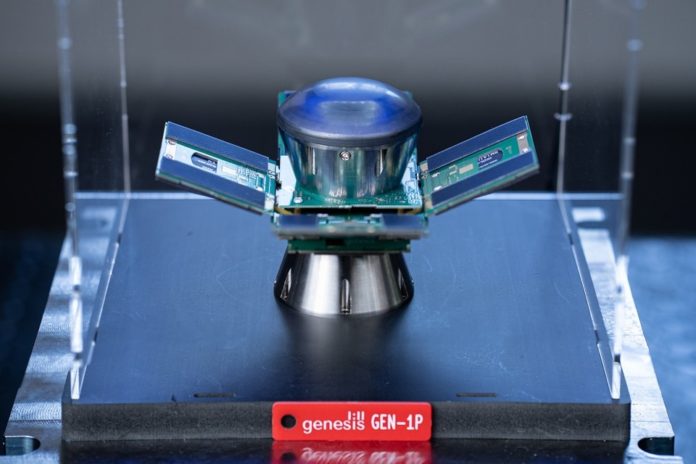
GapMinder, venture capital firm that invests in technology startups from Romania and Eastern Europe, is co-investing in a 1.2 million euros round in the Croatian startup Genesis Space Flight Laboratories alongside Fil Rouge Capital. The investment will support Genesis’ development of next-generation reusable space capsule technology, the launch of its first commercial missions, and the expansion of its mission operations as the company works to make microgravity research more accessible worldwide.
Founded in 2025 by microbiologist Bence Matyas, Genesis is building a reusable microgravity research infrastructure platform based on autonomous space capsules that allow research institutions, biotech companies, and commercial customers to conduct experiments in space and safely recover physical samples back on Earth.
The company is developing a new generation of free-flying orbital and suborbital research platforms designed to provide an alternative to traditional space station-based research. As the International Space Station (ISS), which has supported decades of scientific breakthroughs in microgravity, is planned to be retired by 2030, Genesis aims to create a more flexible, affordable, and scalable solution for the next era of space research.
The investment adds to GapMinder’s growing portfolio of technology and AI-driven companies, including Lasken AI, Codeplain, InsiderCX, Design Verse, SalesTools, VoicePatrol, and Etiq AI.
“Space is entering a new phase, where access to research capabilities beyond Earth will no longer be limited to a small number of organizations. Genesis is addressing a fundamental challenge: how to make microgravity research more accessible, repeatable, and commercially viable. We believe their technology has the potential to become important infrastructure for the future space economy, and we are excited to support Bence and the Genesis team as they scale their vision,” says Alexandru Ruff, Partner at GapMinder.
In May 2026, Genesis successfully completed its first operational reentry mission aboard SSC Space’s RED KITE powered sounding rocket. The company’s GEN-1 reusable capsule successfully reached space, operated in microgravity, returned safely to Earth, and was recovered for further evaluation. The mission carried biological and technology demonstration experiments, including fruit fly research, plant biology studies and DNA preservation experiments.
“This mission was a critical step in proving that our approach works. We demonstrated that a small, reusable, autonomous platform can deliver complete microgravity missions without relying on astronaut involvement or space station infrastructure. Our goal is to build the infrastructure that allows researchers, companies, and innovators around the world to access space as easily and routinely as they access laboratories on Earth”, says Bence Matyas, Founder and CEO of Genesis Space Flight Laboratories.
The company’s approach combines reusable spacecraft, automated payload operations, and end-to-end mission services, including experiment integration, flight operations, data services, and sample recovery. By standardizing mission architectures and reducing operational complexity, Genesis aims to significantly reduce the cost of microgravity research, bringing experiments that traditionally cost hundreds of thousands or millions of euros to a fraction of that.
Genesis’ technology is designed to serve a wide range of applications, including biotechnology, pharmaceuticals, advanced materials, semiconductor research, AI hardware validation, and in-space manufacturing.