
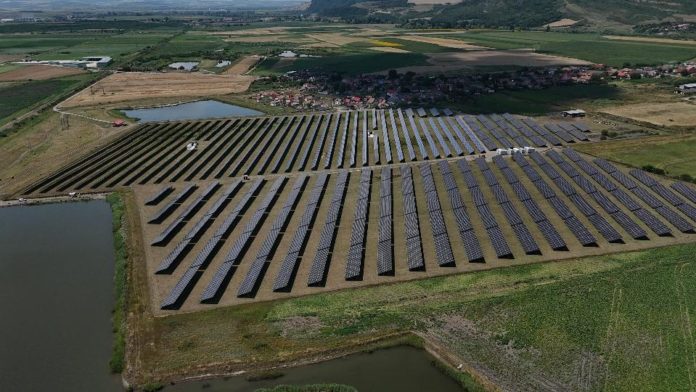
Nearly 15 years after a solar project put the village of Chirileu on Romania’s renewable energy map, the same site is opening a new chapter: photovoltaic generation is now complemented by a large-scale energy storage system.
The current configuration comprises 6 MWp of photovoltaic capacity, 5 MW of charging and discharging power, and 20 MWh of nominal storage capacity, provided by four 5 MWh Dunext PowerMount containers and two PCS containers. The system can store part of the electricity generated when solar irradiation is high and release it later, when demand or the grid’s need for flexibility is greater.
How much electricity can a 6 MWp solar park generate?
For the original 3.63 MW installation at Chirileu, FomCo Solar published an estimated annual output of approximately 3,750 MWh. If the current 6 MWp photovoltaic component achieved a similar specific yield at the same site, its indicative annual production would be around 6.2 GWh, depending on weather, plant availability and operational losses.
As an accessible point of reference, 6.2 GWh is equivalent to the annual electricity consumption of approximately 2,500 households using 200 kWh per month. This is an energy comparison only: it does not mean that the project directly or exclusively supplies those homes.
The battery that shifts energy from midday to the evening
A capacity of 20 MWh and an output of 5 MW define a system with a nominal four-hour duration. In a simplified comparison, one full 20 MWh cycle equals the monthly consumption of 100 households using 200 kWh per month. At maximum discharge, the system can supply 5 MW for four hours.
The battery does not generate electricity; its role is to improve the timing of when already-produced energy is used. Storage can reduce midday injection peaks, make production more predictable and, depending on the operating strategy and applicable approvals, participate in balancing services or make the energy available during periods of higher demand.
What the project can mean for Chirileu residents and Mureș County businesses
A project of this kind does not automatically mean lower electricity bills for Chirileu residents, nor does it create a separate power line for the village. The local benefits are primarily those associated with a long-term technology investment: operation and maintenance activity, local services and contracts, tax or land-use income where applicable, greater visibility for the community, and a signal that the area can host modern energy infrastructure.
For businesses in the county, the project is a practical example of how generation and storage can be designed together. Applied to a factory, industrial park or farm, the same principle can increase self-consumption, limit power peaks, reduce exposure to expensive hours and improve continuity of supply, provided that the system is designed for those objectives.
For Romanian energy consumers, the impact becomes meaningful when projects of this kind are deployed at scale: more solar electricity can be used after sunset and the power system gains additional flexibility. Storage does not guarantee an immediate reduction in bills, because the final price also includes network costs, taxes and supply components, but over time it can help reduce volatility and improve the use of domestic electricity generation.
Mureș County already has more than 10,000 prosumers
ANRE data as of 31 May 2026 show that Mureș County had 10,887 prosumers with a total installed capacity of 114.26 MW. Nationwide, 346,194 prosumers were registered with 3,897 MW installed, and 114,780 of them also had energy storage systems – approximately one in three.
These figures show why the next stage of the energy transition is no longer only about installing solar panels, but also about intelligently managing the electricity they generate. As solar output grows, the ability to shift energy between different times of the day and respond quickly to changes in the grid becomes increasingly important.
A project with a history: from 2011–2012 to the hybrid system of 2026
The story of the Chirileu solar park began in 2011, with its inauguration and grid connection taking place in October 2012. At the time, the press described it as Romania’s largest operational photovoltaic park. The original project covered approximately eight hectares, included 15,456 panels, had an installed capacity of 3.63 MW and represented an investment of around EUR 4.5 million.
In 2026, the same site is moving from the traditional model – immediate generation and grid injection – to a hybrid model in which electricity can be generated, stored and dispatched in a controlled manner. The evolution from panels installed during Romania’s first solar wave to a 20 MWh storage system reflects the transformation of the entire industry.