
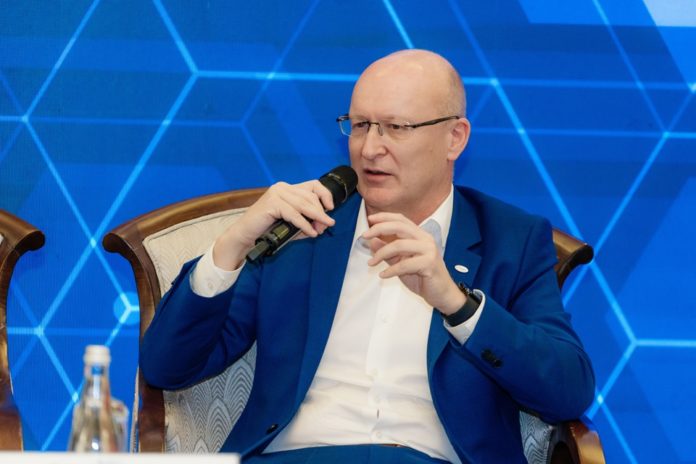
Strong university partnerships, thriving technology ecosystems and targeted funding mechanisms are essential for building sustainable innovation hubs, according to Gunter Krasser, Vice President and Managing Director of Infineon Technologies Romania.
Speaking at the Innovation Forum 2026, organized by The Diplomat-Bucharest, Krasser emphasized that bringing together stakeholders from across the innovation ecosystem is itself a key driver of technological progress.
“Talking about innovation and bringing people together to discuss it is extremely important. It is part of enabling innovation,” he said.
Krasser highlighted Infineon’s continued expansion in Romania, including the recent official inauguration of the company’s new R&D center in Cluj-Napoca.
“We recently officially inaugurated our new R&D site in Cluj, a project we had been working on for several years. It complements our Romanian footprint after more than 21 years in Bucharest, followed by our expansion to Iași three years ago and Brașov two years ago,” he said.
According to Krasser, the company’s expansion strategy is driven by access to talent and the development of local innovation ecosystems rather than the relocation of existing activities.
“We are not moving activities from Bucharest to other cities. Instead, when we have opportunities to grow or attract new areas of activity to Romania, we place them in new locations where they can develop their own identity within a local ecosystem,” he said.
He stressed that strong universities are a fundamental prerequisite for successful technology hubs.
“Capable universities are one of the most important ingredients. Universities are where talent originates and where people acquire the knowledge that later drives innovation,” Krasser said.
Beyond talent, he argued that technology hubs require close interaction between companies, research institutions and entrepreneurs.
“A technology hub is a geographical area where companies active in a specific field come together. You need mechanisms that allow them to interact, exchange ideas and identify overlaps. Innovation often emerges when people from different parts of the value chain work together,” he said.
Krasser also underlined the importance of funding in supporting innovation and reducing the risks associated with new ventures.
“Someone has to finance innovation. It can be companies, venture capital investors or public funding. Whenever you start something new, there is significant risk that it may not succeed. Funding mechanisms help absorb part of that risk and enable new initiatives to move forward,” he said.
He noted that regional support programs can play a decisive role in attracting major technology investments.
“If regions are able to support the initial stages of a project and share some of the risks, they also benefit from attracting large companies and creating new economic opportunities. These are exactly the kinds of enablers that help innovation ecosystems grow,” he said.
Krasser argued that successful technology clusters depend on the participation of multiple types of stakeholders.
“To build a technology hub, you need universities because they provide talent. You need large companies because they bring expertise, global know-how and internationally competitive projects. And you also need small and medium-sized enterprises and startups that contribute innovation and entrepreneurial energy to the ecosystem,” he said.
While Romania has made significant progress in developing regional technology ecosystems, Krasser believes further improvements are needed in public funding frameworks.
“One area where Romania still has room for improvement is access to public funding mechanisms for large enterprises at regional level. Regions need tools that allow them to support major investments and attract companies to launch new activities locally,” he said.
He concluded that innovation hubs are built through long-term collaboration among academia, industry, government and entrepreneurs.
“Creating a successful technology ecosystem requires all players to work together. Talent, collaboration, knowledge transfer and funding must all be present if we want innovation hubs to thrive and remain competitive internationally,” Krasser said.