
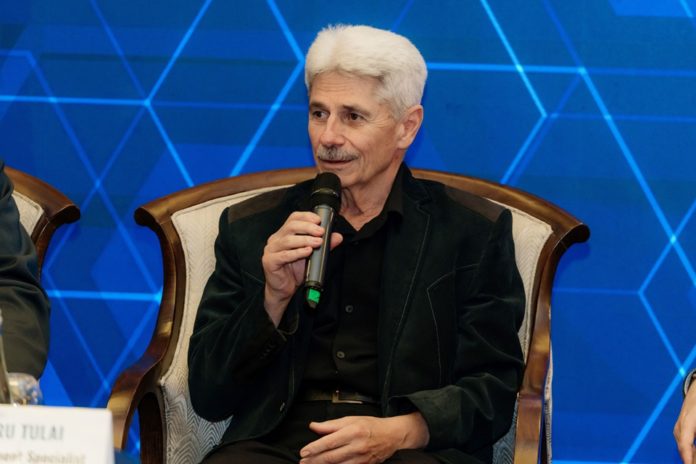
Change management, innovation and digital transformation are often misunderstood and inconsistently applied across organizations in Romania, limiting their ability to successfully adopt and scale innovation, according to Alexandru Tulai, Founding President of Cluj IT Cluster.
Speaking at the Innovation Forum 2026, organized by The Diplomat-Bucharest, Tulai said that change management remains a critical but increasingly neglected discipline in both higher education and business environments.
“Change management is the discipline that ensures the success of projects within organizations. It is a broad cultural context, but unfortunately it is becoming less present, both in higher education and in how its impact is understood in companies,” he said.
He stressed that key concepts such as innovation, technology transfer and digital transformation are frequently misinterpreted.
“We need to clarify what we are talking about when we say innovation, technology transfer and digital transformation. I have observed repeatedly that these terms are understood in very different ways, and that creates confusion,” Tulai said.
Tulai highlighted the differences in how innovation is managed across startups, SMEs and large multinational corporations, questioning whether structured innovation processes truly exist in most organizations.
“Is there a structured innovation management process inside companies? Is there a role such as Chief Innovation Officer at board level? This systematic approach to innovation is one of the fundamental pillars of organizational sustainability,” he said.
He argued that innovation is not limited to research environments, but also emerges organically in startups and smaller companies, especially under pressure.
“Innovation is not only the result of directed research. It also appears in startups and small firms, often driven by crisis situations. When a solution does not exist or is incomplete, companies are forced to innovate or they risk disappearing,” he said.
According to Tulai, technology transfer represents the operational bridge between innovation and the market.
“Technology transfer is essentially the packaging of innovation into products or services that can be directly used by organizations or individuals,” he said.
He also pointed to widespread misunderstandings of digital transformation in Romania, arguing that the term is often reduced to basic computerization.
“In Romania, digital is often understood simply as ‘computer’. But digital means something broader—it refers to numerical representation and relationships between entities. This misunderstanding leads to misaligned approaches,” he said.
Tulai emphasized that digital transformation is fundamentally a cultural and organizational issue rather than a purely technological one.
“Digital transformation is primarily a matter of organizational culture. Even the best innovation produces no value if it is not adopted at scale and integrated into business processes,” he said.
He explained that successful transformation requires both organizational readiness and the ability to integrate innovation into core business workflows.
“The first step is organizational culture, business models and processes, because innovation must be integrated there. If it is not adopted at scale, it produces no real impact,” Tulai said.
He added that organizations often struggle to adopt innovation without external support or expertise.
“If you are a mid-sized company receiving innovation as a product or service, you often don’t know how to implement it. You try, sometimes it works, sometimes it doesn’t,” he said.
Tulai also pointed to the growing impact of AI tools on the IT industry and employment models.
“Programmers were very happy when tools like Claude appeared. But I will make a prediction that may not be popular: the contribution of IT to GDP will decrease significantly because the traditional programming model is coming to an end,” he said.
He concluded by warning that Romania’s development model must remain anchored in productive industries rather than relying solely on external technology.
“How will we achieve national development if we depend exclusively on external technologies? We need a pragmatic approach to build sustainable production industries in agriculture, manufacturing and other sectors,” Tulai said.