
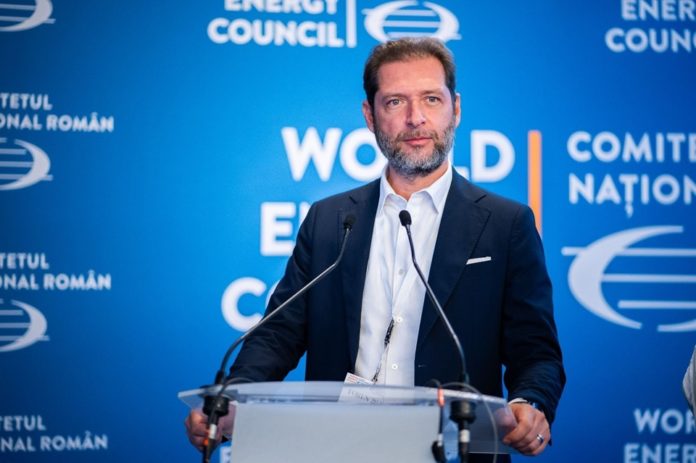
Romania is entering a new phase of its renewable energy transition, with battery storage expected to become the next major investment wave as photovoltaic development continues at record pace, according to Răzvan Copoiu, Deputy CEO of ENEVO Group, speaking at the FOREN 2026 conference.
Copoiu said Romania remains one of Europe’s most attractive and flexible renewable energy markets, with strong interest from international investors and a growing pipeline of utility-scale projects.
“Our company has been active for more than 12 years. Before entering the renewable energy sector, we built electrical substations and automation systems, so we have always been closely connected to Romania’s energy industry,” Copoiu said.
“From the perspective of a general EPC contractor, we see enormous potential in the market. We are talking about tens of gigawatts of projects that can become reality. Most of these developments are backed by foreign investors who continue to view Romania as an attractive and flexible market.”
According to Copoiu, ENEVO Group is currently executing approximately 1.5 GW of photovoltaic projects alongside 1 GW of battery energy storage capacity, highlighting the speed at which renewable projects can now be deployed.
“A photovoltaic park can be built in less than a year, while battery storage projects can be implemented even faster,” he said.
He noted that the energy market has evolved significantly in just a few years.
“If in 2018 or 2020 we did not foresee the rapid expansion of solar energy, and two years ago battery projects were still not considered bankable, today banks finance these investments without hesitation. Technology is evolving extremely fast and continuously reshaping market expectations.”
Copoiu emphasized that battery storage is no longer an optional addition but a fundamental component of future energy systems.
“We have carefully analyzed the experience of other countries, including Spain. While discussions continue regarding the exact causes of the incidents in its power system, one of the conclusions frequently mentioned is that greater storage capacity could have reduced the impact or even prevented some of the problems.”
Referring to discussions held during the recent Eurelectric conference, he said the focus is shifting from installed capacity to the affordability of electricity.
“It is no longer only about how many megawatts we install. What matters is how inexpensive the energy we produce becomes. The objective should be to develop an energy mix capable of delivering affordable and competitive electricity.”
He also pointed to Saudi Arabia as an example of strategic long-term planning.
“Before launching massive renewable energy programs, Saudi Arabia consulted major data center operators to understand what generation capacity they would require and at what cost. Only then did it build its production strategy by combining solar power, battery storage, natural gas and nuclear energy to ensure system stability.”
Romania is already seeing increasingly large renewable energy projects, Copoiu said.
“The largest photovoltaic project we are currently building is around 760 MWp, CEF Ogrezeni, the largest European project of this type, but gigawatt-scale investments are coming next. Almost all of these projects also include battery storage.”
“For this reason, I believe batteries will represent the next major investment wave—not only in Romania but across Europe. Storage must become a central pillar of the national energy strategy because it helps balance the grid, strengthens energy security and, over the long term, reduces costs.”
He added that Romania’s ability to deliver projects quickly remains a significant competitive advantage.
“Although we often focus on the shortcomings of the system, the reality is that Romania remains one of the European countries where renewable energy projects can be developed and commissioned very rapidly. We should capitalize on this advantage.”
Copoiu also highlighted the growing interaction between artificial intelligence, digital infrastructure and energy systems.
“Artificial intelligence is not an entirely new technology. Automation and algorithms have existed for many years. The difference today is that AI systems have far greater autonomy and analytical capabilities.”
He said AI is already transforming energy trading and will increasingly optimize electricity networks while integrating consumers into smarter energy systems.
“At the same time, AI development and the expansion of data centers will generate significant additional demand for electricity.”
According to Copoiu, modern data centers require secure and uninterrupted power supplies, making local renewable generation, battery storage and backup systems increasingly important.
“This is why renewable energy, batteries and smart infrastructure must be developed together.”
He also warned that cybersecurity must evolve alongside digitalization.
“As energy systems become more intelligent and interconnected, cybersecurity becomes a critical component. The European NIS2 Directive and the role of Romania’s National Cyber Security Directorate are essential in this context.”
However, he said many companies continue to underestimate cyber risks.
“Unfortunately, many organizations still approach this issue superficially. The first question we often receive is not how to improve cybersecurity, but how much the penalty for non-compliance is. In reality, the risks are far more important than the fines. Cybersecurity should be treated as an essential component of national security.”
Concluding his remarks, Copoiu said the convergence of AI, digitalization and energy infrastructure will define the next stage of Europe’s energy transition.
“Artificial intelligence, digitalization and energy infrastructure will evolve together. Our challenge is to build these systems in a secure, efficient and sustainable way.”