
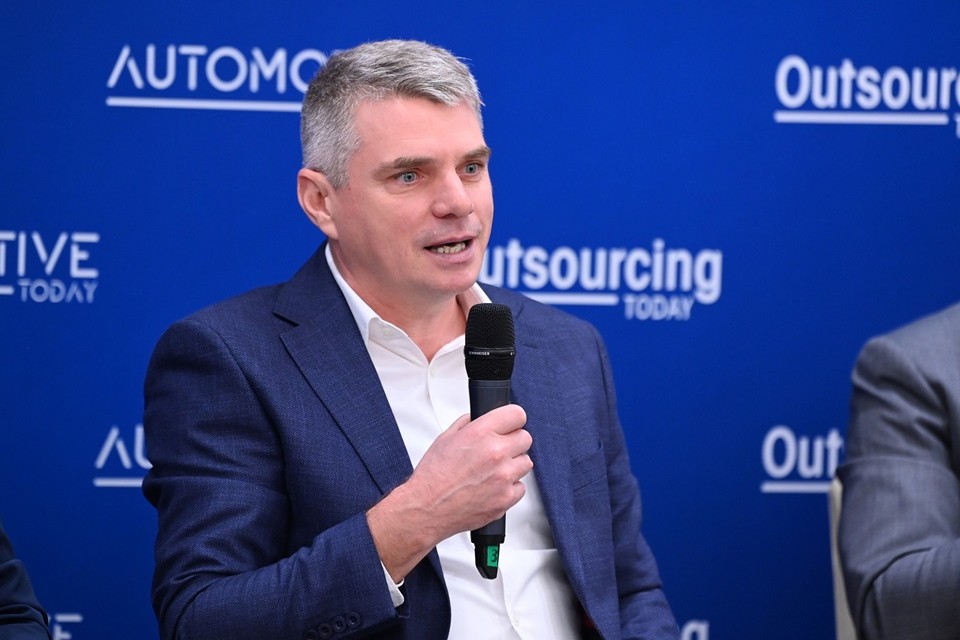
“We installed the first charger for electric vehicles in Romania in 2014. From that moment we started to do education for the transition to electric mobility. When we talk about green mobility, we should start from smart cities.
We talk about technology, but we have to consider people’s needs, the need to be healthier, more connected. Electric mobility helps us to have a different lifestyle, whether we are talking about electric tram, electric bus, subway.
The introduction of a charging station in the network means a pressure on the medium voltage electrical network, on transformers, on the low voltage network, because some stations have high power, 180 kW, 360 kW.
A charging station must be monitored 24/7, it must be able to be diagnosed remotely and it must communicate in all directions. Charge management is very important if we are talking about simultaneous charging for many cars,” Constantin Ichimoaei, Executive Manager, ABB Romania said during Green Mobility Forum organized by The Diplomat-Bucharest and Automotive Today.
“Everyone wants to charge at very fast 360 kW stations and continue their journey. But the needs are different, there are charging points at home, at the office or in long-term parking lots where 11 kW or 22 kW stations are installed, for example. For fast-charge stations, between 50 and 360 kW, the installation of the stations is done with specialists, and our engineers provide technical assistance during commissioning.
All our stations are linked in the Cloud and we have a monitoring of the entire fast-charge network. Regarding alternating current stations, there are no national statistics on the total number of stations that are installed at customers’ homes.
Technology must come as a response to the user’s needs and requirements. Another challenge is to simplify the operation of charging stations: the way the customer “communicates” with the station and the way the station communicates with the vehicle.
The networks of stations are growing, the demand is increasing, and among the challenges are the strengthening of the electrical networks and the reduction of the bureaucracy regarding the authorizations for the connection of the stations.”