
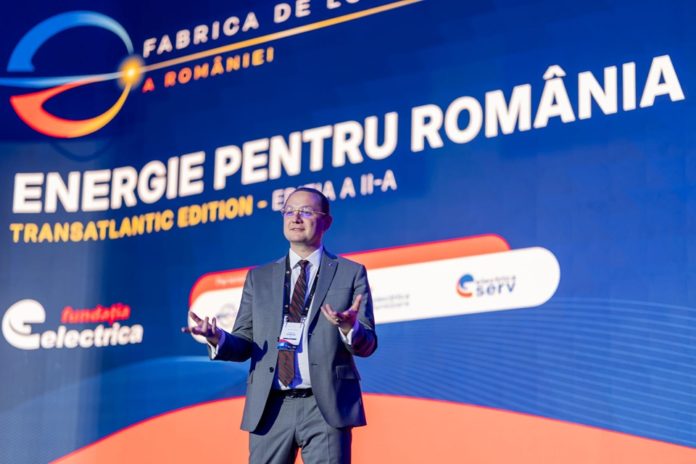
Three proposals after signing the Energy Education Pact: a Pact open to the entire sector, a study center for five countries, and training together with American partners.
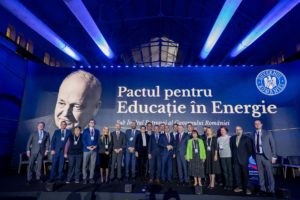
On Monday, November 16, 2026, at the Filaret Electric Plant, the second edition of the event “Energy for Romania” (Transatlantic Edition) took place, organized by the Electrica Group and the Electrica Foundation, in partnership with the Atlantic Council.
In the same room, the Atlantic Council launched its report on the Vertical Energy Corridor, the United States Department of Energy gave the keynote speech, BloombergNEF presented the region’s energy market outlook, and Electrica and 21 other organizations signed the Energy Education Pact, under the High Patronage of the Romanian Government. At the same time, the foundations of the Energy Studies Center “Prof. Eng. Dimitrie Leonida”, open to the region.
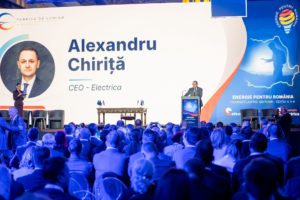 Alexandru Chiriță, CEO of Electrica, states: “I What happened On Monday, at the Filaret Electric Plant, Romania’s energy spoke with one voice. Seven universities, four technological high schools, the regulatory authority, and energy companies signed the same text, the Energy Education Pact, under the High Patronage of the Romanian Government. On the same day, we laid the foundations of the Energy Studies Center “Prof. Eng. Dimitrie Leonida”.
We were joined by the Presidential Administration, the Prime Minister through his message, three ministers, and the Romanian Patriarchate. From across the Atlantic came the United States Department of Energy, which delivered the keynote speech, and the Atlantic Council, which launched the report on the Vertical Energy Corridor in Bucharest.
Bloomberg NEF presented the market outlook in the region: From Bucharest to Washington, the conclusion was the same: no power plant, no grid, and no energy corridor operates without trained people. I thank everyone. It was not the day of one company. It was the day of an entire sector.
II What we propose
A signature is a beginning, not an outcome. That is why we propose three things.
We propose an Open Pact to the sector. It can be signed by any company, university, technological high school, or institution that wants to train people for energy. Joining costs nothing, and everyone chooses their own commitment: what to do, for whom, and until when. Every November we publicly say what we promised and what we did. Next year we will come with the first trained people and their mentors, as recommended from the stage by the Minister of Energy.
We propose to the region that we learn together. The “Prof. Eng. Dimitrie Leonida” Center will be a place for training, practice, and research for Greece, Bulgaria, Romania, the Republic of Moldova, and Ukraine, with programs for electricians, specialists, and managers. We invite partners in the region to build it together. We will present it in November 2027.
To our partners across the Atlantic, we propose that we train these people together. The representative of the Department of Energy spoke on Monday about technical exchanges and specialized training. The center is where they can start.
III Where we want to go
Also on Monday, the United States representative said that Romania can become an energy hub for Central and Eastern Europe. I believe Romania can be more than just an energy hub. It can be the region’s energy school. It has universities, high schools, and companies for that, and on Monday they signed.
In ten years, I want a student from Petroșani, Ploiești, Câmpina, or Galați to know, even in high school, where they will do their internship and where they can work. I want no energy project to be delayed because there is no one to build it. And I want a former classmate to answer when a dispatcher from Bucharest calls at night in Chișinău or Sofia.
This is regional unity: people who learned together before needing each other. And this is the transatlantic connection: projects built together, by people trained together.The generations before us built Romania’s energy system. The duty of our generation is to prepare the people who will carry it forward. The light in every home will depend on them. Light is learned.”
Today’s messages: what the speakers from Filaret conveyed
Representatives of the Presidential Administration, the Government, ANRE, the Atlantic Council, the Romanian Patriarchate, Electrica, and the US Department of Energy spoke on the event stage.
At the opening of the event, Radu Burnete, Presidential Advisor for Economic and Social Affairs, Presidential Administration, spoke about the people behind the energy system: “I think we, the consumers, often forget how complex the energy system actually is and what vast operation takes place behind the scenes for us to turn on the light every morning. And for these things to work, scientists are needed, engineers are needed, electricians are needed. And that’s why I’m glad Electrica is putting this topic in the foreground. How do we prepare the people to manage our energy system in the future?”
Regarding the summer of this year, he specified: “resilience means integration. We, with two reactors shut down, had electricity not by luck, but because we were able to import it from our neighbors.”
Prime Minister Luca Niculescu conveyed, through Mihaela Frăsineanu, State Counselor at the Prime Minister’s Chancellery, the message in which he granted the High Patronage of the Romanian Government: “As Prime Minister of Romania, I am honored to grant High Patronage to this landmark event for the energy sector in our country.” From the same message: “As you also emphasize, there is an acute need for qualified personnel in all occupational fields of the Romanian economy, especially in energy. Therefore, applied cooperation initiatives like the one you proposed are welcome, commendable, and worthy of replication at the macro level. I assure you of all my appreciation and gratitude for gathering concrete support for future energy specialists, those who, literally, give us light in this country.”
Mihaela Frăsineanu added: “Together with the Electrica team, I promise you that we will contribute to this light! ”
Dumitru Chisăliță, Minister of Energy, stated: “As a graduate of an industrial high school with the profession of electrician, I believe what is happening here today is a very important element. I believe that beyond investments, I believe beyond commissioning, I believe beyond budgets, I believe beyond strategies, all these things are done with well-trained people, people who know what they have to do, when they have to do it, how they have to do it. ”
The minister made three proposals to the signatories of the Pact. The first is a “county register to effectively establish the need for staff training.” The second is to “establish the companies where people must do internships.” And the third recommendation is that in a year’s time we see each other here, in the same formation, and the main beneficiaries of this program, the electricians, engineers, who have been through this program, together with their mentors, to tell us concretely what they felt and what they achieved through this program.”
Alexandru-Mihai Ghigiu, Minister of Investments and European Projects, emphasized that: “We can build networks, develop production capacities, and bring in new technology, but we need engineers, technicians, electricians, and well-trained specialists who can turn these investments into concrete results, results for the community.” Regarding the Energy Studies Center, he appreciated: “At the same time, the regional dimension of the center is also an opportunity. Energy challenges do not stop at a country’s borders.”
In turn, Sorin Ionescu, the Minister Delegate for Pre-University Education, said: “I am a history teacher and please believe me, I am very emotional in this space because not only here did light appear, but here a modern Romania was born more than a century ago, a Romania from which we also benefit today.” The Minister added: “For all this, dear partners of the Ministry of Education, we thank you because in this way we are convinced that the school is not alone and will continue to perform in 2040. ”
The message was reinforced by Gabriel Andronache, Vice President of the National Energy Regulatory Authority, who stated: “I welcome the initiative to organize the Energy Education Pact, an initiative that highlights the importance of collaboration among all key actors in the development of the Romanian energy sector.” At the end of his speech, the ANRE Vice President said: “I conclude with the hope that this Pact for Education, for energy, will become an example of best practices for other sectors as well, and that the common denominator, which is education, will be the engine of Romania’s development. A country without education has no future.”
Landon Derentz, Vice President for Energy and Infrastructure, holder of the Morningstar Chair for Global Energy Security and Senior Director of the Global Energy Center, Atlantic Council, spoke about transatlantic partnerships: “Partnerships across the Atlantic, partnerships in the region and between governments and industry. No country can meet today’s energy security challenges alone.” About the Vertical Corridor, he said that “it is no longer just a line on the map,” and about Pact and Center, he stated: “The Energy Education Pact, which will be signed today, recognizes that investment in people must begin long before projects take shape, and the new Energy Studies Center gives this commitment a home. A regional center for training, research, and practical experience for Greece, Bulgaria, Romania, Moldova, and Ukraine, and I welcome the regional vision of this effort. We are constantly working to connect our energy system. We must be just as ambitious in connecting our people.”
He also announced that he will then go to Warsaw for the Transatlantic Energy Partnership (P-TEC) meeting on November 18 and 19: “My message there will be simple: the future of this region depends on the partnerships we build, the energy and digital systems we connect, and the people we seek to empower. ”
Prof. Dr. Nicușor Beldiman, Patriarchal Counselor, Romanian Patriarchate, conveyed the Patriarch’s blessing: “I have the joy of sending you the parental blessing of His Beatitude Father Daniel, Patriarch of the Romanian Orthodox Church, along with wishes of health, peace, and much success in all the beautiful activities you carry out.”
Mihai Diaconu, Chairman of the Board of Electrica, recalled the beginnings of the place: “In 1908, Dimitrie Leonida, a 25-year-old engineer, opened Romania’s first electricians’ school, in the evening, free of charge, in a borrowed building.” He then added: “He knew that light is not just produced, light is first learned.” About the Pact, he said it is “the sector’s response with its own powers” and “a public promise that we will verify together every November of every year,” and about the Center, that “it does not bear the name of any company, it belongs to those who sign today and those who will come after us, from Romania, Moldova, and the entire region.” To guests across the Atlantic, he addressed the message: “Energy security is built with capital, but it works through people. We will be honored to train them together with you.”
Kaveh Farzad, Deputy Secretary of Energy for International Affairs, United States Department of Energy, stated: “The United States and Romania have a strong and lasting strategic partnership based on common security interests, growing economic ties, and commitment to a secure and prosperous Europe.” About Romania, he said: “Romania is uniquely positioned to play a leading role in strengthening regional energy security. Through its strategic position on the Black Sea, significant natural gas resources, a strengthened nuclear sector, and expanding regional interconnections, Romania has the potential to become an increasingly important energy hub for Central and Eastern Europe.”
Regarding today’s theme, Kaveh Farzad stated: “When we talk about major investments in energy, we must also recognize that infrastructure and technology alone will not bring energy security. And this brings us to today’s event theme. People are just as essential as pipelines, power plants, and transmission lines. And that is why I welcome today’s Pact for Energy Education and the establishment of the ‘Professor Dimitrie Leonida’ Energy Studies Center.”
As for the Atlantic Council report, he stated: “I also welcome the Atlantic Council report on the Vertical Energy Corridor, which offers an important opportunity to advance regional infrastructure, investments, and market integration.” And in conclusion, he concluded:
“Together, we have the opportunity to build a safer, more interconnected, and more competitive regional energy system.”
Sessions of the day
The Atlantic Council report, an American public policy institute based in Washington, is called “A New Vision for the Vertical Corridor: European Energy Security Through Infrastructure Optimization.” It is signed by Benjamin L. Schmitt and Uliana Certan and was produced by the Global Energy Center of the Atlantic Council and Atlantic Council Romania. The Vertical Corridor is the south-to-north route on which natural gas can flow between nine countries, from Greece to Ukraine. The report proposes that this route become an energy security platform for several sectors, including power lines and energy production. Electrica is a founding partner of the report.
In Bucharest, the report was presented in a dialogue between Benjamin L. Schmitt and Landon Derentz. This was followed by the policy panel, with Aura Sabadus (CEPA), Alan Riley, and Lieutenant General (ret.) Vasile Toader (New Strategy Center), moderated by Benjamin L. Schmitt, and the private sector panel, with Ion Sterian (Transgaz), Răzvan Popescu (Romgaz), and Alexandru Chiriță (Electrica), moderated by Vasile Iuga (Valorem Advisors).
Adithya Bhashyam, Head of Europe Research at BloombergNEF, Bloomberg’s energy markets research service, presented the region’s market outlook. Next was the panel “Who sets the price: from the Danube to the bill,” with Mihai Gioară (Nuclearelectrica), Bogdan Badea (HENRO), and Virgiliu Ivan (National Energy Dispatcher), moderated by Silvia Vlăsceanu (HENRO).
Two other panels discussed financiers, authorities, and network operators. In “Firm capacity: who builds what and with what money,” Mihaela Mihăilescu (European Bank for Reconstruction and Development), Marius Cara (European Investment Bank), Sorin Elisei (Ministry of Energy), and Dan Stratan (RCI Holding) spoke, moderated by Varinia Radu (Energynomics).
In the panel “The Network Before the Factory” moderated by Gabriel Avăcăriței (Energynomics)
speakers: Ștefăniță Munteanu (Transelectrica), George Agafiței (PPC Romania), Mihaela Suciu (Electric Energy Distribution Romania), and Corina Popescu (Moldelectrica, Republic of Moldova).
Energy Education Pact
The pact was proposed by Alexandru Chiriță in June 2025 and was signed on November 16, 2026. “We will sign it right at the office of Professor Engineer Dimitrie Leonida, and the Pact will remain in the National Technical Museum in his honor and honor,” announced Alexandru Chiriță at the opening of the day. “We will have only one pen and one table,” Mihai Diaconu added before the ceremony.
The pact is a common text, the same for all signatories, with five commitments: opening places where people can learn, time and support for training, bringing education closer to professional practice, collaboration even across borders, and measuring results. Each signatory then sets their own commitment, with a result, a deadline, and a responsible party, and the results are publicly presented once a year. Membership is voluntary, involves no cost, and remains open to any organization. The register of signatories is kept by the Electrica Foundation.
Alongside the Electrica Group, 21 organizations have signed.
Universities: National University of Science and Technology POLITEHNICA Bucharest, Politehnica University of Timișoara, “Gheorghe Asachi” Technical University of Iași, “Ovidius” University of Constanța, Faculty of Business – “Babeș-Bolyai” University of Cluj-Napoca, “Ștefan cel Mare” University of Suceava, and the Bucharest University of Economic Studies.
High schools: “Dimitrie Leonida” High School Petroșani, “Elie Radu” Energy Technical High School Ploiești, Energy Technological High School Câmpina, and “Paul Dimo” Technological High School Galați.
Regulatory authority: ANRE.
Companies: Romgaz, Transgaz, Transelectrica, Nuclearelectrica, PPC Romania, Monsson, ELCEN, Adrem, and Enexus.
The Energy Studies Center “Prof. Eng. Dimitrie Leonida”
The center is designed as a regional platform for training, practice, and research, created by the Electrica Foundation and open to companies from the entire energy sector, institutions, universities, and partners from the region: Greece, Bulgaria, Romania, the Republic of Moldova, and Ukraine. It will have programs for electricians, professionals, and management teams, alongside practical and applied research. It is named after Professor Dimitrie Leonida, who opened in 1908, the year the Filaret Factory started, the first electrician school in Romania. The center will be publicly presented in November 2027.
You can see more details on https://www.energiepentruromania.ro/.
Partners: Distribuție Energie Electrică Romania, Electrica Furnizare, Electrica Serv.
________________________________________________________________________
The Electrica Group is a key player in the distribution, supply, and production market of electricity in Romania, as well as one of the main providers of energy services nationwide.
The group serves 4 million users, covering 18 counties across three geographic areas for electricity distribution (Northern Transylvania, Southern Transylvania, and Northern Muntenia), and the entire country for electricity supply, maintenance, and energy services.
Since July 2014, Electrica, the Group’s holding company, has been listed on the Bucharest and London Stock Exchanges, with majority private capital. Through it, it is the only Romanian energy group operating integrated in the distribution, supply, and production sectors of electricity.