
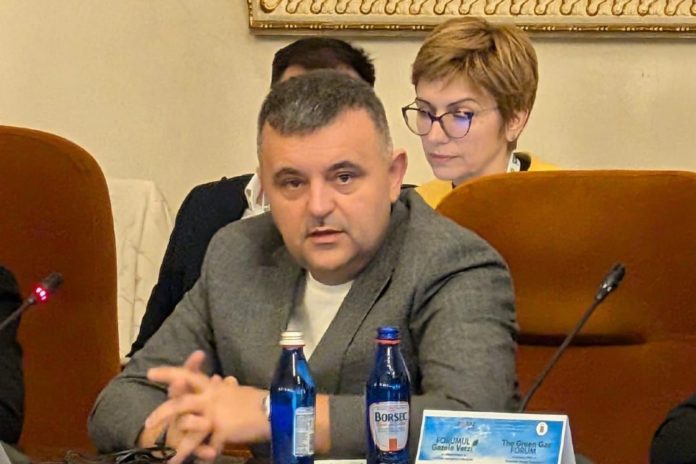
Natural gas will continue to play an essential role in Romania’s energy transition, alongside green gases and renewable energy sources, as the future energy system must rely on a balanced mix of technologies capable of ensuring energy security, economic competitiveness and affordable prices for end consumers, Aristotel Jude, Deputy CEO of Romgaz, said.
Speaking at the first edition of the “Green Gases – A Strategic Pillar of Romania’s Energy Transition” Forum, Jude stressed that energy policy decisions must reflect market realities, resource availability, technological developments and the actual needs of the economy.
The event is organised by Delgaz Grid, with the support of the Romanian Senate’s Committee on Energy, Energy Infrastructure and Mineral Resources, in partnership with Financial Intelligence.
“Natural gas plays an essential role in the energy transition, alongside green gases. The future of the energy system should not be built around a single technology but should result from a balanced mix of all technologies that can ultimately ensure affordability for the end consumer,” Jude said.
He emphasised that Romania and the European Union must adopt energy policies based on realistic assessments of the market and the availability of different resources.
“We must make decisions in line with the realities of the energy market, both in Romania and across the European Union. The share of each energy resource will depend on its availability, technological developments and, above all, the actual needs of the economy,” the Romgaz executive stated.
Neptun Deep – a key project for Romania’s energy security
For Romgaz, the efficient development and utilisation of natural gas resources remains a strategic priority, particularly given the company’s position as Romania’s leading natural gas producer.
“Our priority at Romgaz is to use natural gas resources efficiently. As Romania’s main natural gas producer, we have a direct responsibility to ensure energy security, support the Romanian economy and strengthen Romania’s position on the regional market,” Jude said.
He highlighted the strategic importance of the Neptun Deep offshore gas project, which is expected to bring significant additional natural gas resources into production.
“The Neptun Deep project contributes directly to this objective by bringing these natural gas resources and reserves that need to be developed and put to good use,” he added.
According to Jude, natural gas, as one of the cleanest fossil fuels, will remain an important component of Romania’s energy mix while the country develops alternative energy sources and pursues decarbonisation.
Net Zero 2050 requires realism and investment discipline
Addressing the European climate neutrality objective, Jude said Romgaz remains committed to the Net Zero ambition, while cautioning against unrealistic expectations regarding the feasibility and costs of achieving this target by 2050.
“Romgaz is committed to the Net Zero objective, but we must acknowledge one truth: we cannot realistically achieve Net Zero by 2050. However, we have an obligation to pursue and implement all the investments necessary to get as close as possible to this objective,” he said.
He argued that the transition must take into account not only climate ambitions but also the financial costs and economic efficiency of the investments required.
“If we start from the assumption that we will achieve the Net Zero objective by 2050, we risk denying certain realities that are impossible to overcome. We must also discuss the costs and efficiency of these investments,” Jude explained.
In this context, Romgaz is focusing on improving energy consumption efficiency, modernising its facilities, reducing methane emissions and eliminating operational and production losses.
“Our focus is on improving consumption efficiency, including technological consumption, modernising installations, reducing methane emissions and eliminating losses in gas production and operations,” he said.
Green gases: pragmatism, financial discipline and zero greenwashing
Jude also underlined the importance of developing green gases, including biomethane, renewable hydrogen and synthetic gases, while insisting that these technologies must be assessed realistically and supported by sound investment decisions.
“Green gases must be approached with pragmatism, financial discipline and zero greenwashing,” he stated.
He described biomethane, renewable hydrogen and synthetic gases as genuine medium- and long-term opportunities, particularly for sectors where electrification is difficult or economically challenging.
“From my perspective, biomethane, renewable hydrogen and synthetic gases represent real medium- and long-term opportunities that we must evaluate seriously and realistically, especially in industries that are difficult to electrify,” Jude said.
He also pointed to Romania’s considerable potential in this area, citing its agricultural resources, biomass availability and underground gas storage capacity.
“Romania has significant potential in terms of agriculture, biomass and underground storage facilities, and this potential deserves to be properly harnessed,” the Romgaz Deputy General Manager concluded.
His remarks highlighted the importance of combining conventional natural gas resources with emerging green gas technologies to build a secure, affordable and increasingly decarbonised energy system in Romania.