
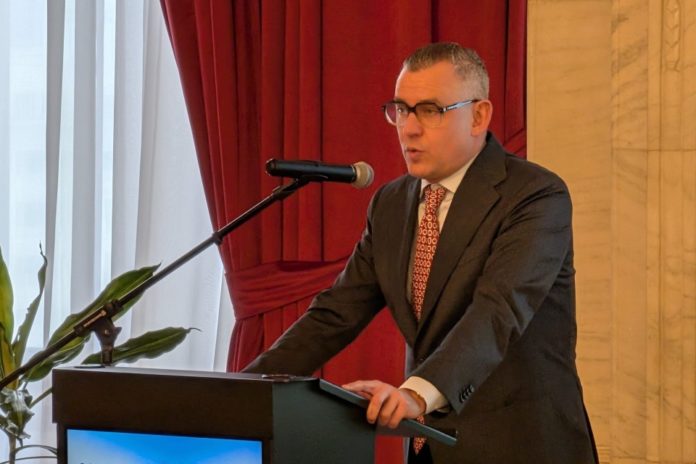
Romania has a major opportunity to become a key regional energy player and a provider of energy security, particularly through the development of the Neptun Deep offshore gas project, but achieving this potential will require a more balanced approach to the European Union’s Green Deal, Senator István-Loránt Antal, Chairman of the Senate Committee on Energy, Energy Infrastructure and Mineral Resources, said.
Speaking at the first edition of the “Green Gases – A Strategic Pillar of Romania’s Energy Transition” Forum, Antal called for an energy transition that is “fair, coherent and logical”, warning that excessive costs and poorly calibrated policies risk undermining Europe’s industrial competitiveness.
The event is organised by Delgaz Grid, with the support of the Romanian Senate’s Committee on Energy, Energy Infrastructure and Mineral Resources, in partnership with Financial Intelligence.
“The European Union bet on green energy, aiming to become the cleanest island in the world and to give up fossil fuels as quickly as possible. However, this green bet has generated one of the greatest challenges for the European Union: extremely high energy prices,” Antal said.
He recalled Romania’s early efforts to promote renewable energy, highlighting the adoption of Law 220/2008, which established the support scheme for renewable electricity producers.
“Initially, we started with six green certificates per megawatt for photovoltaic panels. There was enormous interest in investing in Romania, but following various political decisions and measures taken by different agencies, the six certificates became four, then three. At certain points, investing in renewables was no longer economically viable,” the senator explained.
Antal also criticised the EU’s reliance on imports of photovoltaic panels from China, arguing that European green policies had indirectly supported the expansion of Chinese manufacturing while leaving European industries exposed to high energy costs.
He pointed to the relocation of major industrial companies from Europe, including BASF, as evidence of the growing competitiveness challenge facing European manufacturing.
“BASF, the jewel of the petrochemical industry, is moving from Europe, from Germany to China, because of energy prices,” he said.
According to Antal, the continued growth in global natural gas consumption demonstrates that gas remains essential to the functioning of modern economies, even as countries pursue decarbonisation objectives.
“If we look at any global statistics, natural gas consumption increases from one year to the next. The rest of the world has understood that the economy runs on natural gas,” he stated.
The senator stressed that Romania should pursue its energy transition while maintaining a balanced energy mix and avoiding policies that could weaken its industrial base.
“As Chairman of the Energy Committee, I have always tried to maintain a balance between initiatives that push excessively towards green energy and those that do not want to hear about anything green. Today, we are here to discuss green gases, because we also want to be part of the Green Deal and the green transition,” Antal said.
He added that, after years of implementation, the European Green Deal contains elements that need to be reconsidered, particularly in light of their economic and industrial consequences.
“I believe that some elements of the Green Deal have been misguided. They need to be reconsidered. We need to understand that, from an economic and competitiveness perspective, we must take action in the energy sector,” he argued.
Neptun Deep – a strategic opportunity for Romania
Antal identified the Neptun Deep offshore gas project as a potentially decisive factor in strengthening Romania’s position in the regional energy market.
“Romania, particularly in light of Neptun Deep, has an extremely important opportunity and perhaps a unique chance to become a truly significant regional player and a provider of energy security for the entire region,” he said.
He warned that additional taxation and regulatory pressure on natural gas could jeopardise the economic viability of the sector and undermine future investment.
“If we take everything out of the socket, we will no longer have an economy. If we want to tax methane to the detriment of natural gas, or to the detriment of countries that have the capacity to produce natural gas, we will once again be switching off everything that means industry,” Antal stated.
He argued that Romania should use its natural gas resources to strengthen its strategic position and gain a more influential role in shaping the regional energy market.
“I believe Romania has a major opportunity to become an important player and, indeed, to help set the rules of this market through Neptun Deep and, of course, through a rethink of the Green Deal,” he said.
A more balanced European energy policy
The senator also called for stronger political coordination and diplomatic engagement at the European level to ensure that the interests of energy-producing countries and European industries are better represented in future policy decisions.
He said that national governments, political leaders, foreign ministries and diplomats have an important role in building alliances and strengthening their countries’ voices within the European institutions.
“Ultimately, the decisions depend on us – the political class, governments, representatives of the Ministry of Foreign Affairs and diplomats. If they have the ability to seek allies and make their voices heard in other countries and at the European Commission level, then, over the next five to six years, we can reshape the Green Deal in the interest of the European Union and, ultimately, of European industries,” Antal concluded.
He reiterated that he and his political formation have consistently supported the energy transition, but stressed that its implementation must consider economic realities, energy security and the need to preserve Europe’s industrial competitiveness.