
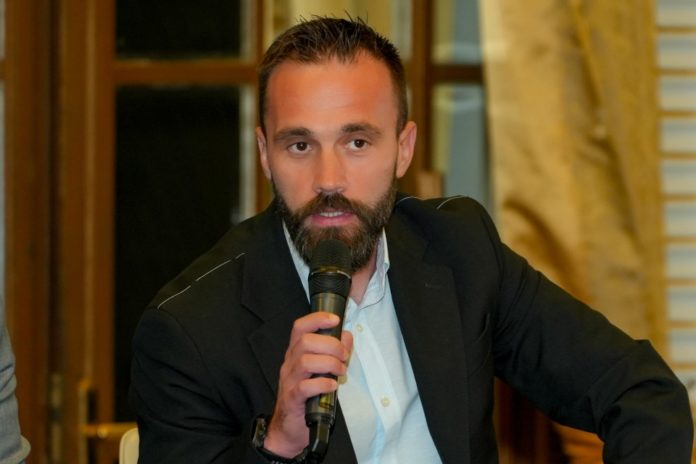
Insurance is often considered too late in the financing process for renewable energy and battery storage projects, potentially creating additional costs or even preventing projects from securing financing, Andrei Cavescu, Placement & Business Development Specialist at Renomia Gallagher, said at the Green Energy Conference, organized by The Diplomat-Bucharest.
“When we talk about financing, insurance is left until the very end. More than once, we have been surprised to receive requests where the proposed insurance solution came with costs that took the project out of financing. Or the contracts simply did not include the insurance component, and the financing was not possible because of additional requirements from the banks,” Cavescu said.
He said insurance requirements should be considered from the early stages of project development and financing, rather than added later as a compliance item.
For battery energy storage systems, Cavescu identified certification, fire safety, cyber risks and project layout among the main issues affecting insurers’ willingness to take on risk.
“What would be the main risks on the battery side? Certifications. There are certain manufacturers that do not yet have the internationally required certifications( UL 9540A) regarding thermal runaway and fire testing,” he said.
According to Cavescu, fire is currently the main risk considered by insurers when assessing BESS projects.
“The main risk that insurers consider when taking on the BESS area is fire. That is where the largest claims have occurred internationally,” he said. Project design and battery placement are also important considerations.
“Insurers, both locally and internationally, do not want batteries stacked on top of each other or batteries in warehouses in their portfolios. They bring up the issue of thermal runaway,” Cavescu said.
He pointed to fire-testing procedures as an example of how technology can help limit the potential for a single battery failure to escalate into a much larger loss.
“I don’t know how many of you have seen or taken part in a test like this. I found it incredible. Two or three batteries are placed next to each other, at 20-50 centimeters. One catches fire and the others are completely unaffected,” he said.
“That is risk management. An insurer will pay for the destroyed battery, but it has certainty that a loss involving one battery will not turn into a total loss that could eventually require a 100% payout,” Cavescu added.
He also highlighted the role of insurance advisers in helping lenders identify and mitigate risks before financing is approved.
“Part of our business is the LIA, or Lender’s Insurance Advisor, where we provide risk-management consultancy precisely on the transfer of risk for a financier,” he said.
When a lender commits capital to a project, he said, the objective is to ensure that major risks are either eliminated or adequately mitigated.
“When a financier puts money on the table to sponsor a project, they want all major risks to be removed or mitigated,” Cavescu said.
This can include risks that may initially appear outside the traditional scope of renewable energy insurance. “We are talking about products that cover drone crashes, for example,” he said.
Cavescu noted that such risks can be insured through products available on international markets.
“Drone crashes can be insured, but not in Romania. There is a product called Political Violence, which is accessible on foreign markets,” he said.
Cavescu said major investors generally approach insurance as an integral part of their investment strategy, particularly because significant losses can have long-term financial consequences.
“Major investors, regardless of their field of activity, have somewhere in the world encountered a substantial financial loss that has caused some of them to cease to exist or to suffer a real financial loss,” he said.
“Major investors do not leave insurance until the end of the discussions. They turn to in-house consultants and international brokers, such as ourselves,” Cavescu added.
He said Renomia Gallagher is the third-largest insurance brokerage group globally and that large investors increasingly seek insurance advice before submitting their financing documentation, allowing them to budget the cost of transferring project risks.
“They ask for consultancy before they even reach the financing application, so they can budget what the cost of transferring their risks will be,” Cavescu said.
The need for early insurance planning becomes even more important for hybrid projects and emerging technologies.
“If there is a hybrid project or a project that introduces a new technology, such as Power-to-X, then insurance should also be considered, because insurers are very reluctant to take on risks that have not yet been tested,” Cavescu said.