
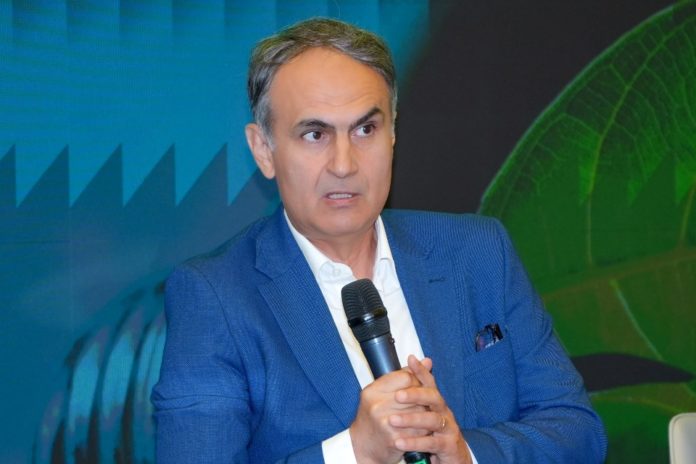
Romania has established itself as a key investment hub for renewable energy, but the country now faces the challenge of turning a large pipeline of planned capacity into actual electricity production, Adrian Dobre, Country Manager of Eurowind Energy Romania, said at the Green Energy Conference, organized by The Diplomat-Bucharest.
“Romania has managed to become this investment hub. The facts and figures demonstrate it. There are 80 GW — some people were surprised when they saw these figures. But they are essentially a consequence of policies that have been done well,” Dobre said.
The main challenge now is execution, particularly ensuring that projects that exist on paper become operational generating assets.
“The main problem, which we all know, is for these megawatts on paper to become megawatt-hours. That is our execution problem,” he said.
According to Dobre, the speed of response and the ability of public institutions to manage permitting, grid connection and other administrative processes will be critical to delivering projects on schedule.
“It depends on the decision-making environment — the speed of response and the capacity of state institutions to manage this issue. We know this was a problem during the development phase, and we see it now as well. We see it at very critical moments,” Dobre said.
He pointed to Eurowind Energy’s Pecineaga project as an example of the challenges faced by renewable developers.
“I can give you the example of our Pecineaga project, which was built in 2025 and energized in 2026. You can imagine that this was a year of suffering for us,” Dobre said.
He stressed that investments in generation capacity need to be developed in parallel with investments in the electricity grid.
“These developments and the implementation of these investments really need to happen in parallel with investments in the grid,” he said.
“If the grid is not available, it will be very difficult for these megawatts to be injected into the grid,” Dobre added.
He also called for public institutions to prioritize projects once construction has been completed and generation assets are ready to enter operation.
“Even more importantly, at key moments, when the investment is completed, when the turbines or solar panels are ready, it is very important that state institutions give priority to these investments,” he said.
“Every day of delay means losses of tens of thousands of euros. And that is no secret to anyone,” Dobre added.
Eurowind Energy currently has 184 MW of operational capacity in Romania, including the 48 MW Pecineaga wind project and the 60 MW Teiuș project, alongside battery storage capacity.
“At the moment, we have completed Pecineaga, 48 MW, and Teiuș, 60 MW, including the batteries that we energized two months ago, adding another 120 MWh. So, in total, we currently have 184 MW operational,” Dobre said.
The company also has another 138 MW across three wind projects that are at an advanced stage of development.
“In a few weeks, we will start the Vișina project, which has 260 MW. It will be the largest project in our Eurowind group, a photovoltaic project combined with 110 MW of batteries,” Dobre said.
Eurowind Energy expects its operational portfolio in Romania to approach 700 MW by 2027.
“We are approaching 700 MW operational in 2027. Our target is to reach 1 GW,” Dobre said.
Dobre said Romania has become one of the group’s strategically important markets and is among a small number of countries that Eurowind Energy has identified as key investment markets.
“We are a key country for the group, and we are proud of that. A major European player considers Romania a key market,” he said.
“There are not many — there are four markets: Denmark, Germany, Poland and Romania. We have made a commitment to invest one billion euros in Romania,” Dobre added.
The company’s expansion plans reflect the growing role of Romania in Eurowind Energy’s European renewable energy strategy, with wind, solar and battery storage forming the core of its planned portfolio.