
Romania’s energy transition and grid expansion efforts depend as much on human resources as they do on funding, according to Virgiliu Ivan, Director of the National Energy Dispatcher within Transelectrica, who warned that workforce shortages are becoming one of the sector’s biggest challenges.
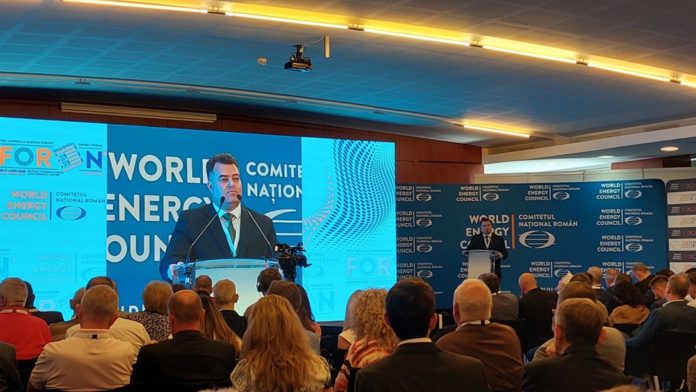
Speaking at the FOREN 2026 conference, Ivan described Transelectrica as the backbone of Romania’s electricity system, connecting generators, distribution operators, consumers and energy markets.
“Transelectrica is the most important company in Romania’s energy sector because it represents the backbone of the system,” Ivan said. “It is the bridge between producers, distribution operators, consumers and, of course, the energy market. Without us, these things would not be possible.”
He emphasized the company’s role in developing the infrastructure needed to support Romania’s evolving energy landscape.
“Transelectrica is building the networks of the future,” Ivan said. “We are building substations and transmission lines, developing infrastructure, architectures, SCADA systems and IT systems.”
According to Ivan, the pace of new generation capacity entering the grid has accelerated significantly, with approximately 1,000 MW receiving energization approvals over the past month alone.
“During the last month, Transelectrica issued approvals and energization modifications, together with our colleagues from the distribution sector, for around 1,000 MW that have either entered the system or are very close to entering operation,” he said. “Adding 1,000 MW in a single month is not a simple task.”
Ivan noted that these achievements have been accomplished despite limited staffing levels.
“I want to tell you that all of this has been made possible by a handful of people, literally,” he said. Looking at future development plans, Ivan highlighted the scale of investments currently underway across Romania’s transmission network.
“For this year alone, more than 900 million RON has been allocated to investments, coming from both our own resources and European funds, which account for nearly half of that amount,” he said.
He added that several major transmission corridors are advancing toward implementation.
“There are energy highways being built right now, and four of these major projects are about to begin. Over the last two months, we obtained the necessary government decisions to move them forward.”
However, Ivan cautioned that grid infrastructure projects remain highly complex and time-consuming throughout Europe.
“In Europe, building a transmission line from the initial concept to completion takes an average of 17 years,” he said. “In Romania, I believe the average is around 10 years. That is a performance in itself.”
The Transelectrica executive also stressed that state-owned companies face constraints that private firms do not, particularly regarding hiring and workforce development.
“We do not have the same flexibility that private companies enjoy,” Ivan said. “We face hiring restrictions, and that is why I say that energy is, first and foremost, about people.”
He warned that a lack of qualified personnel could become a major obstacle to the energy transition, regardless of available funding.
“We are talking about billions of euros that need to be invested in the energy sector. But without people, these projects cannot be delivered,” Ivan said. “Even if we had tens of billions of euros available tomorrow, we would not be able to spend them effectively. Money alone is not enough if you do not have human resources.”
Ivan argued that attracting and retaining talent should become a strategic priority for the industry.
“The focus should be on people,” he said.
At the same time, he pointed to artificial intelligence as an increasingly important tool for managing the growing complexity of power system operations.
“We are discussing artificial intelligence, and yes, it is beneficial. At Transelectrica, we are already implementing it,” Ivan said.
He revealed that the National Energy Dispatcher has launched two procurement procedures for AI-based applications designed to improve forecasting capabilities.
“We currently have two public procurement procedures underway for applications based on artificial intelligence, one focused on renewable energy forecasting and the other on forecasting technological consumption. These are the first projects, and more applications will follow.”
According to Ivan, advanced software solutions will become indispensable as the volume of data handled by system operators continues to grow.
“Given that the number of employees has not increased, I can honestly say that without such AI software we will soon be unable to carry out our activity effectively,” he said. “We are dealing with enormous amounts of data, analyses and diagnostics that cannot be performed by people alone without adequate software tools.”